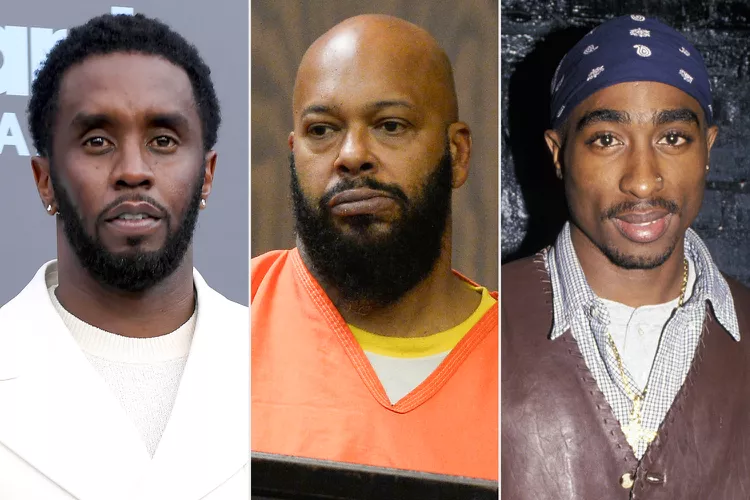
It was just past 11 p.m. on September 7, 1996, when Marion “Suge” Knight — the towering 31-year-old CEO of Death Row Records and one of the most feared figures in the music industry — sped through Las Vegas in a black BMW 750 sedan. Beside him sat Tupac Shakur, 25, hip-hop’s most electrifying voice, his cultural impact already outweighing his multi-platinum record sales.
Shakur was dressed in a Versace silk shirt and a heavy gold chain, his presence commanding even among the neon glare of the Strip. Just hours earlier, following a Mike Tyson fight at the MGM Grand, Tupac had been involved in a violent beatdown of Orlando “Baby Lane” Anderson — a reputed South Side Compton Crip — in the casino lobby. The tension was thick. The air was charged.
Trailing close behind them was a convoy of about ten cars — Death Row’s entourage, riding like a shadowy caravan through the city. Then, at the intersection of Flamingo Road and Koval Lane, a white Cadillac pulled up to their right. Within seconds, the night erupted in gunfire.
According to court documents filed by Clark County prosecutors in July 2024, Anderson, positioned in the front seat, wasn’t in the right position to shoot. Instead, he allegedly passed a Glock .40-caliber handgun to DeAndre “Big Dre” Smith, sitting in the backseat. Smith opened fire — 13 rounds in total. Four hit Tupac: one to the chest, one to the arm, and two to the thigh. Suge Knight was grazed by shrapnel but survived.
Ironically, Tupac — who often wore a bulletproof vest — wasn’t wearing one that night.
Inside the car, the unreleased track “Never Had a Friend Like Me” played faintly, as chaos closed in. “Tupac is my favorite person in the world,” Knight says now, speaking from California’s Richard J. Donovan Correctional Facility, where he’s serving a 28-year sentence for a separate manslaughter case. “It changed me forever. A part of me died with him. He didn’t have to go like that.”
For nearly three decades, no one was held accountable. The crime happened at one of the most surveilled intersections in America — in front of dozens of witnesses and surrounded by security teams. But despite the visibility, the case went cold. Many speculated that fear, influence, and unspoken allegiances kept key figures protected.
That changed in September 2023. Duane “Keefe D” Davis — a former Crips shot-caller and the last known surviving occupant of the Cadillac — was arrested and charged with orchestrating Tupac’s murder. Prosecutors say Davis was the ringleader, the one who directed the ambush.
But that was only the beginning.
In July 2024, a bombshell court filing unearthed a 2009 police interview in which Davis, then cooperating as a confidential informant, not only implicated himself — but also pointed the finger directly at Sean “Diddy” Combs. Davis claimed Combs, then known as “Puffy,” was furious with Shakur’s constant attacks — both lyrical and personal — and wanted him gone.
According to the DEA and DOJ, Davis alleged in a separate 2008 conversation that Combs told him he “needed to get rid of Knight and Shakur” and offered him $1 million to “handle the problem.”
Knight, now 60, doesn’t flinch at the suggestion. “I end up with a bullet an inch in my skull,” he says, “and everybody knows where that money came from. Look — Pac wanted the truth. And if something smells like sh–, looks like sh–, then it’s sh–.”
To date, Combs has not been charged with any connection to Tupac’s killing. A spokesperson for the Las Vegas Metropolitan Police Department reiterated in July 2024: “Sean Combs has never been considered a suspect in the Tupac Shakur homicide investigation.”
Still, Combs faces his own storm: a slew of unrelated federal charges including sex trafficking, racketeering, and conspiracy to promote prostitution. His trial in New York is expected to begin in the coming weeks.
Meanwhile, Davis has pleaded not guilty to first-degree murder and remains behind bars. His attorneys now argue that new witness testimony places him in Los Angeles — 300 miles from the scene — at the time of the shooting. Prosecutors, however, continue to lean heavily on his own confessions, especially those published in his 2019 memoir Compton Street Legend.
As for Knight, the memories of that night in Vegas refuse to fade.
“It was supposed to be a night to celebrate. Tyson won. Pac was alive, laughing, talking about music,” Knight says, voice cracking. “Then the light turned red. And everything turned black.”
Twenty-nine years later, hip-hop still mourns Tupac — and the world continues to chase the truth through a fog of blood, betrayal, and silence.
Continue reading
Be First to Comment