Rain hammered the cemetery as Thomas’s casket was lowered into the ground.
The grass was soaked, and my shoes sank slightly into the mud with every step.
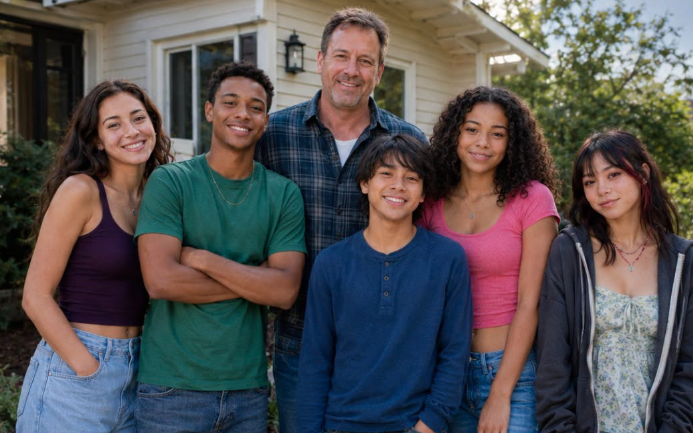
I stood there beside my brothers and sisters—Michael, Mara, Noah, and Susan—and tried to accept the fact that the man who had raised all five of us was gone.
Thomas was only 56.
His death had been sudden.
A heart attack had taken him before any of us were ready.
But as I looked around the cemetery that afternoon, I realized that the five of us had come to say goodbye carrying very different memories of the same man.
Michael stood beside me, holding his wife’s hand.
Mara had flown in from three states away.
Noah, now a father of two himself, stood quietly with his head bowed.
And several yards away, beneath a red umbrella, was Susan.
She wore a black coat.
Her face was pale.
She barely spoke.
Susan was the sister who had walked away from Thomas two years earlier.
She had stopped answering his calls.
She returned his birthday cards unopened.
She rarely responded to messages from the rest of us.
Once, when I asked her why, she simply looked at me and said:
“You don’t know him the way I do.”
I never understood what she meant.
Still, she came to his funeral.
And somehow, seeing all five of us standing there without him felt like the final proof of what Thomas had accomplished.
We weren’t biologically related.
Not all of us, anyway.
But Thomas had made us a family.
He had arrived in my life when I was five.
He wasn’t my biological father.
He married my mother when I was still a little girl.
Two years later, my mother died suddenly in a crash.
Everyone expected Thomas to send me to live with my grandparents.
They thought he would decide raising another man’s daughter was too much responsibility.
Thomas refused.
He didn’t hesitate.
He became my father.
He learned how to braid my hair using a library book.
He packed my lunches.
He learned which teachers I liked and which ones made me nervous.
Whenever someone questioned why he was raising me, his answer was always the same.
“She’s my daughter.”
There was no qualification.
No explanation.
Just certainty.
When I was nine, Thomas adopted twins from a shelter.
Michael and Mara were seven years old.
Two years later, he opened our home to two foster children.
Noah was seven.
Susan was five.
Eventually, Thomas adopted them too.
Our house became loud.
Crowded.
Messy.
Sometimes chaotic.
There were arguments over bathrooms, cereal, homework, television remotes, and whose turn it was to take out the trash.
But somehow, it became exactly what all five of us needed.
None of us had the same beginning.
Thomas made sure we had the same home.
He worked two jobs for much of my childhood.
He packed school bags late at night.
He stretched every dollar.
He repaired things instead of replacing them.
And somehow, despite all the exhaustion, he rarely complained.
He never made any of us feel like we were costing him too much.
He never reminded us that he hadn’t been obligated to take us in.
He simply raised us.
He loved us.
He stayed.
Even near the end of his life, when his hands sometimes shook and medical bills were beginning to pile up, he kept looking toward the front porch.
Especially for Susan.
Three nights before he died, he had quietly said to me:
“Leave it on, Pumpkin. Just in case.”
He meant the porch light.
I didn’t ask why.
I knew.
He was still waiting for Susan to come home.
Now, three nights after his death, we were standing beside his grave.
The service ended.
People began slowly leaving the cemetery.
The five of us remained together.
Then Thomas’s attorney approached us.
His name was Mr. Elwood.
There was something unusually serious about his expression.
“I need all five of you to come to my office,” he said.
We followed him.
On his desk was a locked wooden box.
It wasn’t large.
It was old and worn, with scratches across the lid.
Inside were five envelopes.
One for each of us.
Each envelope had a name written on it in Thomas’s shaky handwriting.
Mine was addressed simply:
Christina.
I stared at it.
“What’s this?” Michael asked.
Mr. Elwood explained that Thomas had left very specific instructions.
Each of us was supposed to receive a private letter.
And there was one unusual condition.
We were not supposed to read one another’s letters.
At first, I assumed it was about money.
Maybe an inheritance.
Maybe some family possession.
But Mr. Elwood quickly made it clear that the letters were not about dividing an estate.
He had carefully reviewed Thomas’s legal documents.
There were no hidden property disputes.
No secret mortgage.
No insurance battle.
No mysterious investment account.
No secret court case waiting to surface.
Whatever Thomas had written was personal.
I opened my envelope.
My hands were shaking.
The first sentence stopped me.
“My sweet girl, Susan left because she discovered something about me the rest of you never knew.”
I read it again.
Then I looked across the room.
Susan had gone completely white.
She had already opened her own letter.
She stared at the page for several seconds.
Then she folded it.
Pushed it into her coat.
And walked outside.
I followed her.
“Susan!”
She didn’t stop.
She walked beneath the oak trees and stood there alone, holding the letter against her chest.
I finally caught up with her.
“What did he tell you?”
She shook her head.
“I can’t.”
“You don’t have to tell me everything. Just tell me why you left him.”
Her eyes filled with tears.
For two years, Susan had believed something terrible about Thomas.
Something she had discovered in his past.
Something she had never allowed him to explain.
The truth began with a woman named Elise.
Elise had been Thomas’s younger sister.
When she was seventeen, she ran away from home and disappeared from his life.
Years passed.
Thomas eventually built his own family.
He married my mother.
He raised me.
He adopted Michael and Mara.
Then, one day, Elise contacted him.
She needed help.
Thomas traveled to her city.
But when he arrived, he discovered that Elise had died after an illness.
Her two children had entered foster care.
Those children were Noah and Susan.
Thomas didn’t walk away.
He brought them home.
Eventually, he adopted them.
He raised them exactly as he had raised the rest of us.
Susan had been too young to understand all of that.
And Thomas had apparently never wanted to burden her with the painful details of her mother’s death.
But years later, Susan discovered something that she misunderstood.
Among Thomas’s belongings, she found a heart-shaped locket.
Inside was a photograph of Thomas standing beside Elise.
She didn’t know they were brother and sister.
She believed the photograph meant something else.
She convinced herself that Thomas had once been romantically involved with her mother.
Or worse.
That he had abandoned her.
At 18, she confronted him.
She was angry.
Heartbroken.
And convinced that the man she had called Dad had betrayed her in ways she couldn’t forgive.
Thomas tried to explain.
But Susan left before he could finish.
For two years, she carried the wrong story.
And Thomas carried the truth.
He didn’t chase her.
He didn’t publicly expose her misunderstanding.
He didn’t tell the rest of us.
Instead, he waited.
Just as he had always waited.
That’s what the letters were for.
Thomas wanted the truth to come out after his death, privately and without turning his final wishes into a public family spectacle.
Mr. Elwood confirmed that the letters weren’t designed to change anyone’s inheritance.
There was no financial motive.
Thomas simply wanted his children to know the truth.
Especially Susan.
She stood beneath the oak tree reading the final lines of her letter again.
Then she whispered through tears:
“He wasn’t the man who abandoned my mother.”
She looked at me.
“He was my uncle.”
Her voice broke.
“He came back for us.”
I didn’t know what to say.
So I simply hugged her.
That evening, all five of us returned to Thomas’s house.
The house looked exactly the same.
But without him, it felt different.
The porch light was still glowing above the front steps.
Susan stopped beneath it.
She stared at the light for a long moment.
Then she finally walked inside.
We made coffee.
We opened old photo albums.
We found pictures of Thomas wearing terrible haircuts.
We laughed at the clearance-rack Christmas pajamas he had bought us when money was tight.
We argued over who had broken the old television.
Then we cried.
Not just because Thomas was gone.
But because we were suddenly remembering all the years we had taken for granted.
All the ordinary moments that had seemed insignificant at the time.
Thomas packing lunches.
Thomas fixing broken toys.
Thomas working late.
Thomas waiting up.
Thomas leaving the porch light on.
Susan finally admitted what she had been carrying.
“I spent two years believing the worst about him.”
She looked at the photograph of Thomas and Elise.
“I thought he had abandoned my mother.”
Christina reminded her of what mattered.
“He never stopped waiting for you.”
Susan lowered her head.
“I know.”
Three days later, the five of us returned to Thomas’s grave.
This time, we came together.
Susan walked to the headstone and placed her hand against it.
She stood there quietly.
Then she whispered an apology.
Christina placed a small lantern beside the grave.
It was a simple gesture.
But it reminded us of the porch light Thomas had kept burning.
The light he had left on for Susan.
Just in case.
When we finally walked back toward the road, none of us walked ahead of the others.
We stayed together.
Five children.
Five different beginnings.
One father.
Thomas had never needed us to share the same blood.
He had only needed us to understand what he had spent his entire life teaching us.
Family isn’t always created by biology.
Sometimes it is created by the person who stays.
The person who chooses you.
The person who opens the door.
The person who makes room at the table.
And sometimes, even after that person is gone, the love they built remains strong enough to bring everyone home.