The key my father left behind would not fit the lock.
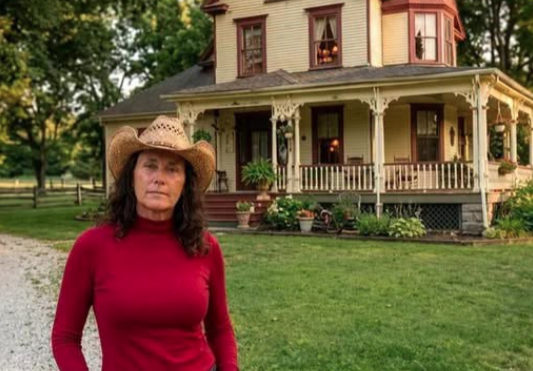
I stood on the porch of a house I had never seen before, rain dripping from my coat, staring at a freshly painted blue door and wondering whether the attorney had made a mistake.
The address in my hand matched the numbers beside the mailbox.
The deed carried my father’s signature.
And yet, someone was clearly living there.
The lawn had been cut recently. Flower pots lined the steps. Wind chimes moved softly beneath the porch roof.
This was not an abandoned property.
It was someone’s home.
I raised my hand to knock.
Before my knuckles touched the door, it swung open.
A gray-haired woman stood in the doorway.
She looked to be in her late sixties, wearing a wool cardigan and holding a dish towel in one hand. Her expression was guarded, almost defensive, as though she had been expecting trouble.
“You need to leave,” she said.
I stared at her.
“I’m sorry?”
She stepped slightly forward, blocking the entrance.
“This is private property.”
I slowly pulled the folder from beneath my arm and held out the papers.
“My father, Richard Bennett, passed away last month,” I explained. “His attorney gave me these documents. According to his will, this house belongs to me.”
The woman’s face changed.
Only slightly.
But enough for me to notice.
For a brief moment, sadness crossed her eyes.
Then it disappeared.
“I’ve lived here for twenty years,” she said quietly. “I pay the bills. I repaired the roof. I planted those flowers. I’m not leaving.”
I looked at her more carefully then.
There was something familiar about her face.
Not enough to recognize her.
Just enough to unsettle me.
And then I saw it.
A small dimple in her left cheek.
The same dimple I saw every morning when I looked in the mirror.
At that moment, I had no idea that this strange house, hidden at the end of a quiet road, was about to unravel everything I thought I knew about my family.
Until that week, my father’s life had seemed simple.
He raised me alone.
He worked hard.
He rarely spoke about the past.
And whenever I asked about my mother, he gave me the same answer.
“She passed away when you were very young.”
I never questioned it.
Why would I?
I was his only child, and he had been both father and mother to me for as long as I could remember.
After he died, I expected the reading of the will to be straightforward.
Dad had never been wealthy.
The small house we shared carried years of memories but also years of financial strain.
His final illness had left behind nearly $74,000 in medical bills, unpaid credit card balances and overdue expenses.
The house itself was close to foreclosure.
I had prepared myself to inherit little more than paperwork and debt.
Then the attorney cleared his throat.
“As per your father’s wishes, his house…”
I smiled, expecting him to mention our family home.
But then he continued.
“…the property located in Cedar Hollow will transfer entirely to his daughter, Emily Bennett.”
I blinked.
“What property?”
The attorney adjusted his glasses.
“Your father’s second residence.”
Second residence.
The words felt impossible.
My father had never mentioned another house.
Not once.
The attorney slid a folder across the desk.
Inside was an address I had never seen before.
A deed.
Tax records.
Insurance documents.
The property had an estimated value of approximately $310,000.
My father had owned it for decades.
And somehow, I had never known it existed.
The more I thought about it, the stranger it became.
If my father had kept this place secret his entire life, what else had he hidden?
A few days later, I drove nearly two hours to find out.
And now I stood on the porch, face-to-face with a woman who claimed the house as her own.
“My lawyer confirmed that my father owned this property,” I told her.
She folded her arms.
“And I confirmed that I have lived here for twenty years.”
Neither of us moved.
Finally, she stepped aside.
“Come in,” she said.
The house smelled faintly of tea and old wood.
Family photographs sat on shelves.
Books lined the walls.
A knitted blanket rested on the couch.
It looked lived in.
Loved.
Nothing about it felt temporary.
Nothing about it suggested a secret property hidden by a wealthy man.
It looked like a home someone had spent years building.
“Who are you?” I asked.
The woman looked down.
“My name is Deborah Hayes.”
The name meant nothing to me.
At least, not then.
I called my attorney that evening.
Legally, he explained, the house still belonged to my father’s estate.
The deed remained in his name.
Deborah had no formal ownership.
If necessary, eviction proceedings could begin.
But something didn’t sit right with me.
This woman had lived here for twenty years.
She had repaired the roof.
Maintained the property.
Paid the bills.
Why would my father leave everything unresolved?
I decided to stay for a few days until I understood more.
It was not an easy arrangement.
Deborah treated me like an intruder.
She moved my belongings.
She shut off the hot water one morning while I was showering.
My keys disappeared.
My phone charger vanished.
One afternoon, I discovered clothes I had left drying outside thrown into the mud beside the porch.
Finally, I lost patience.
“What did I do to deserve this?” I asked.
Deborah looked at me for a long moment.
Then she said something that changed everything.
“This house was never meant for you.”
I stared at her.
“What does that mean?”
She reached into her pocket.
Slowly, carefully, she removed a tiny silver bracelet.
My breath caught.
My name was engraved on it.
Emily.
Alongside my date of birth.
I looked up.
My hands were trembling.
“Where did you get that?”
Her voice was barely above a whisper.
“Your father told you I was gone, didn’t he?”
The room felt suddenly smaller.
“My name is Deborah,” she said.
Then she looked directly into my eyes.
“And I am your mother.”
For several seconds, I couldn’t speak.
The world seemed to tilt.
My mother?
Impossible.
My mother had died.
That was what I had been told my entire life.
Deborah sat quietly while I tried to understand what I had just heard.
Then, slowly, she told me her story.
She admitted that when I was very young, she had left my father.
She believed another relationship would offer her a better future.
It didn’t.
That relationship ended quickly.
When she returned, hoping to rebuild her life, my father refused.
A painful custody battle followed.
The court awarded him full custody.
And afterward, my father made a decision that shaped all our lives.
He allowed Deborah to live in the second house.
He kept the property in his name.
And he never told me she was there.
For decades, two truths had existed side by side.
My father had raised me.
And my mother had lived less than two hours away.
I didn’t know what to feel.
Anger.
Confusion.
Grief.
All of it at once.
Then my attorney arrived with more documents.
He had already begun preparing papers to remove Deborah from the property.
But now nothing seemed simple.
We reviewed records.
Tax receipts.
Insurance statements.
Repair invoices.
Bank records.
Deborah had paid for the plumbing.
The roof.
Maintenance.
Property taxes.
Insurance.
Over the years, she had invested more than $38,000 into the home.
It wasn’t merely where she lived.
It was the only real security she had.
The attorney explained that although the house technically belonged to my father’s estate, Deborah’s decades of financial contributions created a strong legal argument.
It became increasingly clear that my father had left the situation unresolved intentionally.
Perhaps he believed we would find answers together.
Or perhaps he simply couldn’t face explaining the truth.
The matter eventually went before a court.
Documents were reviewed.
Receipts examined.
Years of history unfolded through paperwork.
The ruling allowed Deborah to remain in the home.
I won’t pretend it didn’t frighten me.
I had counted on selling the property.
I needed money to settle debts and rebuild my own future.
Losing that possibility felt overwhelming.
But as I packed my suitcase, preparing to leave, Deborah stopped me at the front door.
She looked older than she had when we first met.
More fragile.
“I know I can’t ask for forgiveness,” she said quietly.
“I lost that right a long time ago.”
She paused.
“But if you’re willing… I’d like the chance to tell you about the years you never knew.”
I looked around the house.
The photographs.
The books.
The flowers outside.
This place I had thought was an inheritance had become something entirely different.
It was a doorway into a hidden part of my life.
I stayed.
At first, cautiously.
We sorted through boxes.
Old photographs.
Letters.
Documents.
Memories.
There were pictures of me as a child that I had never seen.
Birthday cards never sent.
Letters my father had kept.
Stories that had been waiting decades to be told.
We didn’t become mother and daughter overnight.
Life doesn’t work that way.
Trust takes time.
And some wounds leave permanent scars.
But little by little, two strangers began learning how to become family.
My father left behind debts.
He left unanswered questions.
He left secrets that caused pain.
But the most unexpected inheritance was not a house worth hundreds of thousands of dollars.
It was the truth.
The truth about where I came from.
The truth about the people who shaped my life.
And the understanding that sometimes an inheritance is not measured in money, property or legal documents.
Sometimes, it is the chance to uncover a story that was hidden for years—and decide for yourself what comes next.