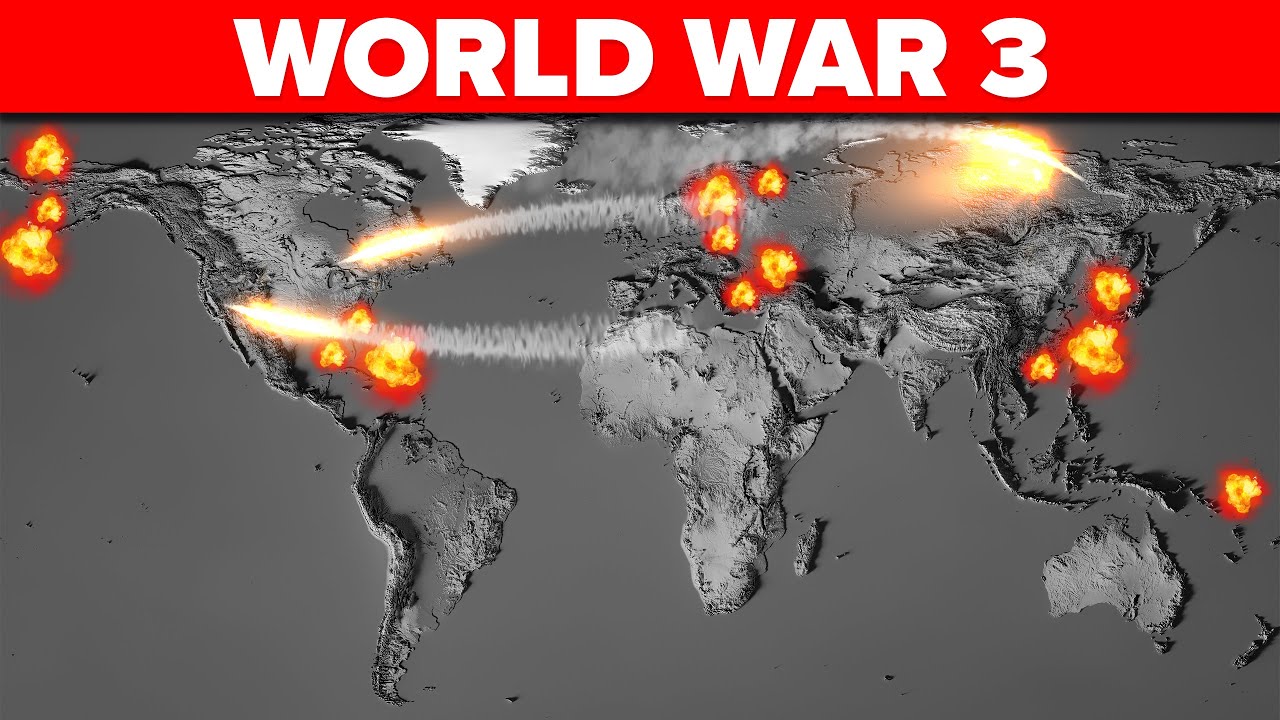
As global tensions escalate and fears of a wider conflict grow, a nuclear historian has outlined the American cities he believes are most at risk of nuclear attack should World War III erupt.
With President Donald Trump ordering airstrikes on Iran’s nuclear sites just last week—and Russian President Vladimir Putin continuing his war in Ukraine—speculation about potential nuclear flashpoints is intensifying. Trump has also stirred tensions with trade confrontations involving Canada, Mexico, and especially China, whose military power and strained relations with the U.S. raise serious concern.
Now, Professor Alex Wellerstein, a nuclear historian at the Stevens Institute of Technology, has shared with the Daily Mail a list of 15 U.S. cities he believes could be primary targets if America’s adversaries were to launch a nuclear strike.
“If the adversary is Russia and the goal is to disable U.S. retaliation, they’ll go after command centers and ICBM sites,” Wellerstein explained. “But if the attacker is a rogue nation or terrorist group, they may go for symbolic or densely populated locations instead.”
Here are the U.S. cities Wellerstein warns could be in the crosshairs:
1. Great Falls, Montana
Population: 60,422
It may seem unlikely, but Great Falls could be an early target. The city is near Malmstrom Air Force Base, which oversees hundreds of nuclear missile silos—a strategic priority for any major enemy. Though Montana is vast and sparsely populated, its military value makes it vulnerable.
2. Cheyenne, Wyoming
Population: 65,168
Despite its small size, Cheyenne is home to Francis E. Warren Air Force Base, a key nuclear command and control site. If a nuclear exchange began, this quiet capital city could be wiped off the map within minutes.
3. Ogden & Clearfield, Utah
Combined Population: 121,737
Just north of Salt Lake City, these twin cities sit beside Hill Air Force Base, another vital U.S. nuclear operations center. Their military significance makes them high on the list of potential targets.
4. Shreveport, Louisiana
Population: 177,959
Shreveport hosts Barksdale Air Force Base, home to B-52 bombers capable of launching nuclear attacks. Its close proximity to residential neighborhoods would make any strike catastrophic for civilians.
5. Honolulu, Hawaii
Population: 341,778
Hawaii’s capital is a strategic military hub and has long been on the radar since the infamous Pearl Harbor attack. Its naval and air force installations, as well as its location between Asia and the mainland U.S., make it a likely target in any Pacific conflict.
6. Omaha, Nebraska
Population: 483,335
Offutt Air Force Base, just outside Omaha, has historically played a central role in nuclear command during the Cold War and remains a crucial site in U.S. strategic defense.
7. Colorado Springs, Colorado
Population: 488,664
Nestled at the foot of the Rockies, this city houses NORAD (North American Aerospace Defense Command), responsible for overseeing the security of U.S. and Canadian airspace. Its military role and central location put it at serious risk.
8. Albuquerque, New Mexico
Population: 560,274
Kirtland Air Force Base in Albuquerque manages one of the largest stockpiles of nuclear weapons in the country, making it an obvious target in a nuclear conflict.
9. Washington, D.C.
Population: 678,972
Home to the President, Congress, the Pentagon, and countless federal agencies, the nation’s capital would be among the first cities struck in any coordinated attack.
10. Seattle, Washington
Population: 737,015
Near Seattle lies Naval Base Kitsap, which hosts strategic submarines and nuclear warheads. The city’s critical role in tech and shipping, combined with its difficult geography for evacuation, adds to its vulnerability.
11. San Francisco, California
Population: 873,965
Though not home to a major nuclear base, San Francisco’s importance in finance, tech, and politics makes it a symbolic target. A strike here would have devastating global economic consequences.
12. Houston, Texas
Population: 2.3 million
A sprawling economic powerhouse and energy hub, Houston’s destruction would be a massive blow to the U.S. economy. It’s also home to NASA’s Johnson Space Center.
13. Chicago, Illinois
Population (City): 2.6 million
Population (Metro): Over 9.6 million
The Midwest’s economic engine, Chicago’s proximity to Lake Michigan would turn any nuclear strike into an environmental disaster on top of the human toll.
14. Los Angeles, California
Population: 3.8 million
LA is the heart of America’s entertainment industry, a global cultural symbol, and a city with immense economic power. Its destruction would send shockwaves through global media and commerce.
15. New York City, New York
Population: 8.8 million
The ultimate target. As the largest city in the U.S. and a global capital for finance, media, diplomacy, and culture, NYC would be a symbolic and strategic bullseye in any nuclear confrontation.
Wellerstein’s grim list isn’t a prediction—but rather a reminder of the fragile balance of power in today’s tense global climate. While many of the cities are home to critical military infrastructure, others are targeted purely for their symbolic value or dense populations.
In a world where conflict looms and diplomacy seems increasingly frail, this list is a chilling wake-up call: nuclear war wouldn’t just be about strategy—it would be about devastation.