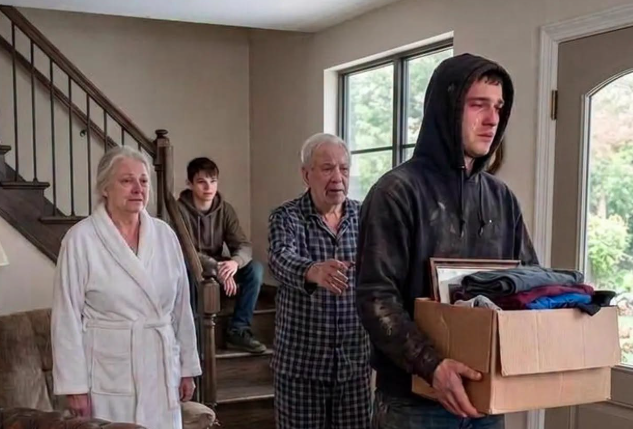
My father stood in the middle of the kitchen, pointed toward the stairs and said the words he probably believed would finally put me in my place.
“If you don’t like it here, move out.”
He said it like he was challenging me.
Like he knew I couldn’t possibly survive without the house I had been helping pay for since I was 21.
My mother stood beside him with her arms folded across her chest. In the living room, my younger brother Jake was laughing from his recliner, wearing a gaming headset that I had probably helped pay for.
Nobody looked worried.
They were expecting an argument.
They expected me to defend myself, get angry, eventually apologize and, as usual, hand over the $800 payment when the first of the month arrived.
Instead, I looked at my father and said:
“Okay.”
The room went quiet.
For a fraction of a second, I saw surprise cross his face.
But he still didn’t understand.
He didn’t know that I had already signed a lease.
He didn’t know that I had somewhere else to go.
And most importantly, he didn’t know that their mortgage payment was due the next morning.
My name is Mike Reynolds, and I was 25 when I finally learned the difference between supporting your family and being used by them.
It took me four years, thousands of dollars and one broken piece of equipment to understand it.
I Thought $800 a Month Was Fair
For four years, I paid my parents $800 every month to live in our family home outside Millbrook, Ohio.
At first, I didn’t think there was anything wrong with it.
I worked full-time.
I was an adult.
I used electricity, water and food. I had a bedroom. I used the driveway and the garage.
Adults contribute.
That’s what I told myself.
My father, Gary, had left his job at the grain elevator after developing problems with his knees. My mother, Sharon, cleaned houses three days a week.
Money was tight.
So when they asked me for $800 a month, I didn’t complain.
I thought I was helping.
Then the extra charges started.
One morning, I found a note on the refrigerator.
Laundry fee: $30
A few days later:
Driveway use: $50
Then:
Garage storage: $40
There were also notes about extra groceries, utility balances and something called “temporary help.”
Nothing was enormous.
That was what made it so difficult to challenge.
Thirty dollars wasn’t worth starting an argument over.
Neither was $40.
Or $50.
Each charge was small enough that questioning it made me feel petty.
But together, they slowly drained my paycheck.
And while I kept paying, Jake paid nothing.
Jake Was “Potential.” I Was Income.
Jake was 20.
He was enrolled in a couple of community-college classes, although he barely attended them.
My parents called him “potential.”
He was “working on his future.”
Apparently, working on his future required a better gaming computer, multiple monitors, streaming lights and faster internet.
His room had once been my father’s office.
Now it was Jake’s gaming setup.
He could spend hours playing games while my parents defended him.
If he failed a class, the teacher didn’t understand him.
If he stayed up all night, he was overwhelmed.
If he didn’t have a job, he was figuring out his future.
I was treated differently.
I worked as a diesel mechanic at Koenig’s Diesel and Ag Repair.
My weeks could stretch to 60 hours.
I repaired tractors, grain trucks and farm equipment.
I came home smelling like oil, with cuts across my hands and my back aching from another day of hard physical work.
And even after all that, I could still get a lecture for leaving one mug in the sink.
Jake could leave the living room looking like a disaster zone and somehow everyone understood.
I began to see the difference.
Jake was potential.
I was income.
That was the family arrangement, even if nobody ever said it out loud.
The Night I Thought the Balloons Were for Me
One evening, I came home after an especially brutal shift.
I was exhausted.
My hands hurt.
My clothes smelled like oil.
But I was also carrying something that made me feel proud.
A customer I had helped had written me a thank-you letter.
He had also given me a $500 tip.
It wasn’t just the money.
It was recognition.
Someone had noticed how hard I worked.
When I walked through the front door, I saw balloons.
For one brief second, I thought they might be for me.
Maybe my parents were celebrating my promotion.
Maybe they had finally noticed how much I was doing.
Then Jake walked into the room.
“I hit a thousand subscribers,” he announced.
The balloons were for him.
Everyone celebrated.
There was cake.
I took a piece, smiled and congratulated my brother.
The $500 tip and the thank-you letter stayed in my pocket.
I didn’t mention them.
I didn’t have the energy to explain what that moment felt like.
Sometimes, silence is easier than admitting you’re hurt.
Then They Damaged the One Thing I Couldn’t Replace
The breaking point came because of my tools.
If you’ve ever worked as a mechanic, you understand that tools aren’t just possessions.
They’re your work.
They’re your income.
They’re your future.
I had built my tool collection slowly over the years.
Every wrench, socket and piece of diagnostic equipment had been purchased because I needed it to do my job.
I kept everything organized, labeled and maintained.
My tools stayed in the garage.
The same garage I was being charged $40 a month to use as “storage.”
Then came Friday night.
I arrived home and noticed light shining from underneath the garage door.
I could hear music.
Loud music.
I walked toward the garage.
Opened the door.
And froze.
My rolling toolbox had been tipped over.
Sockets were scattered across the floor.
Beer had spilled over my equipment.
Tools were lying everywhere.
And in the middle of the mess were Jake and several of his friends.
They had turned my workspace into a beer-pong area.
Then I saw my diagnostic scanner.
It was worth more than $1,000.
Jake had wedged it beneath the garage door to hold it open.
The screen was cracked.
I stared at it.
For several seconds, I couldn’t say anything.
Jake looked at me.
He was drunk.
And he was grinning.
“Relax,” he said.
“We needed space.”
I looked at my tools.
Then at him.
“Do you have any idea what you’ve done?”
One of his friends laughed.
Jake shrugged.
“They’re just tools.”
Just tools.
Those words hit me harder than I expected.
I had spent years buying those tools.
They were how I earned my paycheck.
They were how I supported myself.
Without them, I couldn’t simply walk into work and do my job normally.
I grabbed Jake’s shirt.
“Do you understand what you’ve done?”
He shoved me back.
“Dad will replace them if it’s that serious.”
That sentence stopped me.
I realized that if I reacted the way I wanted to react, I could do something I would regret for the rest of my life.
So I let go.
I stepped away.
Pulled out my phone.
And started taking pictures.
The overturned toolbox.
The scattered sockets.
The spilled beer.
The broken scanner.
The damaged equipment.
Jake.
His friends.
Everything.
Jake’s expression changed.
He sobered up quickly.
“What are you doing?”
“Documenting it before I call the police.”
That was when my parents walked into the garage.
My mother saw Jake looking upset and immediately turned toward me.
“What are you doing to your brother?”
I pointed at the floor.
“Look at my tools.”
Dad looked around.
Then shrugged.
“They were just having fun.”
I couldn’t believe what I was hearing.
My property had been damaged.
My livelihood was at risk.
And somehow, I was still the one being treated like the problem.
That was the moment something inside me finally broke.
I Quietly Made My Exit
The next morning, I toured a small garage apartment.
It wasn’t fancy.
One bedroom.
A basic kitchen.
Nothing luxurious.
But it had something I desperately needed.
Privacy.
It also had secure storage for my tools.
And the rent was actually cheaper than what I had been paying my parents.
I signed the lease that same day.
I didn’t announce it.
I didn’t threaten anyone.
I simply started moving out.
I began with the things that mattered most.
Documents.
Work papers.
Bank records.
My vehicle title.
Then came my clothes.
Then my tools.
The things I had spent years working for.
As I was going through everything, I happened to see my mother’s banking screen.
I wasn’t searching for anything.
But one transaction immediately caught my attention.
It was the mortgage payment.
$800.
Exactly $800.
Not approximately $800.
Exactly the same amount I had been giving my parents every month for four years.
I stared at the screen.
Then I looked again.
That’s when the realization hit me.
My $800 “rent” wasn’t simply helping with the mortgage.
It was the mortgage.
For four years, I had effectively been making the entire monthly mortgage payment.
And nobody had ever told me.
Suddenly, all those little charges looked different.
Laundry.
Driveway use.
Garage storage.
Utilities.
Extra groceries.
Temporary help.
I had been paying far more than I thought.
“If You Don’t Like It, Move Out.”
A few days later, my father demanded that my “rent” increase by another $50.
I questioned him.
The conversation turned into an argument.
Then he pointed toward the stairs.
“If you don’t like it, move out.”
He thought that was the end of the discussion.
He thought I would back down.
He thought I needed the house.
But I had already signed my lease.
I had already started moving my belongings.
And now I knew exactly where my $800 had been going.
So I looked at him.
And said:
“Okay.”
I packed the final box.
Carried it outside.
Put it in my vehicle.
And left.
I didn’t slam the door.
I didn’t scream.
I didn’t give anyone a dramatic speech.
I simply walked away.
The next morning, their mortgage payment was due.
And for the first time in four years, I wasn’t the one paying it.
Then the Phone Started Ringing
It didn’t take long for the calls to begin.
First, Mom.
Then Dad.
Then Mom again.
They wanted to know why the mortgage payment hadn’t gone through.
Eventually, my mother admitted the truth.
The $800 I had been paying every month had been covering the mortgage.
She tried to explain that the family had depended on that money.
I told her that wasn’t my responsibility anymore.
Not after being told to leave.
Not after my tools had been damaged.
Not after being treated as though my only value to the household was the money I brought home.
The financial problems turned out to be deeper than I had realized.
There was very little savings.
Previous late payments had apparently been covered with credit cards.
There was no reliable financial plan for replacing the money I had been contributing.
For years, I had been acting like the safety net.
The moment I stepped away, they finally had to see how much they had been relying on me.
I told Mom I wasn’t returning to live there.
I also wasn’t going to continue financing a house I no longer lived in.
If they wanted to keep it, they would have to make the payments themselves.
The Family Had to Adjust
Without my $800 each month, my parents had to change their lives.
Mom took on another cleaning day.
Jake was told that his gaming equipment couldn’t continue being treated as more important than the household bills.
For the first time, he had to contribute.
Five weeks later, Jake called me.
He had found a job at the local tire shop.
His voice was different.
He sounded older.
He apologized for what happened in the garage.
He apologized for damaging my scanner.
And he admitted that he hadn’t understood what those tools meant to me.
He spent the next four months paying me back.
One cash envelope at a time.
The money wasn’t really what mattered anymore.
The accountability did.
Jake finally had to learn that other people’s hard work wasn’t an unlimited resource.
My Father Never Gave Me the Apology I Expected
My father never gave me the dramatic apology I had imagined.
There was no emotional family meeting.
No long speech.
No moment where everyone admitted I had been right.
But something slowly changed.
Dad began treating me differently.
He stopped treating me like another source of money.
He began treating me more like his son.
I still visit my parents twice a month.
But I arrive on my own terms.
I don’t leave money on the kitchen counter.
I don’t automatically offer to pay a bill.
And I don’t wait around for the next family emergency.
I remain in my apartment above retired farmer Earl Henderson’s machine shed.
It’s not my forever home.
But I’m saving.
I’m putting money aside for a house of my own.
And when I finally buy that house, it will have one feature I now consider essential.
A secure garage.
A place where my tools belong.
A place where nobody can turn my livelihood into a party space.
The broken diagnostic scanner still sits on a shelf.
I kept it.
Not because I need the reminder of what Jake did, but because it reminds me of the moment I finally understood what had been happening.
I had spent years believing that helping my family was an obligation.
I thought being a good son meant absorbing every financial burden.
I thought saying no meant I was selfish.
But there is a difference between helping your family and sacrificing your future so other people never have to face the consequences of their choices.
My father thought telling me to move out would scare me.
He thought I needed that house more than they needed my money.
He was wrong.
I didn’t lose my family when I walked away.
I simply stopped allowing money to determine my place in it.
And when the mortgage payment disappeared the next morning, so did the version of me who believed I had to keep paying in order to belong.
The most powerful thing I said that night wasn’t an argument.
It wasn’t a threat.
It wasn’t even an explanation.
It was one quiet word.
“Okay.”