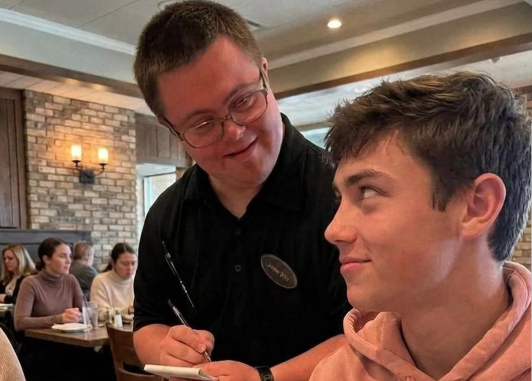
My Son Mocked Our Waiter-Then an Old Letter Taught Him a Lesson About Kindness
I took my 14-year-old son, Leo, to his favorite steakhouse to celebrate something I had been incredibly proud of.
He had brought home a report card filled with excellent grades, and I wanted him to know that his hard work mattered.
I had even worked two extra weekend shifts at the hospital to afford the dinner.
For the first few minutes, everything felt perfect.
Then our waiter arrived.
His name was Sam.
He was a young man in his early twenties who had Down syndrome. He approached our table with a warm smile, introduced himself politely, and pulled a small notebook from his pocket.
He explained that he was still learning some of the restaurant’s specials and wanted to make sure he wrote everything down correctly.
I thought nothing of it.
Sam was focused, polite and clearly proud of his job.
Then I looked across the table at Leo.
He was smirking.
At first, I thought I had misunderstood him.
I nudged his leg beneath the table and gave him the kind of look mothers develop after years of communicating without saying a word.
Stop.
He ignored me.
Sam began explaining the evening’s steak special. He stumbled slightly over one of the words, paused, and tried again.
Leo rolled his eyes.
Then he copied the way Sam was standing.
He quietly mimicked his voice.
And while Sam was still talking, Leo picked up his phone and started texting one of his friends.
I felt my stomach drop.
The pride I had felt only minutes earlier disappeared.
I wasn’t embarrassed because our waiter had struggled with a word.
I was embarrassed because my son had decided another person’s difference was something to laugh at.
I looked at Leo and, for a moment, I struggled to recognize the boy sitting across from me.
This was the child I had raised.
The child I had spent fourteen years teaching to say please and thank you, to help people who needed it, and to understand that being different never made someone less deserving of respect.
And yet, there he was.
Laughing at someone who was simply trying to do his job.
I put my credit card on the table.
When Sam returned, I apologized to him.
Not casually.
Not with a quick, uncomfortable “Sorry about that.”
I looked him in the eye and told him that Leo’s behavior had been disrespectful and that he had done absolutely nothing wrong.
I paid the bill, even though we had barely touched the food.
Then I left a generous tip.
Leo followed me outside.
The entire twenty-minute drive home was almost completely silent.
Finally, he couldn’t take it anymore.
“Mom, come on,” he said. “I was just joking around. Why are you making such a huge deal out of it?”
I kept my eyes on the road.
I didn’t answer.
Because I knew if I spoke while I was angry, I might say something that wouldn’t teach him anything.
When we arrived home, Leo reached for the door.
“Go to your room,” he started to say.
“No.”
He stopped.
“Kitchen.”
He looked confused.
I walked into my bedroom and went to the back of my closet.
Behind a stack of old clothes sat a faded wooden box I hadn’t opened in nearly twenty years.
I carried it into the kitchen and placed it on the table between us.
Leo looked at it.
“What is that?”
“Something I should have shown you a long time ago.”
I lifted the lid.
His sarcastic expression disappeared.
Inside were photographs.
Old handwritten letters.
A faded friendship bracelet.
A birthday card with a message written in blue ink.
And a photograph of a smiling teenage boy standing beside me.
His name was Daniel.
He had Down syndrome.
Leo picked up the photograph.
“Who is he?”
I sat down across from my son.
“Someone I failed.”
That answer surprised him.
So I began telling him a story I had spent almost twenty years trying not to revisit.
I was sixteen when I met Daniel.
He was one of the kindest people I had ever known.
We became friends at school, and our friendship grew quickly.
He wasn’t interested in whether I was popular.
He didn’t care about what clothes I wore or who I sat with at lunch.
When my father died, Daniel was there.
He sat beside me when I didn’t want to talk.
He shared his lunch with me.
He remembered my favorite candy.
And he told the worst jokes I had ever heard.
They were terrible.
Absolutely terrible.
But somehow, he always managed to make me laugh.
During one of the hardest periods of my life, Daniel never asked me to pretend everything was okay.
He simply stayed.
Then one afternoon, everything changed.
A group of popular girls from school were standing near the parking lot when Daniel walked toward me.
They began making jokes about him.
At first, I ignored them.
Then they started laughing louder.
I knew what they were doing was cruel.
I knew Daniel hadn’t done anything wrong.
But I was sixteen.
And I wanted those girls to like me.
So when they laughed, I laughed too.
Just once.
One laugh.
A few seconds.
That’s all it took.
Daniel heard me.
He stopped.
He looked at me.
And I will never forget his face.
He didn’t yell.
He didn’t insult me.
He didn’t ask why I had done it.
He simply turned around and walked away.
That weekend, he moved away with his family.
I never got the chance to say goodbye.
Months later, a letter arrived.
It was from Daniel.
Leo carefully unfolded the faded paper.
His eyes moved slowly across the handwriting.
The letter wasn’t angry.
That was the worst part.
Daniel thanked me for being his friend.
He wished me happiness.
He didn’t call me names.
He didn’t demand an apology.
He simply said goodbye.
I never saw him again.
I kept that letter for nearly twenty years.
No money could have repaired what I had done.
No insurance policy, investment account, inheritance, legal agreement or court decision could have brought that friendship back.
There are some things you lose that cannot be replaced.
And sometimes the smallest moment can become the memory someone carries for the rest of their life.
I looked at Leo.
“That’s why what happened at the restaurant matters.”
He didn’t answer.
I continued.
“You may think Sam will forget what you did tomorrow. Maybe he will. Maybe he won’t.”
“But you don’t get to decide how much someone else’s humiliation is worth just because you were the one who caused it.”
Leo stared at Daniel’s letter.
His eyes had changed.
The defensiveness was gone.
For the first time since we left the restaurant, he wasn’t trying to explain himself.
He was thinking.
The next afternoon, Leo asked me to take him back to the restaurant.
I didn’t ask why.
We went.
When Sam saw us walk through the door, his expression immediately changed.
Recognition.
Then uncertainty.
Leo walked toward him.
“Sam?”
Sam nodded.
Leo took a breath.
“I wanted to apologize.”
Sam listened.
“I was mean to you yesterday. I laughed at you, copied you and acted like you were stupid because you spoke differently.”
He looked down for a moment.
“That was wrong.”
Sam didn’t say anything immediately.
Leo continued.
“You were just doing your job, and I treated you like you were less than me. I’m really sorry.”
Sam looked at him for several seconds.
Then he smiled.
He held out his hand.
“Thank you for coming back.”
Leo shook it.
And that was it.
There was no dramatic speech.
No applause.
No magical moment that erased what had happened.
Just two teenagers—or two young people, in different circumstances—standing across from each other while one learned how powerful a sincere apology could be.
A few weeks later, Leo surprised me again.
He asked if he could volunteer at a local recreation program for teenagers and young adults with developmental disabilities.
I asked him why.
He shrugged.
“I want to learn.”
So he went.
After his first Saturday, he came home exhausted.
And smiling.
“How was it?” I asked.
“They destroyed me at basketball.”
I laughed.
“Really?”
“Yeah. And they kept cheering every time I missed.”
He shook his head.
“I think they were making fun of me.”
Then he smiled.
“No. They were just being nice.”
I didn’t say anything.
I didn’t need to.
He had finally understood.
The wooden box is still in my closet.
I haven’t thrown it away.
I probably never will.
For years, I thought of Daniel’s letter as a reminder of the worst mistake I had made as a teenager.
Now I see it differently.
My mistake didn’t become less painful.
It simply became useful.
Because nearly twenty years after I failed Daniel, his story helped me stop my own son from making the same kind of mistake.
I once believed kindness was something parents taught children through rules.
Say please.
Say thank you.
Don’t make fun of people.
Treat everyone with respect.
But Leo taught me something too.
Kindness isn’t really about memorizing rules.
It’s about learning to see another person as a person before you see their disability, their appearance, their accent, their job, their clothes or anything else that makes them different from you.
Sam wasn’t a joke.
He was a young man working hard at a job he took seriously.
And Daniel wasn’t the boy I laughed at when I was sixteen.
He was the friend who had stayed beside me when I was hurting.
I couldn’t change what happened all those years ago.
But I could make sure my son understood what I had failed to understand back then: