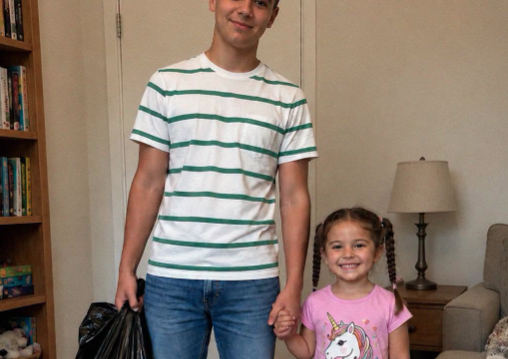
Every family before us wanted four-year-old Josie—until they learned that adopting her meant taking her sixteen-year-old brother, Jace, too.
We didn’t hesitate.
We said yes to both of them.
At the time, I thought we were simply making a decision to give two children a home.
I didn’t realize they had already made a decision about us.
A month after they moved in, their former foster mother called me and asked one question that changed everything:
“They still haven’t told you why they picked you?”
That was the moment I realized the adoption process hadn’t been what I thought it was.
We hadn’t been the only ones making a choice.
They had been choosing us, too.
My husband, Daniel, and I spent five years trying to have a child before we finally accepted that pregnancy wasn’t going to happen for us.
It wasn’t that we wanted a family any less.
We were simply exhausted.
Doctor appointments.
Tests.
Medications.
Hope.
Then disappointment.
Again and again.
Every failed attempt made the next one harder.
One night, after another appointment that ended with the same painful uncertainty we’d grown used to, Daniel sat beside me on our kitchen floor while I cried.
There was nothing either of us could say to make the moment better.
Finally, Daniel looked at me.
“We still have room,” he said quietly.
I wiped my face.
He continued.
“We could adopt.”
Eight months later, we met Josie.
She was four years old, with brown curls, enormous dark eyes, and a smile that appeared slowly, almost cautiously, as though she wasn’t sure whether she was allowed to smile at strangers.
She sat at a small table in the agency’s family room, coloring a purple dog.
Daniel leaned closer.
“That’s a nice dog.”
Josie didn’t look up.
“It’s a wolf.”
Daniel nodded seriously.
“Then that’s an excellent wolf.”
She studied him for about three seconds.
Then she laughed.
I loved her immediately.
I know you’re not supposed to say things like that.
We had been warned not to walk into an adoption meeting expecting some magical instant bond. We were supposed to take our time. Get to know the child. Let trust develop naturally.
But when I looked at Josie, something inside me shifted.
Then our caseworker, Rebecca, asked Daniel and me if we could speak privately.
There was something we needed to understand.
Josie had an older brother.
His name was Jace.
He was sixteen.
“They’re a sibling group,” Rebecca explained. “They need to be placed together.”
Daniel glanced at me.
I looked back at Rebecca.
“Where is he?”
“Down the hall.”
I frowned.
“Why wasn’t he in the meeting?”
Rebecca hesitated.
That hesitation told me more than her answer did.
“A number of families have expressed interest in Josie,” she finally said. “But when they’ve learned Jace is part of the placement, they’ve reconsidered.”
I felt embarrassed on behalf of people I had never even met.
“Why?”
Rebecca folded her hands.
“Teen placements are harder.”
Daniel crossed his arms.
“Does he have behavioral problems?”
“No more than I would expect from a teenager who’s been through significant instability.”
It was a careful answer.
I asked again.
“Does he have behavioral problems?”
Rebecca shook her head slightly.
“Jace knows why previous families changed their minds.”
I looked at her.