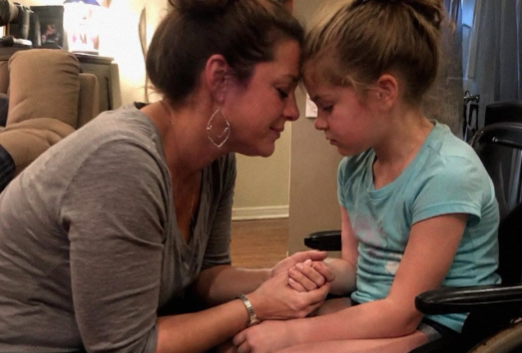
Our newly adopted daughter barely reacted to her bedroom, her books, or the rest of the house.
She didn’t ask where the snacks were. She didn’t want to know where the television was. She didn’t even seem particularly interested in the room we’d spent weeks preparing for her.
There was only one thing she wanted to see.
The basement.
At first, I thought it was simply an odd childhood curiosity.
Then, the next morning, I found her sitting there alone in her wheelchair, staring at a sealed section of the wall.
And when she finally spoke, I realized this child knew something about our home that my husband and I had never known.
My husband, Daniel, and I had spent nearly three years trying to adopt a child.
Three years of paperwork.
Three years of interviews, home visits, classes, background checks, false starts, and cases that looked promising until they suddenly weren’t.
It had been an emotional rollercoaster that taught me one painful lesson: never let one good meeting become an entire imagined future.
So when we first met Ava, I tried to keep my expectations under control.
Then she rolled into the room.
She looked straight at me with those serious gray eyes, and something inside my heart shifted.
She was nine years old.
Small for her age.
Thin.
Careful.
And remarkably self-contained.
Ava used a wheelchair because of a spinal injury she had suffered as a toddler. The social worker assigned to her case, Beth, described her as bright, observant, and slow to trust new people.
She also warned us that Ava had already experienced enough placements that she rarely reacted strongly at first, even when she was interested in something.
“She watches before she decides,” Beth told us.
She was right.
When Daniel and I first met Ava, she barely spoke.
She answered our questions politely and without much emotion.
She told us she liked drawing, lemon ice pops, and books about animals.
She didn’t smile often.
But then Daniel accidentally knocked over a cup of coffee.
He immediately apologized to the table as if the table itself had feelings.
Ava looked down quickly.
I caught the smallest hint of a smile.
That tiny moment was enough for me.
Six months later, after more home visits, more classes, more forms, more waiting, and one stretch when I thought I might lose my mind from trying so hard not to hope too much, we finally brought her home.
I expected nerves.
Maybe tears.
Maybe silence.
Instead, Ava spent almost the entire drive staring out the window as if she were searching for something she couldn’t quite name.
I tried to talk to her without overwhelming her.
“Your room is painted light green,” I said. “We thought you might want to choose another color later, but we didn’t want it to feel too empty.”
She nodded.
From the driver’s seat, Daniel added, “And if you hate green, we can paint it any color you want.”
Ava didn’t answer.
I twisted around in my seat and gave him a look.
“No need to push.”
“Yeah,” he said quickly. “No pressure.”
Ava continued watching the road.
I told myself not to read too much into her silence.
The first days were strange.
First days were filled with shock, politeness, nerves and adrenaline.
Still, when we pulled into the driveway of the old brick house Daniel and I had purchased the year before, I felt that nervous flutter in my stomach all over again.
This was the deeper fear.
What if we loved her with our whole hearts, but she never felt safe enough to believe us?
The house had belonged to an older man named Walter.
He had died several years earlier, and the property had gone through an estate sale before eventually being auctioned.
We had gotten it for less than expected because it needed considerable work.
But the structure itself was solid.
It had wide hallways, a first-floor bedroom, and a basement we’d converted for accessibility.
Daniel and his brother had built ramps off the back deck, and the dry, unfinished basement was mostly used for storage.
When we got inside, I showed Ava around slowly.
The kitchen.
The living room.
The downstairs bathroom with its widened doorway.
Then her bedroom.
There was a reading lamp beside the bed and empty shelves waiting for books she didn’t own yet.
Ava barely reacted.
Then, as we stood in the hallway, she looked up at me.
“Can I see the basement?”
I actually laughed a little because I was so surprised.
“The basement?”
She nodded.
“Sure,” I said. “Later, though. It’s mostly boxes and old tools.”
To my surprise, she looked disappointed.
It wasn’t dramatic.
She didn’t pout or complain.
It was simply a brief, visible drop in her expression, as if something important had just been postponed.
For the rest of the evening, she barely spoke.
Daniel made spaghetti because it was one of the few meals every child we’d hosted before had tolerated.
Ava ate quietly and thanked him after nearly every little thing.
Twice, I caught her looking toward the hallway where the basement door was.
Later that night, after we’d settled her into bed with a pile of library books she didn’t touch, I went downstairs.
Daniel was in the kitchen rinsing dishes.
“So,” I said, “that was weird, right?”
He looked over his shoulder.
“The basement thing?”
“Yes. What nine-year-old asks to see a basement before asking where the snacks are?”
He shrugged.
“Maybe she’s curious.”
“Mmmh. Maybe.”
He dried his hands and leaned against the counter.
“Claire, today was huge for her. If she fixated on one odd detail, it doesn’t automatically mean something’s wrong.”
“I know.”
And I did know.
But something still felt off.
That night, I slept lightly.
I imagine that’s what all new mothers do, even adoptive mothers who aren’t ready to say the word “mother” out loud yet because it feels too sacred to claim too soon.
When I woke the next morning, it was barely after six.
Daniel was still asleep beside me.
The house was silent.
Then I glanced at the baby-monitor-style camera feed we’d set up in Ava’s room for the first week.
We had asked for permission first and explained to Ava that she could unplug it whenever she felt comfortable.
Her bed was empty.
The camera was still on.
My entire body snapped awake.
I got out of bed so quickly that I nearly tripped over the rug.
At first, I thought she’d gone to the bathroom.
Maybe she’d gone downstairs looking for a snack.
Then my mind, cruel and efficient, jumped immediately to the worst possibility.
She had left.
She had panicked during the night and tried to get outside alone.
I checked the hallway.
The bathroom.
The kitchen.
She wasn’t there.
Then I heard it.
A faint metallic sound.
Coming from the basement.
I don’t think I’ve ever moved that fast in my life.
I rushed to the basement door, already calling her name, and pulled it open.
At the bottom of the ramp, sitting in the middle of the basement, was Ava.
She was in her wheelchair.
The overhead light was on.
And she wasn’t looking at me.
She was staring at the far wall.
More specifically, at a section of old brick that was partially hidden behind a metal shelving unit we’d pushed there months earlier.
When she heard me, she raised one hand.
Then she pointed toward the wall.
Her voice was calm.
Almost puzzled.
“That’s not where you hid it last time.”
I stopped so abruptly that I had to grab the banister.
“What?”
Ava slowly turned toward me.
For the first time since we’d met her, she looked openly confused.
Almost frightened.
“The box,” she said.
“That’s not where you hid it last time.”
My heart began pounding so hard I could feel it in my throat.
“When, Ava?”
I stared at her.
“We’ve never been in this basement together.”
She looked at me.
Then, right before my eyes, the color drained from her face.
She looked from me to the wall.
Then back to me.
Her voice became small and shaky.
“I know this house.”
Fear and understanding hit me at exactly the same time.
How could she possibly know this house?
I slowly made my way down the ramp and knelt in front of her.
“What do you mean?”
Ava’s eyes filled with sudden tears.
She seemed embarrassed by them.
“I didn’t know,” she whispered. “I thought maybe I was wrong.”
She looked back at the wall.
“But there was no ramp here. Not here or outside. There were just stairs. The kitchen wasn’t painted, and my room is different.”
She swallowed.
“But the hallway is the same.”
Her eyes moved toward the basement door.
“And the basement door sounds the same.”
The only explanation that made any sense was that she’d been here before.
Just not with us.
“Sweetheart,” I said carefully, “did you live here before?”
Ava pressed her lips together.
“I think so.”
She paused.
“Probably with my mom.”
Behind me, I heard Daniel coming down the stairs.
“Claire?” he called.
Then he saw Ava.
He stopped.
“What happened?”
I looked up at him.
“I think she used to live here.”
He stared at me.
Then he looked at Ava.
“What?”
Ava was becoming increasingly frantic, as though she were trying to pull a stubborn memory out of the back of her mind.
“My mom and I used to keep a box here,” she said.
“She told me more than once to remember the wall in case she wasn’t there one day.”
Her voice trembled.
“She said it was important.”
Daniel came the rest of the way down and crouched beside me.
“Ava,” he said gently, “what was your mom’s name?”
“Marie.”
I looked at Daniel.
We knew no Marie.