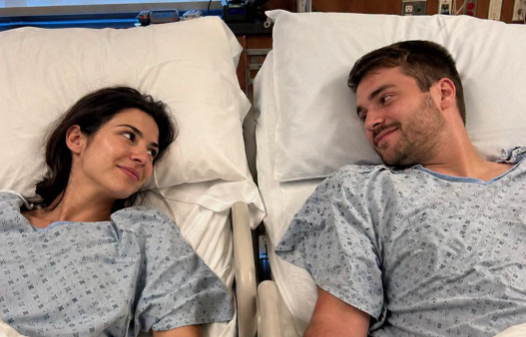
A year ago, I believed receiving a kidney from a complete stranger was the most unbelievable thing that would ever happen to me.
I was wrong.
Because the man who gave me that kidney eventually became the man I married.
And only minutes after we stood in front of our families and promised to spend the rest of our lives together, Nathan leaned toward me, took my hand, and whispered words that instantly changed everything.
“Now I can finally tell you the truth.”
I had no idea that the truth involved a twelve-year-old girl I had never known existed.
A year earlier, my kidneys had begun failing without warning.
I was thirty-one years old and healthy enough to believe hospitals were places other people went. I knew how to work, pay bills, make plans and worry about ordinary things. I knew the names of my friends’ children and which coffee shop stayed open late.
I did not know the names of night nurses.
Then, suddenly, I did.
My life became a cycle of blood tests, dialysis sessions, medication alarms and endless waiting rooms where everyone seemed to speak softly, as if raising their voices might somehow make the situation worse.
Every week ended with the same terrifying thought.
Maybe this was my life now.
Maybe this was going to be forever.
When the transplant team began testing my family members, I tried to pretend I wasn’t frightened.
My mother squeezed my hand while the transplant coordinator explained compatibility. My brother tried to make everyone laugh by joking that his kidney was “premium stock.”
Even my father smiled.
For a little while, we allowed ourselves to believe that one of them might be able to save me.
Then the results came back.
No one matched.
Two months later, my doctor walked into the dialysis unit with an expression I couldn’t quite understand.
He stopped beside my chair.
“We have a volunteer,” he said.
I stared at him.
“A living donor.”
My heart started beating faster.
“Who?”
He checked his notes.
“Nathan.”
The name meant absolutely nothing to me.
A few days later, Nathan walked into a hospital conference room carrying two paper cups.
My doctor gave me the careful smile doctors use when they know more than they’re saying.
“He knows of you through a mutual friend,” he explained. “He’s completed the initial screening.”
I looked at Nathan.
“A stranger wants to give me an organ?”
“Apparently,” my doctor said.
I couldn’t stop myself.
“Why?”
“You can ask him yourself, if you both agree to meet.”
Three days later, Nathan and I sat across from each other in that same hospital conference room.
He had brought coffee.
“Tea?” he asked.
“Coffee. Strong.”
He handed me the darker cup.
I didn’t touch it.
I stared directly at him.
“Why are you doing this?”
Nathan sat back in his chair.
“Hello to you too.”
Despite everything, a small smile appeared on his face.
It disappeared almost immediately when he realized I wasn’t joking.
“I’m serious.”
“I know.”
“Then tell me.”
He looked down at his hands.
“I heard about you from Mara. We worked together years ago. She told me you needed a transplant.”
“Lots of people need transplants.”
“I know.”
“So why me?”
Nathan was quiet for a moment.
Then he finally answered.
“Because I got tested, and I matched. After that, walking away felt like choosing not to help.”
I frowned.
“You don’t know me.”
“Correct.”
There was something strangely disarming about the simplicity of his answer.
He wasn’t pretending we had some special connection.
He wasn’t claiming destiny had brought us together.
He simply knew I needed help, discovered he could help, and decided not to walk away.
Over the next several weeks, there were more tests, more paperwork, more medical appointments and more opportunities for Nathan to change his mind.
He never did.
The closer we got to the surgery, the more impossible the situation felt.
This man had entered my life as a stranger, and now he was preparing to give me one of his kidneys.
The morning of the surgery, I was crying behind a hospital curtain when Nathan found me.
“Hey,” he said. “You’re supposed to be the brave one.”
I wiped my eyes.
“You’re the idiot giving away a kidney.”
“One kidney.”
“Still an idiot.”
He pulled the curtain closed behind him and looked at me.
“Then you owe me something.”
I looked up.
“What?”
He smiled.
“Use it well.”
That was Nathan.
Even then, he somehow managed to make something terrifying feel a little lighter.
The operation worked.
My new kidney started functioning almost immediately.
When I woke up, Nathan was alive too.
Somehow, he recovered quickly enough to become annoying.
He visited my hospital room wearing hospital socks and carrying contraband pudding.
“You look terrible,” he told me.
I stared at him.
“You donated the kidney, not your manners.”
“Those were never eligible.”
I laughed and immediately grabbed my side.
“Don’t make me laugh.”
He grinned.
“Finally, leverage.”
After I was discharged, Nathan kept showing up.
Sometimes he brought groceries.
Sometimes books.
Once, he brought me a plant that I nearly managed to kill.
“You saved me and now you’re assigning homework?” I asked.
“Correct,” Nathan said. “Keep the fern alive.”
Our friendship developed quietly at first.
Then it accelerated.
There was something strange about two people learning ordinary things about each other after already sharing something so enormous.
He knew what my hospital room looked like before he knew my favorite movie.
I knew what his scar looked like before I knew which side of the bed he slept on.
Eventually, I stopped seeing him as the stranger who had saved my life.