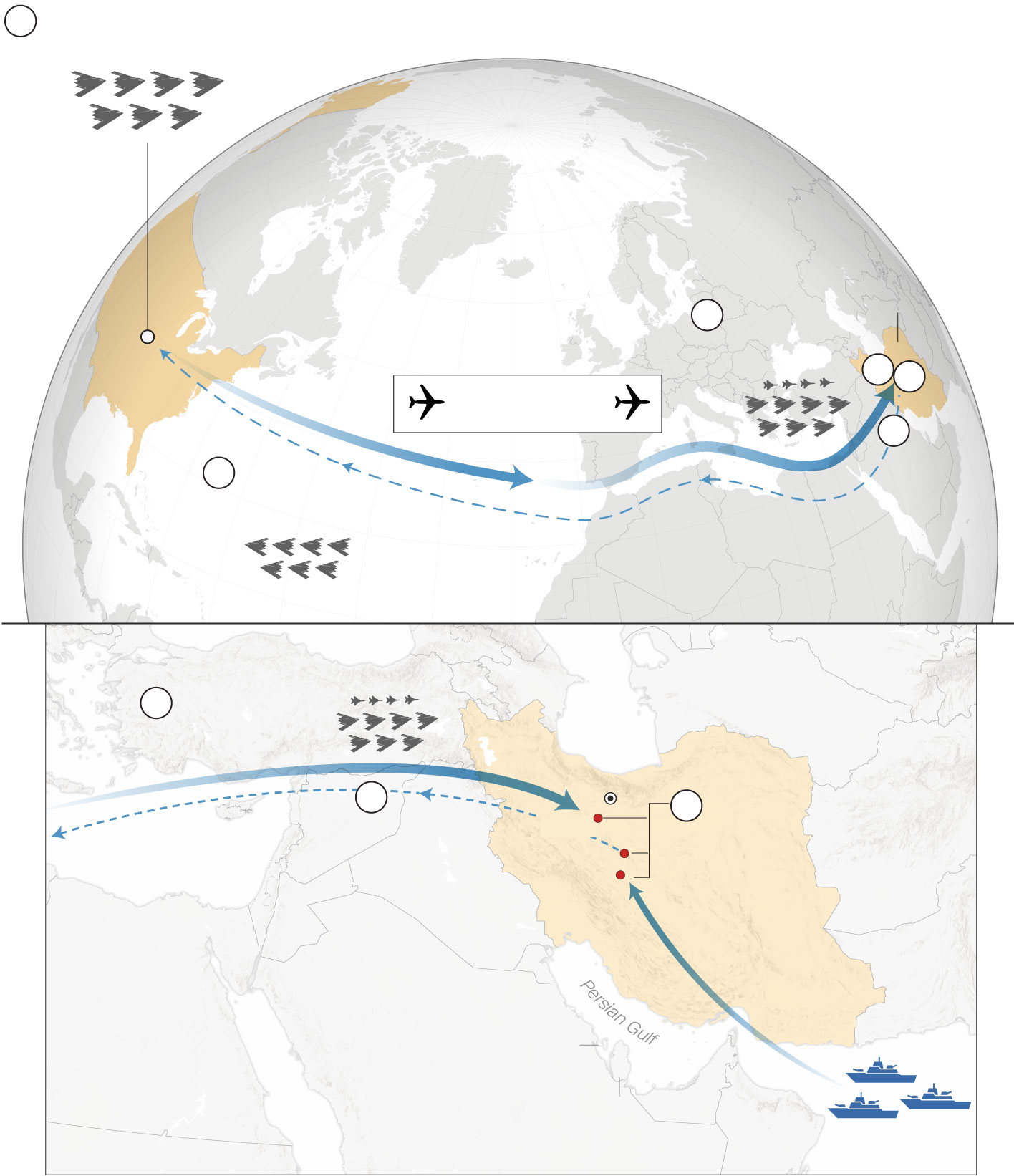
The United States launched a sweeping, high-precision military operation against Iran’s most sensitive nuclear facilities, marking one of the most significant U.S. air campaigns in the region in years. According to Pentagon sources, the operation involved more than 125 military aircraft, including B-2 Spirit stealth bombers, fifth-generation fighter jets, and naval support from the Persian Gulf.
Targets: Fordow, Natanz, Isfahan
The primary targets were Iran’s heavily fortified nuclear enrichment centers in Fordow and Natanz—facilities located deep underground and previously considered impenetrable. In the early hours of the strike, U.S. B-2 bombers—capable of flying undetected across continents—released over a dozen “bunker-busting” bombs specifically designed to penetrate reinforced concrete and buried structures. Simultaneously, Tomahawk cruise missiles were launched from U.S. Navy ships stationed in the Persian Gulf, targeting a facility in the city of Isfahan, known for its uranium conversion capabilities.
Flight Path and Deployment
The operation was staged from multiple continents. Stealth bombers took off from Whiteman Air Force Base in Missouri, flying a continuous intercontinental mission across the Atlantic, passing through the Mediterranean and Middle East airspace before entering Iranian territory. Fighter escorts, including F-22 Raptors and F-35 Joint Strike Fighters, provided air superiority and electronic warfare coverage.
Additional aircraft were deployed from U.S. military bases in Europe and the Middle East, converging along carefully coordinated aerial corridors. Aerial refueling tankers such as KC-135s and KC-46s accompanied the strike force, ensuring uninterrupted flight capability for the duration of the mission.
Complex Air Maneuvers and Element of Surprise
The U.S. military employed deception tactics and complex flight path routing to maintain the element of surprise. Electronic countermeasures and cyber operations were also deployed to disable or confuse Iranian radar systems. The attack occurred just hours after President Donald Trump had publicly declared that he had not yet made a final decision on military action—adding a layer of strategic misdirection to the assault.
Aftermath and Assessment
Initial damage assessments suggest the attack caused extensive destruction to Iran’s underground centrifuge halls and nuclear material infrastructure. While official casualty figures are yet to be confirmed, U.S. defense analysts believe the strike has set back Iran’s nuclear ambitions by several years.
General Dan Caine, Chairman of the Joint Chiefs of Staff and a veteran F-16 combat pilot, stated in a Sunday briefing that the mission’s objectives were met with precision. “We retained the element of surprise and struck critical nodes in Iran’s nuclear apparatus,” Caine said. “Our bombers are back home, and our forces are intact.”
Broader Implications
The scope and precision of the strike highlight the U.S. military’s global reach and ability to execute high-risk missions without permanent regional basing. However, the operation also raises serious questions about potential Iranian retaliation, regional escalation, and the long-term consequences for U.S.–Iran relations.
As the international community braces for Tehran’s response, one thing is clear: the United States has demonstrated that no location, no matter how fortified, is beyond the reach of American airpower.
Be First to Comment