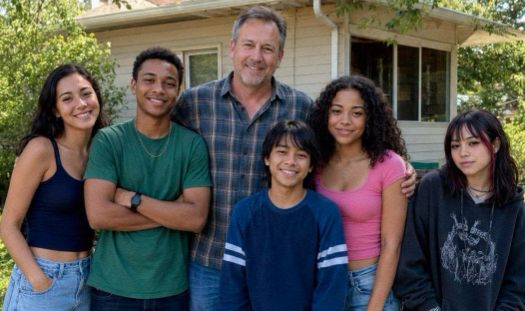
The rain came down hard at my stepfather’s funeral.
Then, barely an hour after we buried him, his lawyer handed the five of us a locked wooden box filled with letters.
The first line of mine explained why one of my sisters had spent years running from the man we all called Dad.
The rain had started just before they lowered Thomas’s casket, which somehow felt exactly like something he would have found mildly inconvenient and then turned into a joke.
Thomas was that kind of man.
If the roof leaked, he would put a bucket underneath it and call it a “temporary indoor water feature.”
If the car broke down, he would tell us it had “decided to take a personal day.”
And if one of us was crying, he had an almost ridiculous ability to make us laugh without ever making us feel like our sadness was being dismissed.
So there I stood in black shoes sinking into wet cemetery grass, watching his casket disappear inch by inch, thinking that grief had no business sharing the same space with memories of his terrible jokes.
And somehow, it did.
Beside me, Michael kept clearing his throat. Mara had both arms wrapped tightly around herself. Noah stared straight ahead, his jaw clenched, looking like a man using every ounce of strength he had not to break down in public.
I locked my hands together and whispered toward the casket.
“Thank you, Dad.”
My voice nearly disappeared beneath the rain.
“Thank you for the school lunches with little notes folded into napkins. Thank you for learning how to braid hair from a library book. Thank you for taking five children who didn’t come from your blood and never once making us feel borrowed.”
That was Thomas.
He never made us feel like we were temporary.
He never made us feel like we belonged to someone else.
He simply called us his children.
And that was the end of the discussion.
My mother married Thomas when I was five.
I still remember the first time I met him.
He crouched down in front of me and held out a pink teddy bear with one button eye missing.
“Your mom says you are very particular,” he told me. “This bear also seems high-maintenance. I thought you two might get along.”
I stared at the bear.
Then I took it.
Thomas smiled.
“Hi, Pumpkin.”
That was it.
That was how my relationship with my father began.
My mother married Thomas when I was five.
Two years later, she died unexpectedly in a crash on a wet road.
I was seven.
After she died, everyone assumed Thomas would step aside.
My grandparents came with practical voices, folded hands, and the quiet certainty of people who believed the obvious decision had already been made. They assumed I would go live with them.
Thomas listened.
He let them explain everything.
Then he looked across the room at me.
I was sitting on the couch in mismatched socks, my pink teddy bear jammed beneath one arm.
Thomas looked back at my grandparents.
“She’s my daughter,” he said.
That was the entire discussion.
Thomas was not my father by blood.
But he was my father in every way that ever mattered.
And if you had asked him whether there was a difference, he would have looked at you the way a person looks at expired milk.
“She’s my daughter.”
There was nothing else to say.
When I was nine, Thomas adopted the twins, Michael and Mara, from a shelter.
Two years later, he fostered siblings Noah and Susan.
Eventually, he adopted them too.
None of us had started life in the same place.
We didn’t share the same biological parents.
We didn’t have matching histories.
But Thomas made sure we shared a home.
And somehow, over the years, that became enough.
I opened my eyes in the cemetery.
Michael leaned toward me and quietly said, “Susan came.”
I turned.
At the back of the cemetery stood Susan beneath a red umbrella.
She looked pale and completely still in her black coat.
I had left her a message about Thomas’s death, not knowing whether she would come.
Thomas had waited for her until the end.
Three nights before his heart finally gave out, he had looked at me and said, “Leave the porch light on, Pumpkin. Just in case.”
I knew exactly who he meant.
Susan.
“Go talk to her, Christina,” Noah said softly. “Before she slips out again.”
I walked toward her.
Susan looked older than twenty should allow.
Not physically.
There was something else about her.
It was as if life had sanded something down inside her.
“You came,” I whispered.
She looked toward Thomas’s grave.
“He’s still my father,” she said. “The one who raised us all.”
Behind me, Michael and Mara were already bristling.
Noah had two children of his own now, and Thomas had always packed snacks into little containers for them, even after his hands began to shake.
To Noah, loyalty had peanut butter crackers in it.
Mara stepped closer.
“That’s all you have to say? He waited for you for years, Susan.”
Michael added, “He sent cards. He called. He left the porch light on every single night.”
Susan’s fingers tightened around the umbrella handle.
“He’s still my father.”
Something flickered across her face.
It was fast.
Painful.
Almost impossible to catch.
“I did what I had to do, guys,” she said.
Mara turned away in disgust.
I remembered another time I had seen Susan say almost the same thing.
Two years earlier, one week after her eighteenth birthday dinner, I had found Thomas sitting alone on the porch.
He was holding a note in his hand.
Susan had written:
“I’m leaving. I’m staying with a friend. I need to build my life on my own terms.”
I had stared at Thomas.
“What do you mean she’s gone?”
He handed me the note.
Then he looked out across the yard.
“I mean, she’s gone.”
“Why?”
Thomas shook his head.
“Not mine to tell, Christie.”