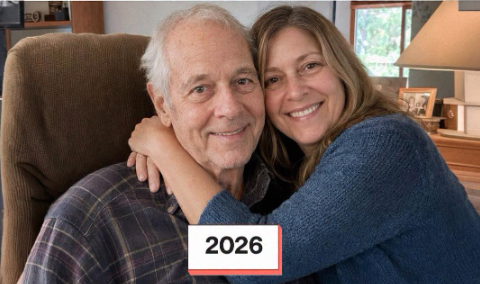
When my stepdad died, I lost the only parent I had ever truly known.
But at his funeral, a stranger pulled me aside and said one sentence that changed everything.
What I found in the bottom drawer of his garage shattered the story I’d been told about my childhood—and rebuilt something even deeper.
There is something disorienting about watching people cry for someone you loved quietly, privately, in all the ways that mattered.
They hug you a little too long. They call you sweetheart as though they’ve known you forever. They lower their voices and speak carefully, as if grief has made you fragile.
I lost my stepdad, Michael, five days ago.
Pancreatic cancer took him. It was fast and brutal. He was 78 years old, and then suddenly, impossibly, he was gone like smoke.
“You were everything to him, Clover,” someone whispered, squeezing my hand as though I might float away.
I nodded.
I said thank you over and over.
And I meant it.
But none of it really sank in.
I stood near the urn beneath a photograph of Michael squinting into the sunlight, a smear of grease visible on his cheek.
That picture had sat on his nightstand for years. Now it felt strangely inadequate, like a placeholder for the man who had taught me how to change a tire, how to work with my hands, and how to sign my name with pride.
“You were everything to him, Clover.”
I stared at the photograph.
“You just left me… alone,” I whispered.
Michael had met my mother, Carina, when I was two years old.
They married in a quiet, intimate ceremony. I don’t remember the wedding. I don’t remember what life was like before Michael.
My earliest memory of him is sitting on his shoulders at the county fair. One sticky hand held a balloon while the other was tangled in his hair.
My mother died when I was four.
That’s a sentence I’ve lived with my entire life.
When Michael became sick last year, I moved back into his house without hesitation.
I cooked for him. I drove him to appointments. I sat beside his bed when the pain became so intense that he stopped talking.
I didn’t do any of it because I felt obligated.
I did it because he was my father in every way that mattered.
After the funeral, the house filled with polite murmurs and the quiet clinking of cutlery.
Someone laughed too loudly near the kitchen.
A fork scraped against a plate hard enough to make several people turn their heads.
I stood near the hallway table, holding a glass of lemonade I hadn’t touched.
Even the furniture seemed to smell like him—wood polish, aftershave, and the faint trace of that lavender soap he always insisted wasn’t his.
Aunt Sammie appeared beside me as though she belonged there.
She wrapped her arms around me tightly.
“You don’t have to stay here alone,” she murmured. “You can come home with me for a while.”
I looked around the house.
“This is my home.”
Her smile didn’t change.
“We’ll talk later then, sweetie.”
I nodded, but something about her words stayed with me.
Then I heard my name from behind me.
“Clover?”
I turned.
An older man stood there, perhaps in his late sixties.
He was clean-shaven, but his face was deeply lined. His tie was pulled too tightly around his neck, as though someone else had tied it for him. He held his cup with both hands, almost as if he were afraid it might slip.
“I’m sorry…” I said slowly. “Did you know my dad from work?”
He nodded once.
“I’ve known him for a long time, honey. I’m Frank.”
I studied his face, searching for some memory.
Nothing came.
“I don’t think we’ve met.”
“You weren’t supposed to,” he said quietly.
I froze.
“What do you mean?”
He stepped closer. I caught the faint smell of engine grease and peppermint.
He glanced around the room once.
Then again.
Finally, he leaned toward me.
“If you want to know what really happened to your mom,” he whispered, “check the bottom drawer in your stepfather’s garage.”
I stared at him.
“I… what?”
“I made him a promise,” he continued. “This was part of it.”
“Who are you?”
“I’m sorry, kid,” he said.
He reached into his pocket and handed me a business card.
“I wish your parents were here for you.”
Then he walked away.
Just like that.
He disappeared into the crowd as though he’d never been there.
I remained standing in the same spot, frozen, while the words echoed louder in my head than the organ music drifting through the living room.
Check the bottom drawer.
I waited until the house was empty that night.
I didn’t turn on the lights when I walked through the front door.
For some reason, the darkness felt gentler.
The garage door creaked as I opened it.
Cold, still air surrounded me. The garage smelled of oil and cedar from the workbench cabinets Michael had built years ago.
My footsteps echoed across the concrete.
Every step toward that drawer felt heavier than the one before it.
The bottom drawer was different from the others.
It was deeper.
It had been built differently.
When I pulled it, it stuck.
Then, with a soft groan, it finally opened.
Inside was a sealed envelope.
My name was written across the front in Michael’s familiar, blocky handwriting.
Beneath it was a manila folder filled with legal paperwork, letters, and a single journal page.
I sat down on the cold garage floor.
My hands were already shaking when I opened the envelope.
“Clover,
If you’re reading this, it means Frank kept his promise.
I asked him not to tell you until I was gone. I didn’t want you carrying this while you still had me.
Frank used to work with me, and I always said he’d outlive us all.
I never lied to you, kiddo.
But I didn’t tell you everything.
Your mom died in a car accident, yes—but she wasn’t just out running errands.
She was driving to meet me.
We were going to sign the guardianship paperwork that day.
You know… to make it official.
But she panicked.
And your Aunt Sammie had threatened court.
She didn’t think that I was fit to raise you.
She said that blood mattered more than love.
Your mom didn’t want a battle.
She was scared of losing you.
I told her to wait. To let the storm pass.
But she got in the car anyway.
I should’ve stopped her.
After the crash, Sammie tried again.
She sent letters, hired a lawyer, and said I had no claim to you.
But I had the paperwork.
I had this letter from Carina.
You’ll see it.
‘If anything happens, don’t let them take her.’
I kept you safe, Clover.
Not because the law gave me the right, but because your mom trusted me to.
And because I loved you more than anything.
I didn’t want you growing up feeling like someone’s contested property.
You were never a case file.
You were my daughter.
But I want you to be wary of Sammie.
She’s not as sweet as she wants you to believe.
I hope you understand why I stayed quiet.
Love always,
Dad.”
I read the final words again.
I hope you understand why I stayed quiet.
The paper trembled between my fingers.
The envelope also contained a draft of the guardianship forms.
Both Michael and my mother had signed them.
At the bottom was a clean, complete notary stamp.
Everything had been ready.
Then I found Aunt Sammie’s letter.
Her handwriting was sharp and formal.
She had written that Michael wasn’t stable.
She said she had spoken with lawyers.
She wrote that “a man with no relation to the child cannot provide proper structure.”
I read the sentence several times.
For years, I’d believed my childhood had simply happened the way I’d been told.
Now I was seeing how much of it had been shaped by decisions made behind closed doors.