My 14-year-old son had just brought home a report card worth celebrating.
Straight A’s.
So I decided to take him somewhere special.
It wasn’t something we did often. I had worked two extra weekend shifts at the hospital to make room in the budget, but I didn’t mind. Leo had been asking for months to go to the steakhouse, and I thought his grades deserved a reward.
That evening, our dinner cost $82.
For us, it was a rare expense, but as I watched my son sit across from me, I thought it was money well spent.
At least, that’s what I believed when we first sat down.
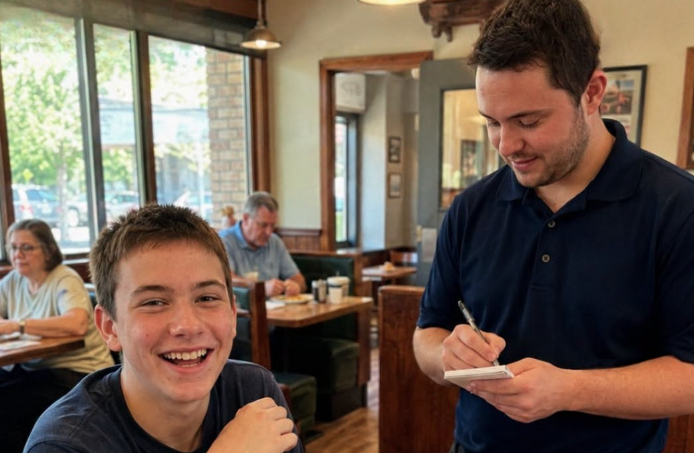
Everything was perfectly ordinary until our waiter approached the table.
His name was Sam.
He looked to be in his early twenties. He was polite, patient, and careful with every part of his job. He had Down syndrome, and I immediately noticed how seriously he took making sure he got our order right.
He held his notepad with both hands and carefully read our drink order back to us, line by line.
“Two waters, one iced tea…”
He was checking each item before moving on.
That’s when I noticed Leo.
He was smirking.
At first, I thought maybe I had misunderstood.
I gently pressed my foot against his leg beneath the table and gave him a warning look.
He looked straight past me.
Sam continued.
He began explaining the evening’s specials, carefully going through each one.
Then he reached one of the dishes and stumbled over the word.
He stopped.
Took a breath.
Then started the word again, more slowly.
Leo rolled his eyes.
I felt my stomach tighten.
Before I could say anything, he leaned forward, pushed his shoulders inward, tilted his head to imitate Sam, and held the expression.
Then he picked up his phone.
He began texting one of his friends, still wearing that same smug smile.
I sat completely still.
Sam finished explaining the specials.
He thanked us politely and walked toward the kitchen.
I watched him disappear through the doorway.
Then I looked across the table at my son.
And for the first time that night, I couldn’t recognize him.
The boy sitting across from me had the same face as my son.
The same voice.
The same hands.
But the considerate, accomplished teenager I believed I had raised seemed to have vanished.
I put my credit card on the table before Sam returned.
When he came back with the check, I quietly apologized.
I didn’t try to make excuses for Leo.
I didn’t say my son was tired.
I didn’t tell Sam that Leo was usually a good kid.
None of those things would have changed what had happened.
I paid the bill.
Then I left the biggest tip I had ever left in my life.
$100.
It wasn’t an attempt to buy forgiveness.
I knew money couldn’t erase humiliation.
It was simply the only immediate way I could show Sam that at least one person at that table understood that what had happened was wrong.
Then Leo and I walked to the car.
I didn’t say a word.
He waited until we were several minutes down the road.
“Mom, come on,” he said. “I was just joking around. Why are you making such a huge deal out of this?”
I kept driving.
He continued trying to defend himself.
“Everyone jokes around.”
“It’s not like I hurt him.”
“He probably didn’t even care.”
I didn’t answer.
The entire drive home took about twenty minutes.
For twenty minutes, Leo heard nothing from me.
When we arrived, he headed toward the stairs.
“Sit down.”
He stopped.
“What?”
“The kitchen table. Sit.”
He reluctantly walked into the kitchen and pulled out a chair.
I went into my bedroom.
Then I reached into the back of my closet.
There, behind boxes and things I hadn’t touched in years, was a faded wooden box.
I hadn’t opened it in nearly twenty years.
I carried it downstairs and placed it on the table between us.
Leo looked at it.
“What is that?”
I didn’t answer.
I lifted the lid.
His smile disappeared before he had even finished looking inside.
The box contained photographs.
Handwritten letters.
A faded green-and-white friendship bracelet.
And an old birthday card.
But it was the photograph on top that made Leo’s expression change completely.
It showed me as a teenager standing beside a smiling boy with Down syndrome.
His name was Daniel.
And Daniel was one of the most important people I had ever known.
I was sixteen when my father died.
I was angry.
Confused.
Heartbroken.
Most of the people around me didn’t know what to say, so many simply kept their distance.
Daniel didn’t.
He sat beside me at lunch.
He shared his sandwiches with me.
He remembered my favorite candy.
He told the worst jokes imaginable until I finally laughed.
He never told me to stop grieving.
He never tried to make my pain disappear.
He simply refused to let me go through it alone.
Daniel became my closest friend during one of the hardest periods of my life.
And then, one Friday afternoon, I made a mistake I would carry with me for the rest of my life.
Several popular girls at school began mocking Daniel as he crossed the parking lot toward me.
They laughed at the way he walked.
They made fun of the way he spoke.
Then they looked at me.
They wanted me to laugh with them.
And I did.
For two seconds.
That’s all it took.
Two seconds of laughter because I wanted the approval of people I barely even knew.
Daniel heard me.
I still remember his face.
It wasn’t anger that stayed with me.
It was disappointment.
Pain.
The look of someone realizing that a person they trusted had chosen to hurt them just to fit in.
His family moved away that weekend.
Before they left, Daniel gave me a letter.
I had kept it in that wooden box for almost two decades.
I handed it to Leo.
He unfolded it carefully.
He read it.
Then he read it again.
By the time he reached the end, tears were running down his face.
He finally understood why I had been so silent in the car.
Why I hadn’t yelled.
Why I hadn’t grounded him immediately.
Why I had brought out that box.
I looked at him and said quietly:
“What happened to Sam tonight reminded me of Daniel.”
Leo wiped his face.
“I didn’t know.”
“I know.”
“I didn’t mean…”
“I know you didn’t think about what it would do to him.”
He stared at the photograph again.
“That doesn’t make it okay.”
“No,” I said. “It doesn’t.”
I told him something I had learned much too late.
A cruel joke can last only a few seconds for the person making it.
For the person being mocked, the memory can last years.
Sometimes a lifetime.
No achievement, no report card, no expensive dinner, no amount of money can make a person better if they believe their success gives them permission to humiliate someone else.
The following afternoon, Leo asked me to take him back to the steakhouse.
He wanted to see Sam.
This time, there was no audience.
No friend to impress.
No excuse.
When Sam came over, Leo looked him directly in the eye.
He apologized.
Not with a joke.
Not with “I’m sorry if you were offended.”
Not with an explanation about why he hadn’t meant anything by it.
He simply admitted that what he had done was cruel.
Sam listened.
Then he accepted the apology.
He extended his hand.
And the words he said were simple.
“Thank you for coming back.”
Those words stayed with Leo.
Several weeks later, he began volunteering at a recreation program for teenagers and adults with developmental disabilities.
I didn’t force him to do it.
It was his decision.
After his first Saturday, he came home exhausted.
But he was laughing.
Apparently, everyone there had beaten him at basketball.
And what surprised him most was that they still cheered for him every time he missed a shot.
“They were terrible at basketball,” he told me, smiling.
Then he paused.
“Actually, Mom… I was terrible too.”
I smiled.
For the first time since that night at the steakhouse, I saw something familiar in his face.
The wooden box is still in the back of my closet.
I haven’t opened it since that night.
Maybe I don’t need to.
Daniel’s kindness never erased my regret over what I did as a teenager.
And Leo’s apology could never erase the humiliation Sam experienced that evening.
But both moments taught us something I wish I had understood much earlier:
Being a good person isn’t about never making a mistake.
It’s about what you do after you realize you’ve caused harm.
Sometimes you have to go back through the door.
Sometimes you have to look someone in the eye.
Sometimes you have to admit you were wrong without expecting anything in return.
And sometimes, the most important lesson a parent can teach a child isn’t delivered through punishment at all.
It’s delivered by showing them what it means to become better than the person they were yesterday.