My Sister Planned a 52-Person Party in My Backyard – Then She Reached My Gate and Saw an Officer
The first message from my sister arrived on a Wednesday evening while I was standing in the northwest corner of my backyard, looking at an orange survey stake I had driven into the ground nearly a year earlier.
To everyone else, it was just a small piece of wood wrapped in orange flagging tape.
To me, it represented the first mark I had made on the property that was finally, completely mine.
Eleven months earlier, the foreclosure house had officially become my home.
I had paid $189,000 for it.
Then came another $34,000 in renovations.
The roof needed work. The plumbing was outdated. The electrical system was a mess. The floors had to be replaced, and the kitchen looked as if nobody had touched it since 1962.
I worked on a survey crew during the day and spent nearly every evening rebuilding the house myself.
There were nights when I was still laying tile at midnight, knowing I had to be at a job site by six the following morning.
The house wasn’t impressive when I bought it.
It was broken.
So was I.
My marriage had ended not long before, and rebuilding that property became the one thing in my life that felt entirely under my control.
Then my phone buzzed.
It was Naomi.
“We’re using your backyard for the family cookout. Fifty-two people, two days. Fill the pool by Sunday.”
There was no question.
No “Would you mind?”
No “Is that okay?”
Just an announcement.
I stared at the message for several seconds before replying.
“Not happening.”
The typing indicator appeared almost immediately.
Then came her response.
“Everyone already said yes. You can’t cancel something 52 people are planning for.”
I wrote back:
“My property. My decision.”
She wasn’t impressed.
“Don’t be like this. Cecil already told everyone.”
Cecil was our father.
Apparently, he had decided he could give permission to use a property he didn’t own.
“Cecil doesn’t speak for me,” I replied.
Naomi responded with a sentence that told me everything I needed to know about how she viewed my home.
“You have a pool you haven’t even filled. You have a backyard nobody uses. What are you holding on to?”
I read that message several times.
What are you holding on to?
As though I had somehow taken something from the family.
As though my backyard were a communal space and I was being selfish for refusing to hand it over.
I stopped responding.
I thought that would be the end of it.
I was wrong.
Two days later, my coworker Shaw showed me something on his phone.
It was the family group chat.
I wasn’t included.
Naomi had posted my address and announced:
“Cookout at his place Saturday and Sunday. Pool open. Bring chairs.”
Dozens of relatives had already reacted.
Forty-three people had confirmed.
Then, Thursday morning, Naomi made a mistake.
She sent me a message that was clearly intended for her friend Gentry.
It read:
“He doesn’t have the spine to call the cops. Once 50 people are in his yard, what is he going to do? Arrest his own family? Cecil already told everyone he agreed.”
I didn’t answer.
I took a screenshot.
Because this was no longer a misunderstanding.
Naomi knew I had said no.
She simply believed my answer didn’t matter.
And the more I thought about it, the more I understood why she felt so confident.
Two weeks earlier, I had been sitting at my parents’ dinner table when my father decided to make my life the evening’s entertainment.
“You stick flags in dirt for a living,” Cecil had said loudly enough for everyone to hear. “And you think you can tell this family what to do with a backyard you bought at a foreclosure auction?”
Then he smiled.
“Your wife left because you’re the kind of man who buys a broken house instead of fixing a broken marriage.”
Nobody defended me.
Naomi looked pleased.
My mother stared into her glass.
My cousins suddenly became very interested in their plates.
That night, I realized something I probably should have understood years earlier.
Nobody at that table was going to protect me from the way my father saw me.
So I would have to protect myself.
This time, I had something stronger than an argument.
I had a deed.
A locked gate.
And the law.
I contacted Holland, the attorney who had handled my divorce.
I explained what Naomi was planning and showed him the messages.
“Do you have her admitting she knows you refused?” he asked.
“Yes.”
“Anything else?”
I sent him the screenshot.
There was a pause.
Then he told me to document everything and arrange for a civil standby with a police officer.
So that’s exactly what I did.
I still didn’t tell Naomi.
Friday afternoon, I came home from work and immediately knew something had happened.
A sixteen-foot rental truck was sitting in my driveway.
My side gate was open.
And in my backyard, Gentry and two other men were assembling a massive event tent.
For several seconds, I simply stood there.
Then I looked toward the northwest corner.
The orange survey stake was gone.
Someone had pulled it from the ground and tossed it beside the fence to make room for the tent.
That little stake meant nothing to them.
But it meant something to me.
It was the first thing I had placed on the property after it became mine.
I walked into the yard.
Gentry looked up.
“Naomi said you were fine with this,” she said. “Cecil gave us the key.”
That’s when I remembered the spare key I’d given my father during the renovation.
He apparently still had it.
I looked at the tent.
Then at Gentry.
“Take it down.”
She stared at me.
“Excuse me?”
“Take everything that belongs to you and leave my property.”
She actually laughed.
“You know how many people are coming Sunday?”
“Yes.”
“Your family is driving hours for this.”
“That’s something Naomi should have considered before lying to them.”
Her expression hardened.
“You’re really going to ruin this over a tantrum about a backyard?”
There it was again.
Tantrum.
My boundary wasn’t a decision.
It was something they believed they could simply dismiss.
“Leave,” I said.
Gentry called Naomi from the sidewalk.
Even through the fence, I could hear my sister shouting.
“He can’t kick you out! Cecil gave you the key. That’s permission!”
I stood there listening to my sister explain why my permission wasn’t required on my own property.
The truck left eleven minutes later.
That evening, I changed every lock.
Then I walked back into the yard and found the orange survey stake.
The tape was muddy but still attached.
I drove it back into the northwest corner.
Two strikes with the mallet.
Right where it belonged.
Saturday night, I finally filled the pool.
Not for Naomi.
Not for the cookout.
For me.
I sat outside until nearly sunrise, watching the water slowly rise inside a concrete pool that had been sitting at the bottom of my renovation list for eleven months.
By Sunday morning, it was full.
The yard was clean.
The new gate was locked.
And I waited.
At noon, Shaw arrived and stood with me on the porch.
At 12:15, the first car pulled up.
Then another.
Then five more.
Within minutes, both sides of the street were packed.
Children appeared in swimsuits.
Relatives carried folding chairs, coolers, bags of food and boxes of supplies.
One man started unloading a folding table.
Then my father’s truck arrived.
Mom climbed out carrying a casserole dish.
Cecil stepped out with a speaker tucked beneath his arm.
Naomi followed, already directing people toward the side yard as if she were running an event at a venue she had rented herself.
“Gate’s around the side!” she called.
People started moving.
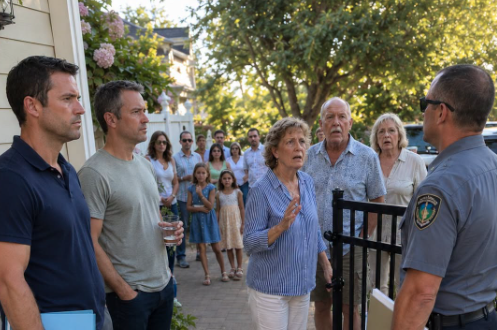
Then the front of the group suddenly stopped.
My mother took two more steps.
She looked toward the side gate.
And froze.
Naomi was already reaching for the latch when she finally saw who was standing beside it.
A uniformed police officer.
A manila folder tucked under one arm.
And a brand-new lock behind him.
Naomi’s hand stopped in midair.
Behind her stood more than fifty relatives, scattered across the sidewalk with coolers, chairs, food and bags.
Cecil stepped forward.
“What is a police officer doing at my son’s house?”
The officer remained calm.
“The property owner filed a trespassing report earlier this week. I’m here at his request.”
My father’s face changed.
Then Naomi turned toward the porch.
That’s when she saw me.
Shaw stood beside me.
And in my hand was a full-page printout.
The screenshot of the message she had accidentally sent me three days earlier.
The one she clearly believed nobody outside her circle would ever see.
I unfolded it slowly.
The conversations around the sidewalk faded.
Fifty-two people turned toward me.
For the first time all week, Naomi had nothing to say.
I looked at my sister, then at the relatives she had convinced to drive hours for a party they had no permission to attend.
“This wasn’t a misunderstanding,” I said. “You knew I said no.”
Nobody answered.
Even Cecil was silent.
Then Holland called me.
He had discovered another problem.
Nearly $4,000 in catering and tent expenses had reportedly been ordered through vendor accounts connected to Naomi’s employer for the private family event.
What Naomi had described as a harmless family disagreement had suddenly become something much more serious.
There were property issues.
Documentation.
Potential financial consequences.
And a very long list of people who had been invited somewhere without the owner’s permission.
Slowly, the crowd began to disperse.
Chairs were folded.
Coolers were carried back to cars.
Food disappeared into trunks.
The tent was never assembled.
No one entered the backyard.
A few days later, my father came back alone.
He brought his checkbook.
“How much money would make this problem disappear?” he asked.
I left the gate locked.
It wasn’t about money anymore.
Naomi eventually faced consequences at work over the vendor charges, and several relatives called her demanding to know why she had misled them.
Two weeks later, she drove slowly past my house.
The pool was finally filled, shining blue beneath the afternoon sun.
Shaw was sitting at my patio table because I’d invited him over.
And in the northwest corner of the yard, the orange survey stake stood exactly where I had placed it eleven months earlier.
The lesson wasn’t really about a cookout.
It wasn’t about a pool.
And it wasn’t even about fifty-two relatives showing up at my gate.
It was about something much simpler.
For years, my family had treated my boundaries as suggestions.
They assumed that because we were related, they were entitled to whatever I had worked for.
But that Sunday, they finally learned the difference between being family and having permission.
The gate could be open whenever I chose.
But this time, everyone inside needed permission first.