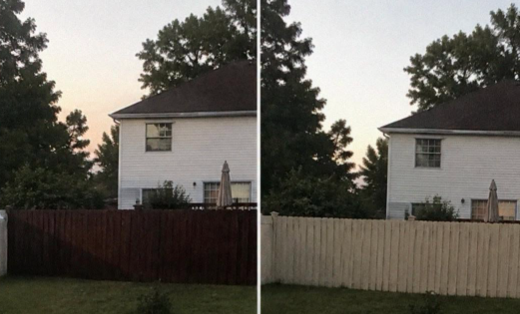
The day I came home from vacation, my neighbor proudly admitted that he had changed my property without asking for permission.
He didn’t look embarrassed.
He didn’t apologize.
He didn’t even seem to understand why I was angry.
Instead, he stood there with the satisfied expression of a man who genuinely believed he had done me a favor.
I could have argued with him.
I could have called the police.
I could have demanded that he pay to restore my fence.
But I did none of those things.
I simply looked at him, looked at what he had done, and told him I would think about it.
Then I went inside.
What Rodgers didn’t know was that I had already started thinking.
And while he believed he had finally gotten the neighborhood to look the way he wanted, I was waiting for the right moment to show him something he had apparently forgotten.
The neighborhood did not belong to him.
Rodgers had been trying to manage my property since the week I moved in.
Our first argument was about my trash cans.
Trash collection was on Wednesday, and that evening I rolled the cans back beside my garage, exactly where I normally kept them.
The following morning, Rodgers knocked on my door.
When I opened it, he didn’t bother with small talk.
“They’re visible from the street,” he said.
I looked behind me toward the garage.
“They’re beside my garage.”
“Yes,” he replied, as though that proved his point. “But people can see them.”
I waited.
I honestly thought there had to be more to the explanation.
There wasn’t.
He simply stood there with his hands on his hips, as if the fact that my trash cans could be seen from a public street somehow constituted a violation.
A month later, the problem was my grass.
Then it was my porch light.
Then it was the basketball hoop at the end of my driveway.
According to Rodgers, it gave the street “a cluttered appearance.”
The irony was that three neighborhood kids used that basketball hoop almost every afternoon.
Rodgers wasn’t the HOA president.
He wasn’t on the board.
He didn’t hold any official position that I knew of.
He was simply a man with a spotless lawn, a loud voice, and an extraordinary amount of confidence.
He had somehow managed to make his personal preferences sound like municipal law.
At first, I argued with him.
That was my mistake.
Every disagreement turned into a lecture.
Every lecture became a list of all the ways the rest of us were supposedly failing the neighborhood.
He talked about property values the way a preacher talked about salvation.
Everything was about appearances.
Everything had to match.
Everything had to look “right.”
Eventually, I learned to nod, close the door, and continue doing whatever I had already planned to do.
I told myself I wasn’t surrendering.
I was simply choosing peace.
That explanation worked for a while.
Until the day I came home from vacation and discovered that Rodgers had painted my fence beige.
I had spent the previous summer restoring that fence myself.
It ran along the side of my driveway and enclosed the backyard.
Nearly seventy feet of old timber had been faded gray when I bought the house.
I pressure-washed every section.
I replaced six warped boards.
I sanded the panels.
Then I stained the entire fence a dark cedar brown.
It took most of a weekend.
For days afterward, my shoulders ached every time I moved.
But I loved the finished result.
The deep cedar color gave the backyard warmth, and more importantly, it was exactly what I wanted.
Apparently, Rodgers disagreed.
I pulled into my driveway after eight hours on the road.
My suitcase slid off the back seat when I stopped so abruptly.
I stared through the windshield.
The entire fence was light beige.
The color continued around the corner toward the backyard.
The thick, flat coat had completely covered the cedar finish beneath it. In the afternoon sunlight, the beige looked almost gray.
For several seconds, I honestly wondered whether I had somehow turned onto the wrong street.
The fence looked nothing like the one I had left behind.
Then it hit me.
There was only one person who would have the audacity to do something like this.
Rodgers.
Nobody else would have thought they had the right to walk onto someone else’s property and change it.
I got out of the car, furious, and headed straight toward his front door.
Before I could even knock, it opened.
Rodgers stepped outside.
He was smiling.
That smile told me everything.
He knew exactly why I was there.
He walked across his lawn wearing white shorts and a pale blue polo shirt, looking completely pleased with himself.
“You’re back,” he said.
I stopped at the edge of his lawn.
“What happened to my fence?”
His smile widened.
“I took care of it while you were away.”
“You painted it?”
“It was no trouble. I already had the sprayer out.”
I stared at him.
He turned toward the fence and admired his work.
“The cedar was too dark,” he explained. “It didn’t really match the neighborhood. This is much cleaner. More consistent.”
“You came onto my property and painted my fence.”
“I did you a favor, Ian.”
He actually expected me to thank him.
That was the part that stunned me most.
He wasn’t worried about trespassing.
He wasn’t worried about damaging my property.
He wasn’t worried about the fact that he had covered hours of work I had personally done.
He had simply decided that his preference mattered more than mine.
A year earlier, I would have shouted.
Two years earlier, I might have threatened to call the police.
