My Neighbor Moved His Fence 8 Feet Onto My Property – Then His Pool Permit Exposed Everything
“Take one step past that fence and I’ll have you arrested for trespassing.”
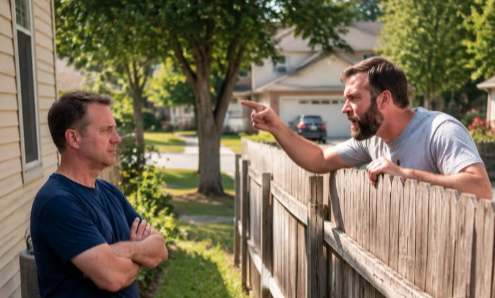
Tyler Bennett said it calmly, almost casually, as he stood in his newly landscaped backyard with one hand resting on the top rail of the cedar fence he had just built.
I looked at him.
Then I looked down at the bright orange survey flag sticking out of the grass only a few feet from his shoe.
“That’s my land,” I said.
Tyler smiled.
“Not anymore.”
That was the moment I realized this wasn’t a simple mistake between neighbors.
He knew exactly where the property line was.
And he had moved the fence anyway.
My name is Jason Miller. I’m 43 years old, a commercial electrician, and I had lived in my small brick house outside Raleigh, North Carolina, for eleven years.
I bought the house after my divorce because it gave me something I desperately needed at the time: a place that was mine.
Nothing extravagant.
Just an old oak tree, a backyard, a shed, a grill, and the wooden swing my daughter Emma had used since she was six.
I knew that yard better than I knew most things in my life.
For eleven summers, I had mowed it almost every Saturday.
I knew where the ground dipped after heavy rain.
I knew where the grass grew thickest.
I knew exactly where my mower stopped at the eastern boundary.
So when eight feet of my yard suddenly disappeared behind a brand-new fence, I noticed immediately.
It happened on a Thursday morning.
I walked outside expecting to finish mowing the narrow strip along my eastern boundary.
My mower was still sitting exactly where I had left it the previous weekend.
The grass wasn’t.
Instead, a new cedar privacy fence stretched from the rear corner of Tyler’s house all the way toward the drainage ditch.
The straight mowing line I had followed for years now ended at the fence.
I walked along it once.
Then twice.
I measured it.
Then I called a professional surveyor.
His name was Carl Jennings.
Two days later, Carl arrived with his equipment and began checking the original property markers.
He located the old survey pins, reviewed the recorded plat, measured from the street monuments, and began placing bright orange flags along what he determined was the actual property boundary.
Every flag landed on the other side of Tyler’s fence.
Carl looked at his measurements.
“You’re not imagining this.”
“How far off is it?”
He checked his tablet.
“Between seven feet eight inches and eight feet four inches, depending on the section.”
I stared at the fence.
“That’s almost four hundred square feet.”
“Closer to five hundred by the time we reach the rear.”
I took photographs of everything.
Then I emailed Tyler.
I kept the message professional.
No insults.
No threats.
Just the facts.
I explained that I had commissioned a survey and that his new fence appeared to have been installed approximately eight feet inside my property.
I attached the survey and asked when he wanted to discuss moving the fence.
Three days passed.
Nothing.
Then four.
After a week, I went to his house.
His wife, Ashley, answered the door.
She had always been friendly enough since they moved in eight months earlier.
That friendliness disappeared when she saw me.
“Tyler?”
He eventually stepped onto the porch.
“You get my email?”
“Oh, yeah.”
“So what are we doing about the fence?”
He rubbed the back of his neck.
“Honestly? Moving it would cost a fortune. The posts are already set. The landscaping is done.”
I waited for him to offer a solution.
Instead, he shrugged.
“You’ve still got plenty of yard.”
I stared at him.
“You’re asking me to give you eight feet of my property because fixing your mistake is expensive?”
“Fences end up a little off all the time.”
“Eight feet isn’t a little off.”
He smiled.
“We’re pretty busy right now.”
Then he closed the door.
That afternoon, I walked the entire boundary.
Behind Tyler’s fence was fresh sod, ornamental stone, two Japanese maple trees, and a concrete pad intended for a hot tub.
Everything looked expensive.
Everything had been designed around land Tyler didn’t own.
That night, I pulled up the county parcel map.
The map hadn’t changed.
The title hadn’t changed.
My deed hadn’t changed.
The strip behind Tyler’s fence was still mine.
The next morning, I sent him a certified letter giving him thirty days to correct the encroachment.
His response came by text.
Stop harassing us. The fence stays.
That was when I called an attorney.
Rachel Monroe specialized in real-estate disputes.
I gave her everything I had.
The survey.
My deed.
Photographs.
The county records.
Tyler’s fence permit.
She studied the documents carefully.
Then she stopped.
“His fence permit?”
“What about it?”
She turned the document toward me.
The site drawing showed the correct property boundary.
Not where Tyler had built the fence.
The actual line.
Rachel tapped the page.
“He certified this placement when he applied.”
I stared at the drawing.
“So he knew.”
Rachel nodded.
“According to this document, he had access to the correct boundary before construction began.”
For the first time, my anger changed.
It wasn’t about an honest mistake anymore.
It looked deliberate.
Rachel sent Tyler a formal demand.
His response was to put a padlock on his gate.
Two days later, I found him spreading mulch over the strip of my property.
I walked toward the orange survey flags.
He came across the yard.
“Don’t cross that fence.”
“I’m standing on my property.”
“Take another step and I’ll call the cops.”
I pointed toward the flag beside him.
“That marks my boundary.”
Tyler kicked the marker over.
“Your surveyor can stick flags wherever he wants.”
I looked at the fallen marker.
Then he leaned closer.
“I built the fence. It’s my yard now.”
Behind him, contractors were assembling a pergola.
One corner of it sat directly on my property.
Rachel had already warned me not to touch the fence.
So I didn’t.
Instead, I went home and opened the county permit portal again.
The pergola permit wasn’t there.
Neither was the electrical permit for the hot tub.
But something else immediately caught my attention.
Tyler had applied for a swimming pool.
A large one.
The approved plan required ten feet of clearance from the property line.
According to Carl’s survey, Tyler’s proposed pool was less than three feet from the actual boundary.
I called Rachel.
She was quiet for several seconds after I explained what I had found.
Then she said something that changed the entire situation.
“Jason, don’t touch a single board.”
“Why?”
“Because if he pours that pool where the approved plan shows it…”
She paused.
“…he’s about to build roughly $60,000 worth of concrete around a property line he has already moved.”
Then I heard something outside.
I looked through my kitchen window.
A concrete truck was backing into Tyler’s driveway.
What happened next moved much faster than I expected.
Rachel immediately contacted the county and submitted the survey and supporting documentation.
The county froze portions of the pool project while the property dispute was reviewed.
Then Rachel obtained another document from Tyler’s contractor.
It was a handwritten instruction.
One sentence stood out.
Tyler had specifically asked the contractor to shift the fence approximately eight feet.
Not eight inches.
Not “somewhere around the property line.”
Eight feet.
He had wanted the extra space for his backyard.
Suddenly, the fence’s location wasn’t a construction error.
It was a decision.
And that decision was now documented.
Rachel filed the property case.
During mediation, Tyler’s attorney reviewed the survey, photographs, county permit, contractor records, and original deed.
They all pointed in the same direction.
My direction.
Tyler made an offer.
$5,000.
I refused.
Then $10,000.
I refused again.
Then $18,000.
Finally, $25,000.
The number might have sounded tempting to someone who didn’t understand what was actually at stake.
But I wasn’t selling him a patch of spare grass.
That strip affected drainage, privacy, future improvements, the layout of my property, resale considerations, and the long-term value of the home.
More importantly, I didn’t want to establish the principle that someone could move a fence onto my land and then buy the land only after getting caught.
I told Rachel I wanted the property restored.
The fence removed.
The structures removed.
The boundary permanently established.
And reimbursement for the costs I had incurred because of his decision.
Eventually, the matter reached superior court.
The judge asked Tyler for documentation supporting his fence location.
A deed.
An easement.
A competing survey.
A legal agreement.
Anything showing he had a right to occupy that strip of land.
He had nothing.
The court ordered Tyler to remove the encroaching fence and structures within 45 days and restore my access to the property.
Months after that first confrontation, I watched the same contractor who had built the fence begin taking it apart.
The cedar panels came down one by one.
The pergola was dismantled.
The landscaping was removed.
The concrete work was dealt with.
The fence was eventually rebuilt exactly where Tyler’s original permit had shown it should have been.
The process was strangely quiet.
There was no satisfaction in watching someone lose money.
But there was relief in seeing the property line restored.
For the first time in months, I could look across my yard without seeing someone else’s fence where it didn’t belong.
I didn’t want to leave the reclaimed strip as damaged grass.
So I asked Emma what she wanted to plant there.
She remembered the blueberry bushes my father used to grow when she was little.
So we planted six blueberry bushes.
Then hydrangeas.
And a young red maple.
It took time for the yard to look normal again.
But eventually it did.
Tyler eventually sold the house.
Before he left, he admitted something I already suspected.
He had expected me to see the cost of legal action and simply give up.
“I thought you’d decide it wasn’t worth it,” he told me.
Maybe he thought that because that’s how people had treated me before.
Maybe he assumed that if something became difficult enough, I’d eventually surrender.
But there was a difference this time.
It wasn’t about winning an argument.
It was about protecting something that belonged to me.
Years later, when Emma and I stand beside that fence picking blueberries, those eight feet don’t look like much.
A strip of grass.
A few bushes.
A young tree.
But I remember what happened there.
I remember the orange survey flags.
I remember Tyler telling me, “Not anymore.”
And I remember the moment I realized something important:
A fence can change where people think a property line is.
It cannot change where the property line actually is.
The new owner, Ben, understood that from the beginning.
Before making any changes to the yard, he walked over and asked where we both understood the boundary to be.
It took five minutes.
Five minutes.
That’s all it took to accomplish what Tyler had turned into months of construction delays, legal fees, permits, negotiations, and court filings.
We stood there, looked at the survey markers, and agreed.
The boundary was clear.
And this time, everyone respected it.