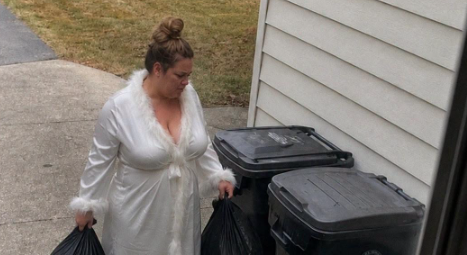
I thought I had finally bought myself a peaceful life at 55.
After years of working, saving, and putting almost everything I had into a little suburban house with a white porch, a small backyard, and two maple trees, I believed I had earned the right to enjoy some quiet.
Then I caught my wealthy neighbor dumping her garbage beside my house.
At first, I thought it was simply rude.
But when I began looking through those bags and discovered what was hidden inside them, I realized the garbage problem was only the beginning.
For most of my life, I had been the woman who said, “It’s fine,” even when it absolutely wasn’t.
By the time I turned fifty-five, I knew that wasn’t exactly one of my best qualities. I simply preferred peace to being right.
So when I finally bought my little house in the suburbs, peace was exactly what I wanted.
I had saved for years, sold my old home, and put nearly everything I had into the new place. It wasn’t enormous, but it was mine. It had a white porch, a modest backyard, and two beautiful maple trees that dropped considerably more leaves than the realtor had bothered to mention.
On my first morning there, I carried my coffee outside and sat on the front step.
A man watering the lawn next door raised one hand.
“You’re the new owner?”
I looked at him.
“That depends. Are you here to complain about something?”
He lowered the hose.
“Not yet. I’m George.”
“Nora.”
He nodded toward my lawn.
“You’re cutting that too short.”
I stared at him.
“Are you here to complain about something?”
He shrugged.
“I’m trying to save your lawn.”
“My lawn hasn’t asked to be saved.”
That made him laugh.
“Good morning to you too, George.”
Most of the neighbors were like that. Curious, friendly, and occasionally far too interested in what someone else was doing with their grass.
Then there was Helen.
Helen lived two houses down in the largest home on our side of the street. Her husband was a dentist, and Helen seemed to consider staying home a full-time position in neighborhood management.
She first introduced herself while I was arranging flowerpots on my porch.
“That one should go on the other side,” she said.
I turned around.
“Hello to you too.”
She pointed toward my blue flowerpot.
“Move it left. Your windows aren’t balanced.”
I looked at the flowerpot, then at her.
“I like it there.”
“You’ll see it once you’ve lived here longer,” Helen replied with a little laugh.
That should have warned me.
A week later, her children ran straight through the flower bed I had just planted.
“Careful!” I called.
Helen was standing at the end of her driveway, scrolling through her phone. She barely looked up.
“They’re kids, Nora.”
“I know. That’s why I asked them instead of calling the police.”
She laughed.
So did I.
It was easier.
That was how it always happened with Helen.
She crossed a line, I said something small, she laughed, and somehow I laughed too.
Helen had a strange ability to treat other people’s property as if it were a shared neighborhood resource.
One afternoon, I found her inside my open garage holding my pruning shears.
I stopped in the doorway.
“Looking for something?”
She lifted the shears.
“These. Mine are dull.”
“You could’ve asked.”
Helen smiled.
“Would you have said no?”
Probably not.
But that wasn’t really the point.
“That’s not really the point.”
“I’ll bring them back.”
Three days later, I had to ask for them.
And Helen’s habits weren’t limited to me.
At a neighborhood barbecue, I watched Susan ask Helen to keep her children out of her flower beds.
Helen immediately smiled.
“Of course. I’m so sorry.”
An hour later, the two women were drinking lemonade together as if nothing had happened.
“That’s what adults do,” I told George.
“You say something, you move on.”
“Mm-hmm.”
I looked at him.
“What?”
“Nothing.”
“You’re terrible at nothing.”
George simply nodded toward Helen.
She was standing beside the food table, admiring a small wooden picture frame.
Helen picked it up.
“What’s this?”
I watched her fingers move over the frame.
“Careful.”
She looked at me, surprised by my tone.
I took the frame from her and set it back down.
“My husband made it.”
“Oh. Your late husband?”
I nodded.
The frame wasn’t beautiful.
One corner sat slightly higher than the other, and there was a tiny groove where my husband had slipped with a tool. That was precisely why I loved it.
Helen studied it.
“You could have the photograph put into something nicer.”
I laughed because I assumed she was joking.
She wasn’t.
I touched the uneven corner.
“That’s the point. He made it.”
She lifted both hands.
“Fine. Keep your crooked frame.”
I assumed that was the end of it.
The next morning, the wooden frame was gone.
I searched everywhere.
I opened moving boxes I’d already unpacked. I checked drawers. I even looked behind the mantel.
