For twenty-two mornings in a row, I woke up knowing there was a chance my children would be late for school.
Not because they were slow getting dressed.
Not because we overslept.
Not because of traffic.
Because my neighbor kept parking her car directly across our driveway.
Every single time I asked her to move it, she acted as though I was the unreasonable one.
“You’ll survive,” she told me once.
I never imagined those two words would eventually become the reason I stopped asking politely and started documenting everything.
My neighbor’s name is Denise.
She moved into number 14 in May.
At first, I had no reason to dislike her.
She seemed friendly enough.
She smiled when we passed each other on the street. We exchanged the usual greetings. Nothing about her suggested that within a few months, one silver Corsa would become the source of one of the most frustrating periods our family had ever experienced.
The strange thing was that Denise had her own driveway.
She also had two parking spaces outside her house.
She had options.
Yet for some reason, she repeatedly chose to park across the bottom of ours.
Not beside it.
Not slightly over the edge.
Directly across it.
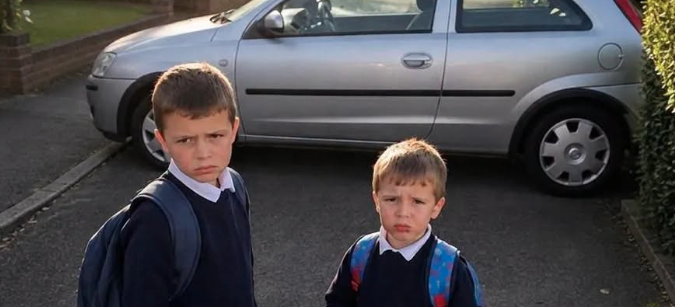
The nose of her silver Corsa would sit almost against the hedge, completely blocking our exit.
The first time it happened, I assumed it was a mistake.
I knocked on her door.
She opened it and immediately apologized.
“Oh—I’ll only be a minute. Sorry!”
I accepted the apology.
What else was I supposed to do?
The next time, she gave me almost exactly the same explanation.
“Just a minute.”
Then it happened again.
And again.
By the fourth incident, I stopped believing it was accidental.
I began taking photographs.
Every picture showed the same thing: Denise’s silver Corsa sitting across our driveway.
I photographed the car.
The position.
The time.
The date.
And I saved everything.
Denise eventually noticed.
One morning, as I stood in the driveway taking another photograph, I looked up and saw her watching me through her front window.
She didn’t wave.
She didn’t come outside.
She simply watched.
The Morning My Son Asked If He Was Going to Get in Trouble
Tuesday the ninth was particularly difficult.
My two boys, Ben, eight, and Oliver, six, were already dressed and sitting in the back seat.
Their school bags were packed.
Their shoes were on.
Lunches were ready.
We were supposed to leave.
Instead, we sat there.
Twenty-two minutes passed.
Oliver looked at me from the back seat.
“Am I going to get in trouble again?”
That question broke my heart.
He had already received late marks for two consecutive weeks.
At his school, the late marks were displayed on a classroom chart with the children’s names.
To a six-year-old, something like that can feel enormous.
Oliver had begun worrying that his teacher thought he was naughty.
I tried to reassure him.
“You’re not in trouble. It’s not your fault.”
But I was angry.
Not at my children.
Not at the school.
At the woman who had made this happen repeatedly when she could have simply parked somewhere else.
Eventually, I gave up trying to get the car out.
I walked both boys to school.
By the time I reached work, I was an hour late.
My manager, Karen, called me into a meeting.
It was one of the most uncomfortable conversations I’d had during my eleven years at the company.
I explained what had happened.
Again.
That afternoon, I went back to Denise’s house.
This time, I didn’t try to soften my words.
“Denise, I’m asking you properly now. My kids are being marked late, and it’s affecting my job.”
She stood in the doorway with one hand resting against the frame.
She looked at me.
Then she rolled her eyes.
“You’ll survive.”
And she closed the door.
I stood there staring at the door for a moment.
Then I walked home.
I didn’t knock again.
I didn’t leave a note.
I didn’t send her a message.
And I didn’t tell my husband what had happened.
Instead, I did something else.
I set my alarm for 5:30 a.m.
Before Sunrise, I Made a Decision
The house was completely quiet when the alarm went off.
I got out of bed, made coffee, and walked downstairs.
Outside, the street was still dark.
I stood at the kitchen window.
There it was.
The silver Corsa.
Exactly where it had been on so many mornings before.
Blocking our driveway.
I picked up my phone.
Then I opened the folder containing the photographs.
Three weeks of evidence.
Dates.
Times.
Twenty-two separate occasions.
I looked at the pictures one after another.
And for the first time, I wasn’t thinking about how to convince Denise to be considerate.
I was thinking about what I could do through the proper channels.
The previous evening, I had spent time reading the local parking rules carefully.
I didn’t want an argument.
I didn’t want revenge.
I wanted a solution.
So before sunrise, while Denise’s curtains were still closed and there wasn’t a single light on in her house, I made one phone call.
I explained the situation.
I provided the information requested.
I was told what steps I needed to follow.
So I followed them.
Then I went back into the kitchen.
I made coffee.
Packed the boys’ lunches.
Prepared their breakfast.
And waited.
At 6:18, Everything Changed
At exactly 6:18 a.m., I heard the sound of a vehicle approaching.
I looked through the window.
A recovery vehicle had turned onto our street.
My heart started beating faster.
Within minutes, the driver stopped beside Denise’s silver Corsa.
The moment the recovery worker began preparing the vehicle, Denise’s bedroom curtains suddenly moved.
A light came on.
Then the front door opened.
She came outside wearing slippers and a dressing gown.
Her hair was messy.
She looked furious.
“What are you doing?”
The recovery worker calmly explained the situation.
Denise immediately demanded to know who had called.
Then she saw me.
I was standing in my doorway with a cup of coffee in my hand.
I didn’t say anything.
I didn’t need to.
She knew.
“This is harassment!” she shouted.
The enforcement officer remained calm.
“Have you previously been asked not to block this driveway?”
Denise hesitated.
“No.”
That was when I stepped forward.
“Yes, she has.”
I opened my phone.
I showed the photographs.
One.
Two.
Three.
Then more.
Twenty-two photographs.
Twenty-two different mornings.
Twenty-two timestamps.
The officer looked through them.
Denise’s expression changed.
This was no longer my word against hers.
There was a record.
A pattern.
Evidence.
She reluctantly moved the vehicle before it was removed.
But the penalty remained.
For once, “You’ll survive” wasn’t enough to make the problem disappear.
She Did It Again
I thought that would be the end of it.
It wasn’t.
A week later, Denise blocked our driveway again.
This time, there was no argument.
The proper process was followed.
She received another penalty.
And slowly, she realized something important.
Ignoring me no longer meant nothing would happen.
She couldn’t simply close her door and pretend the problem didn’t exist.
Eventually, her husband, Paul, spoke to me.
What he told me surprised me.
Denise hadn’t continued parking there because she had nowhere else to go.
She had other options.
She had simply convinced herself that our driveway was easier.
Paul left for work around 5:30 each morning.
Their own driveway was narrow and awkward.
Denise didn’t like maneuvering her car around his.
So she had decided that parking across ours for “five minutes” was easier.
Five minutes.
Except it wasn’t five minutes.
It was twenty-two mornings.
And every one of those mornings had consequences for my family.
Paul eventually arranged to have their driveway widened.
After that, Denise stopped blocking ours completely.
The silver Corsa never appeared across our entrance again.
The Apology I Never Expected
Months later, something happened that I never expected.
Denise came to my door.
She looked uncomfortable.
She wasn’t angry this time.
She wasn’t defensive.
She simply stood there and said:
“I owe you an apology.”
I let her continue.
She told me that she had recently started working as a school office administrator.
One of the parents had complained because her daughter was receiving late marks after repeatedly arriving late on the school bus.
The story had immediately reminded Denise of my boys.
She remembered Oliver worrying that his teacher thought he was naughty because his name kept appearing on the late chart.
“I understand now,” she said.
“I didn’t before.”
I appreciated the apology.
But I didn’t pretend that everything suddenly became perfect.
We never became close friends.
We didn’t start visiting each other’s homes.
We simply became civil neighbors.
And honestly, that was enough.
Because every morning after that, my children could walk out of our front door without me wondering whether someone had decided their time didn’t matter.
Ben could get to school without another late mark.
Oliver could stop worrying about what his teacher thought.
And I could drive to work without having to negotiate with someone who had repeatedly treated my driveway as though it belonged to her.
Looking back, I realize the silver Corsa wasn’t really the biggest problem.
The bigger problem was what happened every time I asked for consideration and was told, in one form or another, that my inconvenience didn’t matter.
For weeks, I tried being polite.
I tried explaining.
I tried asking again.
Eventually, I stopped arguing and started documenting.
That early-morning decision didn’t involve shouting, threats, or revenge.
It involved something much simpler.
I finally decided that being a good neighbor didn’t mean allowing someone else to make my family pay the price for their convenience.
And sometimes, the most effective response isn’t the loudest one.
It’s the one that leaves a record.