My Mom and Twin Sister Sent Me Away at 19 – Twelve Years Later, They Arrived Expecting to Move Into My Home
The first thing my mother said through the intercom wasn’t hello.
“Open the gate, Paige. We’ve been driving for three hours, and the kids are exhausted.”
I was sitting at my desk reviewing payroll for the twelve employees who worked for my furniture-restoration business when her voice came through the security system.
I looked up at the monitor.
There she was.
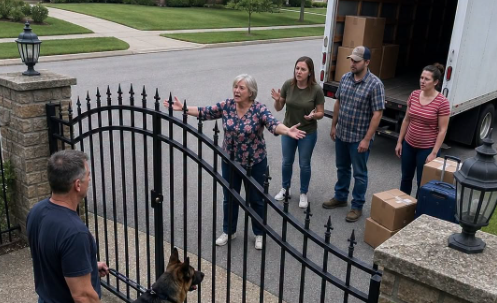
Diane Whitaker, my mother, standing beneath the security camera in a beige coat, wearing the same impatient expression I remembered from childhood.
Beside her stood my twin sister, Mallory, her husband, Grant, and their three children.
A rented moving truck was parked across half the entrance.
Cardboard boxes were stacked beside the gate.
They hadn’t called.
They hadn’t asked whether they could stay.
They had simply arrived.
And judging by the amount of furniture packed into that truck, they had already decided they were moving in.
Mallory stepped closer to the intercom.
“The downstairs suite should be perfect for us,” she said. “The kids can take the rooms across the hall.”
Grant looked past the gate toward my detached workshop.
“Is that building heated?” he asked. “I could probably set up a furniture business in there.”
I stared at the screen.
They were assigning themselves rooms and buildings on my property as though my permission was nothing more than a formality.
My mother glanced toward the neighboring driveway.
“Don’t humiliate me by making everyone stand outside.”
For twelve years, I had wondered what I would say if my family ever came back needing something from me.
In my imagination, I always delivered some perfect speech. Something sharp and unforgettable that would finally make them understand what they had done.
But standing behind that locked gate, I realized I didn’t need a speech.
A few words would be enough.
Because twelve years earlier, these same people had watched me walk away from home with almost nothing.
Now they were standing outside the home and business I had built from the ground up.
And they were expecting me to open the gate.
Mallory and I were born seven minutes apart.
But in our house, those seven minutes seemed to mean everything.
My mother treated my sister as though being born first—even by a few minutes—made her more deserving.
Mallory got the bedroom with the biggest window.
She got new winter coats while I wore hers after she outgrew them.
She got dance lessons, birthday parties, and school activities arranged around her schedule.
I was always the easy one.
“You’re independent,” Mom would tell me whenever Mallory wanted something that belonged to me.
At first, I thought it was a compliment.
Eventually, I understood what it really meant.
Independent meant nobody expected to have to take care of me.
Nobody had to plan for me.
Nobody had to put me first.
The one person who seemed to notice was our grandmother, Elaine.
Grandma taught me things my mother never thought were important.
She took me to estate sales.
She taught me how to inspect old furniture.
She showed me how to recognize quality beneath layers of paint and damage.
Once, while we were examining an old wooden cabinet with a cracked door, she placed her hand on my shoulder and said:
“Don’t be ashamed of a crack. Pay attention to what created it.”
I didn’t fully understand what she meant then.
Years later, I would realize she had been teaching me about far more than furniture.
At Grandma’s kitchen table, I could talk without being told I was causing trouble.
I could disagree without being called difficult.
For the first time in my life, I felt like someone actually saw me.
Then she died during my senior year.
Everything changed after that.
Mallory stopped pretending to share.
My mother stopped pretending to be fair.
A few months after graduation, Mallory announced she was pregnant.
Her boyfriend, Grant, moved into our rented duplex carrying two laundry baskets, a huge television, and very little evidence of a stable job.
My mother immediately decided that my bedroom was the only room large enough for the baby.
I remember standing in the doorway.
“What am I supposed to do?”
Mom barely looked at me.
“You can sleep somewhere else.”
“I could sleep on the couch until community college starts.”
“Grant has back problems. He may need the living room.”
“What about the basement?”
“We need that for the baby’s things.”
Then she folded her arms.
“You’re nineteen, Paige. At some point, you have to stop being my responsibility.”
Mallory stood behind her, one hand resting on her stomach.
“You’ve always acted like you don’t need us,” she said. “This should be easy for you.”
I looked from one face to another.
Neither of them seemed to understand what they were asking.
Or perhaps they understood perfectly.
I packed my belongings into two trash bags.
Two.
That was what my nineteen years of childhood came down to.
Two garbage bags.
My mother watched me leave.
Before I stepped outside, she handed me a few cans of soup and a box of crackers.
“Tell people you chose to move out,” she said. “It sounds more responsible.”
I never forgot that sentence.
For the next several weeks, I slept wherever someone would let me.
Friends’ floors.
Spare rooms.
A couch here and there.
Eventually, I ran out of places to go.
I bought a cheap tent and hid it behind storage sheds at a roadside flea market outside Ridge Hollow.
Every morning, I cleaned myself up in a gas-station bathroom before work.
I kept my clean shirt sealed inside a grocery bag so it wouldn’t smell like wet grass.
I learned to sleep lightly.
I learned to carry everything I owned with me.
And I learned something else.
Nobody was coming to rescue me.
One rainy afternoon, while I was collecting shopping carts outside a grocery store, I looked up and saw a familiar vehicle.
My mother’s car.
She was behind the wheel.
Mallory was sitting beside her, laughing at something on her phone.
Our eyes met through the windshield.
For a moment, I thought Mom might stop.
She didn’t.
She drove away slowly enough that I knew she had seen me.
And slowly enough that I knew she had made a choice.
That night, I sat inside my tent holding my prepaid phone for nearly an hour.
I could have called her.
I didn’t.
Instead, I made myself a promise.
I would never again depend on someone who had already decided I was disposable.
My life began changing because of one unexpected person.
The owner of the flea market, Walt Perrigo, eventually discovered where I had been sleeping.
I expected him to tell me to leave.
Instead, he offered me a cot in a storage room.
In exchange, I helped around the property.
Then he noticed how carefully I handled old furniture.
He began teaching me restoration.
Sanding.
Repairing joints.
Replacing damaged hardware.
Stripping layers of paint without destroying the wood underneath.
It reminded me of everything Grandma had taught me.
I was good at it.
Better than I realized.
Years passed.
Then, when I was twenty-five, an attorney contacted me with news I never expected.
Grandma had left me something.
It wasn’t a fortune.
It wasn’t enough to make me wealthy overnight.
But she had created a modest trust specifically for me, protected so that other relatives couldn’t simply claim it.
For the first time, someone had left me something without expecting me to surrender it to someone else.
I used the money as a down payment on eleven acres.
Then I started Ridge Hollow Restoration.
The first years were difficult.
There were months when payroll was stressful.
Equipment broke.
Clients canceled.
There were mornings when I wondered whether I had made a terrible mistake.
But slowly, the business grew.
One employee became three.
Then six.
Then twelve.
We gained commercial clients.
We acquired better equipment.
We restored furniture for hotels, private homes, historic properties, and businesses.
Eventually, I built a house on the property.
I paid it off.
I expanded the workshop.
And somewhere along the way, I stopped thinking of myself as the nineteen-year-old girl carrying two garbage bags.
I had built a life.
My own life.
So when my family arrived twelve years later with a moving truck, I knew exactly what stood behind that gate.
It wasn’t simply a house.
It was everything I had worked for.
“Paige?”
My mother’s voice brought me back to the security monitor.
“Open the gate.”
Mallory stepped forward.
“We really need somewhere to stay.”
I finally pressed the intercom button.
“You should have called first.”
My mother sighed.
“We didn’t think we’d need permission.”
I almost laughed.
“You brought a moving truck.”
Mallory crossed her arms.
“Things have been difficult.”
I looked at the three children standing behind her.
They looked exhausted.
That changed something.
Not my decision.
But my approach.
I wasn’t going to punish children for decisions adults had made.
“I’ll help the kids,” I said. “I’ll arrange food and a warm place for tonight.”
Mallory immediately brightened.
“Great. So we’ll unload—”
“No.”
Her smile disappeared.
“You’re not moving into my house.”
Grant stepped forward.
“Paige, you’ve got plenty of room.”
“This isn’t about room.”
“It’s family.”
I looked directly at him.
“Loading a moving truck before asking permission isn’t a request, Grant. It’s an assumption.”
My mother became angry.
“You’re really going to leave your own sister outside?”
“I already offered to help.”
“You have no idea what we’re going through.”
“I know you lost your house.”
Silence.
Then my mother looked away.
That was the first confirmation I needed.
They hadn’t come because they wanted to reconnect.
They had come because they needed somewhere to live.
And somewhere along the way, they had decided my home was available.
I arranged three nights at a nearby motel and paid the bill directly.
I bought groceries.
I made sure the children had what they needed.
But I did not open the gate.
Not because I hated them.
Because I finally understood the difference between kindness and surrender.
My attorney had already helped me make sure my property records, business agreements, insurance documents, investment accounts, and estate planning were properly organized.
Everything I owned was documented.
Everything was clear.
There was no confusion about who owned the house.
Who owned the workshop.
Who owned the business.
And who had the right to decide what happened to them.
My mother eventually stopped arguing.
The moving truck left.
The children went to the motel.
And my gate remained closed.
They stayed there for eleven days.
Eventually, Grant’s brother offered them a temporary place to live.
A week later, Mallory called me.
I expected her to ask for money.
Or a job.
Or another favor.
Instead, she simply talked.
For the first time in years, we had a conversation that wasn’t about what I could provide.
Months later, she called again.
“Could I visit your workshop?”
I said yes.
When she arrived, she walked slowly between the restored pieces of furniture.
She touched the edge of an antique cabinet and looked around at everything I had built.
Then she quietly said:
“Grandma would have loved this.”
I looked at her.
“She would have.”
We stood there for a while without saying anything else.
Mallory and I still aren’t the kind of twins people imagine when they hear the word “twin.”
We don’t talk every day.
We don’t share everything.
There are still twelve years of hurt between us that can’t disappear because of a single conversation.
My relationship with my mother remains distant.
But something has changed.
I no longer feel guilty for protecting my own life.
For years, I believed being a good daughter meant saying yes.
Yes to the bedroom.
Yes to the sacrifice.
Yes to helping.
Yes to giving.
Yes to whatever someone else needed.
I finally learned that saying no doesn’t make you cruel.
And helping someone doesn’t mean handing them the keys to everything you’ve built.
That locked gate was never about revenge.
It was about boundaries.
It was proof that the nineteen-year-old girl who once walked away carrying two garbage bags had finally become someone who knew her own worth.
I could help my family’s children find a safe place to sleep without giving away my home.
I could care about my sister without allowing her to take over my life.
And I could love my mother from a distance without reopening the door she had once closed on me.
After twelve years of rebuilding my life piece by piece, that may have been the most valuable lesson of all:
Kindness and boundaries are not opposites. Sometimes, protecting what you’ve built is the only way to make sure your kindness remains something you freely choose—not something other people feel entitled to.