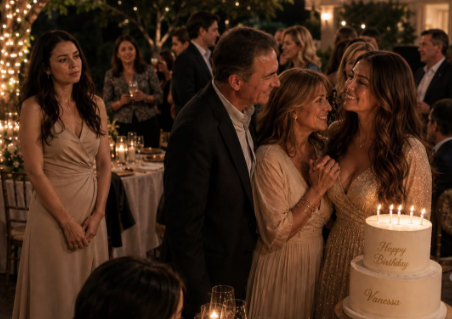
For years, my family insisted my birthday was “too expensive” to celebrate because it fell just two days before Christmas. Meanwhile, my younger sister received yacht parties, live bands and private chefs. So when I turned 28, I stopped waiting for them to make my birthday special. I quietly flew first class to Tokyo. When I posted the view from my hotel, my family completely lost it.
My birthday is December 23.
Two days before Christmas.
Growing up, that date never felt like something worth celebrating.
Instead, it felt like an inconvenience.
Every year, my birthday was swallowed by Christmas preparations, shopping lists, family gatherings and holiday expenses. My parents always had the same explanation.
“Everything is so expensive around Christmas, sweetie. You understand, right?”
I understood.
At least, I thought I did.
Then I watched what happened every June when my younger sister, Vanessa, celebrated her birthday.
Vanessa was born on June 14, right in the middle of summer.
And my parents treated her birthday like a national holiday.
When she turned 16, they rented a yacht on Lake Michigan.
An actual yacht.
There was a DJ, catered food and around 80 guests.
When she turned 18, they hired a local band that had once opened for Twenty One Pilots. There was a red carpet, professional photographers and a chocolate fountain that seemed specifically designed to destroy expensive dresses.
Meanwhile, my 16th birthday happened at the Christmas Eve dinner table.
My dad handed me a wrapped iPhone box.
Everyone clapped.
For a few seconds, I actually felt excited.
Then I opened it.
Inside was a $50 Visa gift card.
“For your birthday and Christmas,” my mother said brightly, as though she’d just solved a major family problem.
I smiled.
What else was I supposed to do?
I was 16.
I didn’t have the words to explain what was happening, but I understood the feeling.
Vanessa’s birthday received planning.
Mine received an explanation.
When I was seven, I finally asked why Vanessa had gotten a bouncy castle and a petting zoo while my birthday was celebrated with a grocery-store cake after Christmas dinner.
My mother looked at me as if I had asked an impossibly complicated question.
“Vanessa’s birthday doesn’t compete with Christmas, honey. It’s completely different.”
Different.
That word stayed with me.
Vanessa was different.
Her birthday deserved attention.
Her celebrations deserved money.
Her happiness deserved planning.
I learned to swallow my disappointment and act grateful.
Every December, I’d watch my birthday disappear into Christmas.
Sometimes my parents would buy one gift and attach two cards.
“Happy Birthday!”
“Merry Christmas!”
The same cheerful lettering.
The same forced smile.
The same feeling that I was somehow asking for too much by wanting one day that belonged to me.
By the time I was 15, I stopped asking for birthday parties altogether.
There was no point.
The answer was always the same.
Holiday expenses.
Family budgets.
Bad timing.
“Maybe next year.”
Next year never came.
It was simply another December.
Vanessa never seemed to understand the difference.
Or maybe she did and didn’t care.
When she was 16, she once showed me photographs of her birthday plans while getting her nails done.
She talked about venues, themes and decorations.
Then she looked at me and said casually:
“You’re lucky your birthday is near Christmas. You get presents either way.”
I laughed.
Actually laughed.
Because sometimes laughing is easier than explaining why something hurts.
The financial excuse might have made sense if my parents had been struggling.
They weren’t.
My father was a successful corporate attorney.
My mother managed a chain of dental offices.
We lived in a five-bedroom house in Oak Park with a pool and a three-car garage.
Money wasn’t the problem.
Priorities were.
I eventually stopped expecting my family to recognize that.
Instead, I built my own life.
I attended Northwestern, chose finance as my major and graduated with a job offer from a prestigious investment firm in Chicago.
Numbers made sense to me.
They had rules.
They didn’t change depending on which child was asking for attention.
I worked hard.
Very hard.
By 25, I was managing a seven-figure portfolio and earning a salary that made my parents’ old explanations about money even harder to believe.
I bought my own condo in River North.
I furnished it exactly the way I wanted.
And for the first time, I began traveling.
Paris for a long weekend.
Iceland to see the Northern Lights.
Bali for two weeks of peace.
I realized something during those trips.
I didn’t need permission to enjoy my own life.
Meanwhile, Vanessa was 23 and still living at home.
She worked part-time at a boutique while trying to build an influencer career.
Our parents supported her.
They paid for her car.
Her phone.
Her shopping.
And everything else they considered part of helping their daughter succeed.
I stopped attending her birthday parties several years earlier.
I’d use work conferences or travel as excuses.
Sometimes the excuses were even true.
Afterward, my mother would call.
“Vanessa really missed you.”
I never pointed out that Vanessa hadn’t attended my birthday dinner in years.
I had already learned not to expect fairness from people who insisted they were being fair.
Then came the year I turned 26.
I had just been promoted to senior portfolio manager.
It was one of the biggest professional accomplishments of my life.
I called my mother because I wanted to share the news.
She congratulated me.
Then, almost immediately, she changed the subject.
Vanessa had broken up with her boyfriend.
She was devastated.
Apparently, she needed emotional support.
That support turned into a spa weekend paid for by our parents.
“Can we celebrate your promotion next month?” Mom asked.
“Things are just really intense with Vanessa right now.”
Next month came.
Then another.
Nobody mentioned my promotion again.
Around the same time, Vanessa landed a small sponsorship deal with a local boutique.
Our parents threw her a celebration dinner at Gibsons Steakhouse.
Aunts, uncles and cousins were invited.
They made speeches about her creativity and entrepreneurial spirit.
I found out through Instagram.
That was the moment I realized I wasn’t imagining the difference.
I had simply been pretending not to see it.
That year, I started therapy.
Not because I had experienced some dramatic breakdown.
A friend named Morgan suggested it after I spent an entire brunch explaining all the ways my family made me feel invisible.
“You sound exhausted,” she told me.
She was right.
My therapist, Dr. Patricia Chin, listened as I described 26 years of birthday disappointments, canceled plans and casual comments that had slowly taught me to minimize my own needs.
Eventually, she asked me something simple.
“How does it feel to be your family’s afterthought?”
I started crying.
Not quietly.
Not gracefully.
The kind of crying that leaves your face blotchy and your nose running.
For years, I had believed that if I worked harder, achieved more and became successful enough, my family would finally see me differently.
“I keep thinking if I just prove I’m worth their attention…”
Dr. Chin stopped me.
“You’re trying to earn something that should have been freely given.”
Then she said something I’ll never forget.
“Love isn’t a merit system.”
Those sessions changed me.
I began understanding the golden-child dynamic in my family.
I learned why I minimized my needs.
Why I felt guilty for wanting attention.
Why I kept making excuses for people who never made excuses for me.
“You’re allowed to stop participating in a system that devalues you,” Dr. Chin told me.
“You’re allowed to choose yourself.”
The idea frightened me.
But it also felt liberating.
Then December came again.
I was about to turn 27.
I suggested dinner at my favorite sushi restaurant.
Nothing extravagant.
Just my family.
My mother replied by text.
“Can we do it in January? Everything’s so hectic with the holidays. You understand?”
I stared at the message for a long time.
Yes.
I understood perfectly.
Then came June.
Vanessa turned 24.
Her invitation arrived on thick, expensive cardstock.
An Evening Under the Stars Celebrating Vanessa.
The party was held at a vineyard in Michigan.
String lights.
Live jazz.
Artisan cocktails.
A private chef.
Everything my family had always claimed was too expensive when it came to me.
That was when I stopped waiting.
I didn’t argue.
I didn’t complain.
I didn’t send an angry message.
I simply decided that if my family wouldn’t make December 23 special, I would.
For my 28th birthday, I quietly saved $12,000 for a trip I had dreamed about for years.
Tokyo.
I bought a first-class ticket for $3,200.
I booked a room at the Park Hyatt Tokyo for $600 a night.
I planned a birthday dinner.
I made a list of places I wanted to see.
And I told my family only that I would be traveling.
I didn’t tell them how.
I didn’t tell them where I was staying.
And I certainly didn’t ask for their approval.
Then December 23 arrived.
I woke up in Tokyo.
By morning, I was standing beside a floor-to-ceiling window on the 48th floor of my hotel, watching the city stretch beneath me.
The skyline was glowing.
Tokyo was alive.
And for the first time in my life, December 23 felt like it belonged entirely to me.
I took one photograph.
Just one.
The Tokyo skyline through the window.
I posted it on Instagram.
Then I put my phone down.
It didn’t stay quiet for long.
When I finally checked it again, I had 43 text messages, 26 missed calls and dozens of notifications.
My family had discovered where I was.
Mom’s messages started with concern.
Then came criticism.
Dad wanted to know whether the trip was financially responsible.
He said we needed to discuss my “priorities.”
I almost laughed.
My father was a corporate attorney.
He knew I earned my own money.
I paid my own mortgage.
I carried my own insurance.
I managed my own investments.
I hadn’t borrowed money from them.
I hadn’t touched anyone’s estate.
I hadn’t asked them to pay for anything.
I had simply used money I had earned and saved to take myself on a birthday trip.
Vanessa was even more direct.
She accused me of showing off.
Other relatives called the vacation extravagant.
For years, my family had spent far more on Vanessa without ever questioning whether those celebrations were excessive.
But the moment I spent my own money on myself, suddenly everyone had an opinion.
On December 26, after I returned from Tokyo, I finally answered my mother’s call.
I didn’t yell.
I didn’t insult anyone.
I simply asked the question that had been waiting for an answer for most of my life.
“Why was spending thousands of dollars on Vanessa considered love, while spending my own money on myself is selfish?”
There was silence.
Then Dad tried to insist that they had always treated us equally.
So I reminded him.
The yacht.
The bands.
The photographers.
The vineyard.
The private chefs.
The canceled birthday dinners.
The December birthdays absorbed into Christmas.
The $50 gift card.
The “maybe next year” that never came.
The silence on the other end of the phone lasted longer than any argument could have.
Then something unexpected happened.
Vanessa apologized.
She admitted that seeing my photographs from Tokyo had made her jealous.
But it had also forced her to confront something she’d spent years ignoring.
We hadn’t grown up the same way.
Our parents had given us very different versions of childhood.
My mother and father eventually asked to meet me for coffee.
They acknowledged that they should have treated my birthday as its own occasion.
I appreciated the apology.
But I also told them something important.
I didn’t need them to make December 23 special anymore.
Tokyo had already done that.
I had walked through Shibuya.
I had eaten sushi I’d dreamed about for years.
I had watched Mount Fuji from my hotel.
I had celebrated myself without waiting for anyone else to decide that I was worth celebrating.
For the first time, my birthday wasn’t something I had to defend.
It wasn’t competing with Christmas.
It wasn’t an inconvenience.
It wasn’t an afterthought.
It was mine.
And that changed something inside me.
My next birthday trip is already taking shape.
Maybe my family will join me.
Maybe they won’t.
Either way, that decision belongs to them now.
It isn’t my responsibility anymore.
For 28 years, I thought my family had the power to decide whether my birthday mattered.
I finally realized they never did.
I did.
And on December 23, thousands of miles from home, overlooking Tokyo, I gave myself the one thing I had been waiting for since childhood:
A birthday that was finally about me.