“My sister says you were expelled from law school for falsifying an exam.”
My father said the words over the phone as though he were delivering a verdict that had already been decided.
I was 26 years old.
I was three semesters away from finishing law school, and I had an official transcript sitting open on my laptop that proved I was still enrolled and near the top of my class.
I stared at the screen for a moment before answering.
“That isn’t true.”
Dad didn’t respond.
“Give me five minutes,” I said. “I’ll email you my enrollment verification and transcript.”
“That won’t matter.”
I stopped typing.
“Why not?”
“Records can be manipulated.”
My fingers froze above the keyboard.
A screenshot my sister had supposedly received from some unnamed source was being treated as unquestionable truth.
A certified university record that I was offering directly to my parents was being dismissed as something I could have manipulated.
It was the first time I realized I wasn’t being asked to explain myself.
I’d already been judged.
Then Mom joined the call.
Her first question wasn’t whether the accusation was true.
It wasn’t even what happened.
It was:
“Has anyone from church heard about this?”
I closed my eyes.
“No one has heard about it because it didn’t happen.”
There was a pause.
Then my mother said the sentence that would stay with me for years.
“Selena would never lie about something this serious.”
I remember looking at my laptop.
The university seal was right there.
My name was right there.
My grades were right there.
My enrollment status was right there.
Everything my family needed to know was sitting in front of them.
They simply didn’t want to know it.
Nobody called the university.
Nobody contacted the registrar.
Nobody asked Selena to identify the person who had supposedly exposed me.
Nobody asked why she had no original document, no official notice, no email, and no evidence beyond a screenshot.
By Sunday night, my parents had removed me from the family phone plan.
They told relatives that I had disgraced the family.
Then they told me I was no longer welcome in their Massachusetts home.
The next morning, I sent them everything.
My enrollment verification.
My transcript.
Professor evaluations.
And a letter from the university confirming that I was a student in good standing.
My father replied with three words.
“Stop making excuses.”
That was the moment I stopped begging them to believe me.
Eventually, I learned why Selena had created the lie.
She had left her marketing job and was struggling to pay her rent.
My parents were supporting her financially.
But a week before the accusation, Dad had told Selena that they were going to have to reduce that support because my tuition expenses were increasing.
And then, suddenly, I was expelled.
At least, that was the story Selena created.
Once I was pushed out of the family, the money that had been helping me with law school began going to her instead.
Her lie wasn’t an impulsive act of sibling jealousy.
It wasn’t a misunderstanding.
It was a transaction.
She had traded my reputation for financial security.
And my parents had accepted the bargain without ever checking the records.
I had a choice.
I could spend the rest of my life trying to convince people who had already decided I was guilty.
Or I could move forward.
I chose forward.
My university approved additional financial aid.
A legal services clinic hired me to review contracts at night.
I studied during the day.
I worked at night.
I slept very little.
And eventually, I finished law school.
I passed the bar.
I moved to Portland, Maine.
And I built a career investigating financial fraud.
There was an irony to the work I ended up doing.
I spent my days dealing with people who assumed they could control the truth simply by telling a convincing story.
People who believed confidence could replace evidence.
People who knew that if they repeated something enough times, others might stop asking questions.
I knew exactly what that looked like.
Because I’d lived it.
For years, my family continued telling a softer version of the story.
I had supposedly “left law school after some trouble.”
I had “gone through a difficult period.”
There was always some vague explanation.
Whenever relatives whispered about what happened, I could have shown them my transcript.
I could have shown them the university letters.
I could have proven everything.
But eventually, I stopped.
Silence became easier than trying to prove myself to people who preferred the lie.
Then, ten years after that phone call, an evidence packet landed on my desk.
The case involved Harbor Haven Housing Foundation, a respected nonprofit organization that provided housing assistance.
The initial allegations involved falsified invoices.
Shell vendors.
Unauthorized transfers.
And federal housing grant money that appeared to be missing.
The estimated loss was $480,000.
I turned the page.
Then I saw the name.
Finance Director: Selena Carter.
I stopped reading.
For several seconds, I simply stared at the page.
My sister.
The same woman who had once convinced my parents that I had been expelled from law school was now the subject of a federal fraud investigation.
She had spent four years managing the finances of one of Maine’s respected housing nonprofits.
Investigators believed several vendors had been paid for services they never provided.
Three companies shared mailing addresses.
Two online banking accounts used the same recovery phone number.
The number belonged to Selena.
There were invoices deliberately submitted just below internal review thresholds.
Descriptions had been copied across unrelated projects.
There was a reimbursement form bearing Selena’s signature.
And the financial records suggested money intended for housing programs had been diverted elsewhere.
I closed the file.
The federal seal on the cover seemed almost surreal.
Ten years earlier, I would have given almost anything for one person in my family to check a document.
Now, twelve investigators had spent six months doing exactly that to Selena.
But I didn’t celebrate.
I didn’t smile.
I didn’t feel vindicated.
Instead, I called my division chief.
I disclosed the entire history between Selena and me.
I explained the false law school accusation.
I explained our estrangement.
And I requested immediate reassignment to an independent prosecution team.
It was the first time in ten years that I held professional power over a situation involving my sister.
And the first thing I did with that power was limit it.
I recused myself.
The next morning, at 6:17 a.m., my phone rang.
Selena.
I stared at her name before answering.
“Brooke, don’t hang up.”
There was no apology.
No acknowledgment of the decade we’d spent apart.
No “I’m sorry.”
No “I know what I did to you.”
Just fear.
“I’m listening.”
“I know the case came through your office.”
That caught my attention.
The reassignment had not yet appeared on any public docket.
“How do you know that?”
She ignored the question.
“You need to understand that the numbers look worse than they are.”
Not, “I didn’t do it.”
Not, “Someone made a mistake.”
Not even, “I’m innocent.”
Just:
The numbers look worse than they are.
“I can’t discuss an active investigation with you.”
“You’re my sister.”
I almost laughed.
“You remembered that quickly.”
Her voice softened.
“I know we have history. I know things happened.”
“You fabricated an expulsion notice and watched our parents disown me.”
“I made a mistake.”
“You maintained that mistake for ten years.”
Silence.
Then she said:
“I didn’t know they’d go that far.”
That sentence told me more than she probably intended.
She knew what she’d done.
She simply hadn’t expected the consequences to reach as far as they did.
Then her tone changed.
“You should think carefully about how this looks for you, too.”
I said nothing.
“A federal prosecutor with a sister under investigation? Reporters will dig. They’ll find out your own family cut you off over law school.”
There it was.
The old weapon.
The same story.
The same accusation.
The same threat that my reputation could be damaged simply because someone repeated a lie.
“You called the wrong person,” I said.
“No.”
Her voice became sharper.
“I called someone who knows what it feels like when everyone decides you’re guilty before hearing your side.”
For one second, she almost reached me.
Because I did know.
I knew exactly what that felt like.
But there was one crucial difference.
I had been condemned despite evidence.
Selena was being investigated because of evidence.
“They are hearing your side,” I told her. “Through counsel, discovery, and the legal process. That’s more than anyone in our family gave me.”
“Mom and Dad are terrified.”
“Of course they are.”
“They want the family together.”
Ten years earlier, family unity had required removing me.
Now, apparently, family unity meant protecting Selena.
“I’ve recused myself,” I said. “I won’t make charging decisions. I won’t negotiate a plea. I won’t recommend a sentence.”
For the first time, her voice sounded genuinely frightened.
“No, Brooke. You can’t do that.”
She hadn’t wanted mercy.
She had wanted access.
“Why not?”
“Because strangers won’t understand.”
I looked at the evidence packet on my desk.
“That is precisely why strangers should handle it.”
Before ending the call, I warned her that any further attempt to discuss the investigation would be documented and forwarded to the assigned team.
Five minutes later, I wrote a memorandum recording the conversation.
Three days later, my receptionist called.
“There are two people downstairs who say they’re your parents.”
I already knew who they were.
Diane and Robert Carter.
My mother and father.
I met them in a public conference room rather than my office.
My mother reached for my hand.
I moved my chair before she could touch me.
“We need to talk about Selena,” she said.
“Of course you do.”
Dad placed a thick envelope on the table.
Mom kept one hand resting on top of it.
“We only need you to speak to someone,” she said.
“Speak to whom?”
“People involved in the investigation.”
I looked at her.
“What exactly do you want me to say?”
“Tell them what kind of person your sister really is.”
I almost couldn’t believe what I was hearing.
Then she pushed the envelope toward me.
A handwritten note was clipped to the first page.
I recognized the handwriting immediately.
Selena’s.
I read the first few lines.
And then my father finally admitted something they had hidden from me for an entire year.
Selena had already confessed to them that the law school story was false.
She had admitted that I had never been expelled.
She had admitted that she had fabricated the accusation.
And my parents had known.
For a full year.
They had never called me.
Never apologized.
Never told me they knew.
They had simply kept the truth to themselves.
My mother looked down at the table.
“We didn’t know how to fix it.”
“You could have called.”
“We were ashamed.”
“You believed her without checking anything.”
My father’s voice broke.
“We thought you would forgive us eventually.”
I looked at him.
“You didn’t ask me to forgive you. You asked me to disappear.”
Nobody spoke.
The room was silent.
Then I opened the investigation file again.
The independent prosecution team had continued following the evidence.
Bank statements.
Emails.
Vendor invoices.
Accounting records.
Forensic data.
The paper trail kept growing.
Investigators identified shell companies connected to payments from Harbor Haven.
Several transactions had been deliberately structured below internal review thresholds.
Money had moved through accounts linked to Selena’s personal expenses and an investment account.
Some records involved property costs.
Others involved credit-card payments and insurance-related expenses.
The defense argued that Harbor Haven had weak financial controls.
That was true.
But weak controls weren’t an explanation for falsified invoices.
They weren’t an explanation for shell vendors.
They weren’t an explanation for transfers.
And they certainly weren’t an explanation for $480,000.
There was no family connection that could explain it.
No mortgage obligation.
No estate dispute.
No emotional history.
No courtroom drama.
Just records.
The evidence was either true or it wasn’t.
Eventually, Selena’s defense suggested that prosecutors had targeted her because of me.
That accusation brought me into the courtroom.
Not as a prosecutor.
Not as an investigator.
Not as someone with authority over her case.
But as a witness to a simple fact.
I had recused myself.
Under oath, I confirmed the history.
Then I was asked the question that, ten years earlier, my own parents had refused to answer.
Had I ever been expelled from law school?
“No.”
Had I ever been suspended?
“No.”
Had I ever been disciplined for falsifying an exam?
“No.”
The prosecutor displayed the certified university record on a courtroom screen.
My enrollment.
My academic standing.
My transcript.
Everything I’d tried to show my parents ten years earlier.
The same records that had once been called “manipulated” were now part of a federal proceeding.
I didn’t look at Selena.
I didn’t need to.
The truth was on the screen.
Later, Selena testified in her own defense.
Her attorney argued that the nonprofit’s financial systems were weak and that responsibility for the missing money could not be placed entirely on her.
But prosecutors introduced additional evidence.
Among it was an audio recording from a former accounting manager.
On the recording, Selena warned an employee against questioning suspicious payments.
The evidence continued to point in the same direction.
The jury eventually convicted her on multiple fraud-related counts.
She was sentenced to eight years in federal custody, along with restitution and financial restrictions.
For the first time, the story my family had created about me was no longer the most important thing in the room.
The evidence was.
Before sentencing, Selena finally admitted what she’d done ten years earlier.
She had invented the law school accusation because she was afraid my success would make her invisible to our parents.
She wanted their attention.
She wanted their financial support.
And she believed that making me look like a failure would make her look successful by comparison.
It had worked.
For a while.
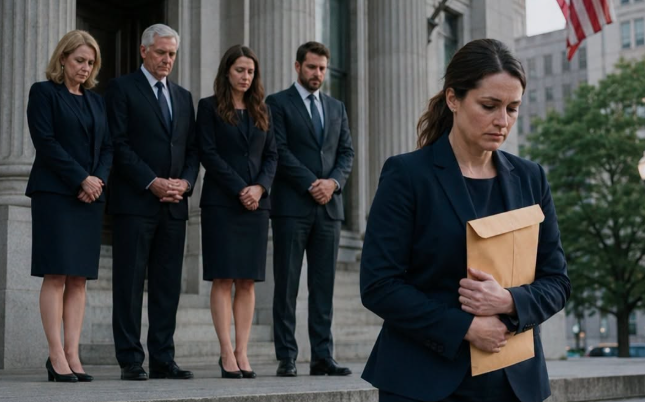
Outside the courthouse, my mother stood beside me.
Her eyes were red.
“I failed you,” she said.
I looked at her.
For years, I had imagined what it would feel like to hear those words.
I thought I would feel victorious.
I didn’t.
I felt tired.
“I know,” I said.
I accepted the truth without pretending it erased ten years.
It didn’t.
Nothing could.
Not the conviction.
Not the apology.
Not the restitution.
Not even the courtroom record.
Ten years was still ten years.
But as I walked away from the courthouse, I realized something more important than seeing Selena lose her freedom.
When I finally had power over a situation involving my sister, I hadn’t used it to destroy her.
I hadn’t manipulated the evidence.
I hadn’t called reporters.
I hadn’t demanded special treatment.
I hadn’t tried to punish her personally.
I had done something much simpler.
I stepped aside.
I disclosed the conflict.
I let independent investigators follow the records.
And I let the evidence speak for itself.
That was the thing my family had refused to do for me ten years earlier.
They had chosen a story over a document.
A screenshot over a certified record.
A sister’s accusation over the truth.
But this time, no one had to take my word for anything.
The records were there.
The signatures were there.
The bank statements were there.
The invoices were there.
And, eventually, so was the truth.
I had spent years thinking the worst thing Selena had taken from me was my family’s trust.
I was wrong.
What she took was ten years of my life spent believing I needed to prove that I wasn’t the person they had decided I was.
I don’t carry that burden anymore.
Because I finally understand something I wish my parents had understood from the beginning:
When the truth is available, you don’t need to choose sides.
You only need to check the records.