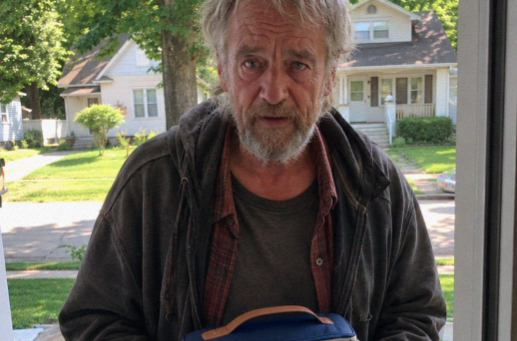
For months, my 15-year-old daughter packed an extra lunch every day for a homeless man who stayed near her school.
I thought it was a simple act of kindness.
Then one morning, that man knocked on our front door holding the lunchbox she had packed for him.
It was still completely untouched.
Before I could even ask why, he looked me in the eyes and told me something that made my stomach drop.
Chloe had been spending her afternoons with him.
And there was something she was too afraid to tell us.
The first thing I noticed was the weight of the lunchbox.
It should have been empty.
Instead, when the older man held it toward me on my porch, the blue insulated bag sagged heavily from his hand.
Exactly the way it had when Chloe carried it out the door that morning.
I stared at him.
“How do you know where we live?”
The man looked down at the white label I had stuck beneath the handle months earlier.
Our last name.
My phone number.
Our address.
“Your handwriting is very informative, ma’am.”
Under any other circumstances, I might have laughed.
I didn’t.
His coat was worn shiny at the elbows. Gray threaded through his beard, and his face had the weathered look of someone who had spent too many nights outside.
But his eyes held mine, dark with worry.
He nudged the lunchbox toward me.
“I think you should take this.”
“Where’s Chloe?” I asked.
“At school.”
“Did something happen?”
His hesitation frightened me more than any answer could have.
“There’s something she’s too terrified to tell you.”
“Is someone hurting her?” I breathed.
“No.”
“Did she tell you she’s in danger?”
“Not exactly.”
I grabbed the lunchbox from his hand.
“Then what?”
He glanced toward the street.
“My name’s Bram.”
“I know.”
That surprised him.
“Chloe told me,” I explained.
For half a second, his expression softened.
Then the worry returned.
“Ma’am, I think your daughter has gotten very good at making sure nobody worries about her.”
My hand tightened around the blue handle.
That was when I realized I had heard almost the exact same thing before.
Only then, it had sounded like praise.
Three months earlier, Chloe had been eating like she had spent the entire school day crossing a desert.
She would walk through the front door around four o’clock, drop her backpack, and head straight for the pantry.
Crackers.
Granola bars.
Peanut butter.
Once, I watched her eat cold leftover pasta directly from the container while standing in front of the refrigerator.
“Didn’t you eat lunch?”
“Mhm.”
Her mouth was full.
“What did I pack?”
She paused.
“Sandwich.”
I narrowed my eyes.
“Which kind?”
She swallowed.
“Turkey?”
It had been pasta salad.
The next day, I decided to test her.
I picked her up from an appointment after school and waited until we were halfway home.
“Was the chicken good today?”
Chloe smiled automatically.
“Yeah. Really good, Mom. Thanks.”
I glanced over at her.
“I didn’t pack chicken.”
Her face collapsed.
For the rest of the block, she stared down at her hands.
Finally, she whispered, “You’re going to be mad.”
“Try me.”
“I’ve been giving him my whole lunch.”
I pulled into our driveway.
“To who?”
She told me.
There was an older homeless man who stayed near the bus shelter a short distance from her school.
“The first time I noticed him, the temperature had dropped unexpectedly,” Chloe explained. “He was sitting under the shelter in a thin jacket.”
