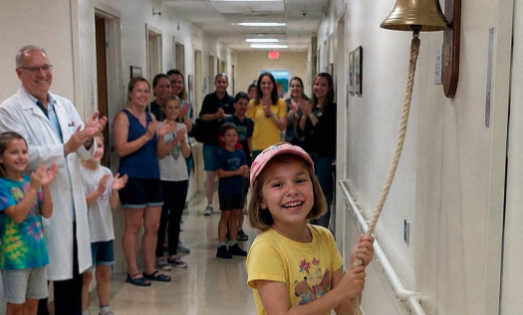
The hallway outside the pediatric oncology ward erupted in applause.
My daughter, Martha, still had both hands wrapped tightly around the rope she’d just pulled. Above her, the brass victory bell swayed gently, its bright sound lingering through the corridor as if it refused to disappear.
Nurses were clapping.
Parents were crying.
Doctors were smiling in that quiet, exhausted way people smile after holding their breath for far too long.
Someone handed Martha a paper certificate decorated with glittering stars.
She lifted it above her head like she had just won an Olympic medal.
“I did it, Mom!”
Her smile stretched from one freckled cheek to the other.
I pulled her into my arms so tightly that she laughed.
“You sure did, sweetheart.”
For the first time in two years, I didn’t have to force myself to smile.
It simply happened.
People often ask what the hardest part of childhood cancer is.
They expect parents to say chemotherapy.
The needles.
The hospital stays.
The endless waiting.
They’re wrong.
The hardest part is watching your child slowly stop acting like a child.
Two years earlier, Martha had been eight years old.
She collected shiny rocks because she was convinced every one contained a tiny dinosaur egg. She named squirrels. She insisted pancakes tasted better when they were cut into stars.
Then, one ordinary Wednesday afternoon, I noticed bruises that shouldn’t have been there.
Three days later, we had a diagnosis.
Leukemia.
I barely remember leaving the doctor’s office.
I remember holding Martha’s tiny hand.
I remember looking at her face and thinking there had to be some terrible mistake.
Then she looked up at me.
“Mom?”
“Yes, sweetheart?”
“Are we still getting pizza tonight?”
I burst into tears.
She thought I was crying because we might have to cancel dinner.
That became our life.
Hospital rooms.
Blood tests.
Chemotherapy.
And waiting.
Always waiting.
As a single mother, I learned very quickly that I didn’t have time to fall apart.
Someone still had to manage medications.
Someone still had to argue with insurance companies.
Someone still had to remember appointment times.
Someone still had to braid whatever little hair Martha had left.
So every night, after Martha fell asleep, I would lock myself inside the hospital bathroom.
I’d sit on the closed toilet lid and cry for exactly five minutes.
Then I’d wash my face.
I’d look at myself in the mirror.
I’d smile.
And I’d walk back into her room.
She never knew.
Or at least, I thought she didn’t.
One afternoon during her second round of chemotherapy, I returned from one of those bathroom visits.
Martha looked at me over the top of her coloring book.
“You cried again.”
I froze.
“What makes you think that?”
“Your nose gets pink.”
I tried to laugh.
“It does not.”
“It does.”
She patted the empty space beside her.
“Come here.”
I sat carefully on the edge of the hospital bed.
Martha reached up and wiped away the tear I’d somehow missed beneath my eye.
“We’ll beat this, Mom.”
Her voice was soft but certain.
“You’ll see.”
Sometimes, I honestly wondered which one of us was raising the other.
The nurses adored her.
Martha wasn’t always cheerful.
Some days she screamed after another needle.
Some days she cried over the hair she’d lost.
Some days she was simply exhausted and angry and wanted to be left alone.
She was still a little girl going through something no child should have to endure.
But somehow, she never stayed broken for long.
One morning, I found her sitting cross-legged on her bed, drawing something with fierce concentration.
“What are you making, darling?”
“Birthday cards.”
“It isn’t your birthday.”
She looked at me as though I’d missed something obvious.
“They’re for Nurse Angela.”
“It isn’t her birthday either.”
“It is next week, Mom.”
“How do you know?”
“I asked.”
She shrugged.
“Nobody should work on their birthday without getting a card.”
Angela cried when Martha gave it to her.
A month later, Martha discovered that Mr. Howard, one of the hospital janitors, had a granddaughter who loved dinosaurs.
The next afternoon, Martha insisted on giving him her favorite dinosaur sticker.
“I have lots,” she told him.
Then she pressed it into his hand.
“Now your granddaughter has one too.”
Mr. Howard carried that sticker inside his work badge for months.
Every Tuesday morning, the security guard seemed to forget how to operate the electronic doors.
“Oh no,” he’d sigh dramatically. “I guess I’m trapped.”
Martha would roll her eyes.
“You forgot again, Johnny?”
“I’m afraid so, Little Miss.”
She would proudly scan his badge across the reader.
“There! You’re rescued.”
He’d salute.
“My hero.”
Martha loved that game.
I honestly believed it happened naturally.
I never questioned why Johnny always seemed to forget on Tuesdays.
The cafeteria ladies somehow knew that Martha hated peas but loved strawberries.
Whenever strawberries appeared on the dessert menu, an extra bowl would mysteriously find its way onto her tray.
One rainy afternoon, Martha whispered to me, “I think the cooks like me.”
“I’m pretty sure they do,” I said.
She smiled proudly.
“I like them too, Mom.”
As the months passed, I became so focused on blood counts, medications, treatment schedules, test results, and side effects that I stopped noticing the little things happening around us.
The colorful bandages instead of plain white ones.
The nurses wearing ridiculous socks covered in ducks or superheroes.
The child-life specialist somehow producing bubbles at exactly the moment Martha looked frightened before a procedure.
The pharmacist who always tucked a tiny joke inside Martha’s medication bag.
I thought they were simply wonderful people.
I never imagined how carefully those moments were being planned.
Finally, after two years of treatment, Dr. Collins walked into Martha’s room carrying a smile I’d never seen before.