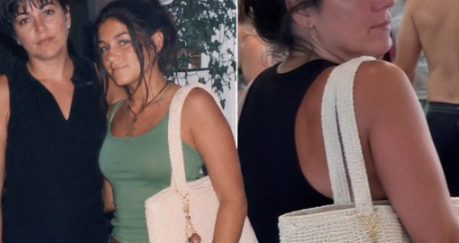
My daughter walked out of our house at 17, and I haven’t seen her since.
The last thing I ever said to her was, “Then go. See how far you get.”
For years, I hated myself for those words.
I hated the way they sounded whenever I replayed that moment in my mind.
Cold.
Proud.
Final.
It was the sort of sentence a mother says when she expects her teenage daughter to come back twenty minutes later with tears in her eyes and an apology waiting.
I expected Gia to come back.
That was the problem.
She didn’t.
She was standing in the doorway that afternoon holding the beach bag I’d knitted for her that spring.
It was cream-colored.
One of the handles was crooked because I’d never been particularly good at knitting, but I had finished it anyway.
Gia had laughed when I gave it to her.
“It looks homemade,” she’d said.
“It is homemade.”
“I mean really homemade.”
She had grinned when she said it, and I had tossed a dish towel at her.
After that, she used the bag constantly.
Her little brass keychain hung from the strap, the same keychain she’d had since she was six. By then, it was scratched and dull. She had moved it from her backpack to her purse and eventually to that beach bag, and I never understood why she kept it.
Maybe children hold on to things for reasons they can’t explain.
Maybe mothers do too.
That afternoon, Gia stood in the doorway with one hand wrapped around that crooked handle.
She said, “Fine.”
She didn’t slam the door.
That’s the part I think about most.
If she had slammed it, maybe I could have remembered her as furious.
Maybe I could have told myself anger carried her away.
But she didn’t.
She simply walked out.
That was July 12th.
She was wearing a green tank top I’d told her was too small, which was how the whole argument had started.
It embarrasses me now when I think about it, considering everything that followed.
At the time, I thought I was being a mother.
Gia thought I was controlling her.
We had been circling the same arguments all summer.
Her clothes.
Her curfew.
Her friends.
The way she spoke to me.
The way I spoke to her.
At seventeen, Gia could turn almost any sentence into a challenge.
At forty-one, I could turn almost any challenge into a lecture.
That afternoon, I told her she wasn’t leaving the house dressed like that.
She stared at me as if I’d just announced that I owned her.
“It’s a tank top, Mom.”
“It’s too small.”
“It’s mine.”
“That’s not the point.”
“Then what is the point?”
I wish I had answered differently.
I wish I had looked past the shirt and simply seen my daughter standing in front of me.
Instead, we pushed harder.
Every sentence became sharper.
Then she grabbed the beach bag from the chair.
I thought she was bluffing.
She thought I was bluffing too.
“Then go. See how far you get.”
She looked at me.
“Fine.”
And she left.
By sunset, I was irritated.
By midnight, I was scared.
By morning, fear had become something physical.
It sat inside my chest and refused to move.
I called her friends.
I called their parents.
I drove streets I’d driven a thousand times before, and suddenly I saw every ditch, parking lot, and side road differently.
When the police arrived, I gave them everything.
Her height.
Her clothes.
The bag.
The green tank top.
The brass keychain.
I repeated those details until they stopped sounding like facts about my daughter and started sounding like facts about somebody else’s child.
For months, I jumped whenever the phone rang.
For years, I studied girls in grocery stores.
A certain walk could stop me in the middle of an aisle.
A laugh could make my hands shake.
Dark hair seen from behind could ruin an entire afternoon.
I kept her toothbrush in the cup for nine years.
At first, removing it felt like admitting something.