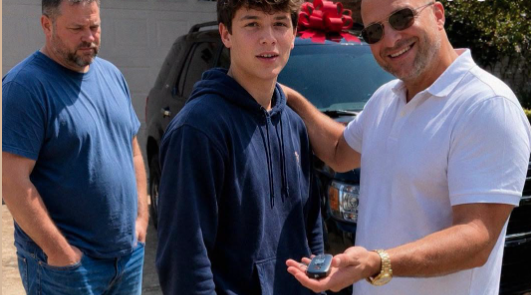
My biological father came back on my 17th birthday determined to prove that he could give me more than the man who had actually raised me.
He arrived in our driveway with an expensive car, a huge red bow, and a set of keys in his hand.
He thought that one spectacular gift could somehow make up for fourteen years of silence.
He was wrong.
“Come on, son. Your stepdad could never compete with this.”
Then he held out the keys and waited for me to thank him.
Instead, I went back inside.
And when I came back out, I was carrying something that made the entire driveway go quiet.
I hadn’t seen my biological father in fourteen years.
He left when I was three years old.
For most of my childhood, it was just Mom and me.
We didn’t talk about money very often, but somehow money was always present in our house. It was in the decisions we made, the things we didn’t buy, and the little sacrifices Mom tried to hide from me.
I knew the electric bill was late because Mom suddenly stopped buying coffee.
I knew that if I got a new pair of sneakers, we probably weren’t ordering pizza that month.
I learned early that asking for something didn’t necessarily mean I would get it. More importantly, I learned how to stop asking before Mom had to look at me and say no.
By the time I was thirteen, I had become very good at pretending I didn’t want things.
I understood what things cost.
And I understood what my mother could afford.
Then, when I was fifteen, Mom met Ray.
Ray came with two children of his own.
Danny was eleven, and Cara was nine.
They stayed with us every other weekend, which meant our little house suddenly had five people inside it, three backpacks piled by the door, and approximately nine thousand dirty cups scattered around the kitchen.
Ray paid child support.
Mom still worked overtime.
Nothing about our financial situation magically changed just because Ray came into our lives.
We still had to be careful.
We still counted.
But Ray never once made me feel as though I were another mouth to feed or another expense the family had to carry.
That was one of the first things I noticed about him.
He never made me feel like a burden.
He came to my football games.
Every single one.
Even during the season when I barely left the bench.
I remember one game especially well.
I had played for maybe four minutes.
Afterward, I found Ray standing beside the fence.
I walked over to him.
“You know I didn’t really play, right?”
“I saw.”
“You sat there for two hours.”
“Yeah.”
“Why?”
He looked genuinely confused by the question.
“Because you were here.”
That was Ray.
He didn’t make speeches.
He didn’t make promises he couldn’t keep.
He simply showed up.
Again and again.
When I was struggling in chemistry and nearly failed the class, Ray sat beside me at the kitchen table until almost midnight.
The funny part was that he understood the periodic table even less than I did.
At one point, I threw my pencil down.
“You’re literally making this worse.”
“Probably.”
“Then why are you still here?”
He shrugged.
“Because parents don’t get to quit before their kids do.”
Parents.
He didn’t even seem to realize what he’d just called himself.
I did.
I remembered those words.
A few months later, Mom married him.
That fall, she told me something I wasn’t supposed to know.
She and Ray had opened a college savings account for me.
“We can’t put much in,” Mom warned me. “So don’t get excited.”
“How much?”
“Whatever’s left.”
Sometimes, what was left was almost nothing.
Ray had Danny and Cara to provide for, too.
There were bills.
There were groceries.
There were repairs.
There were all the ordinary expenses that came with raising a family.
So I tried not to think about the college account.
At school, everyone seemed to be thinking about something completely different.
Cars.
One of my friends got his aunt’s old Honda.
Another got a pickup truck.
A girl in my English class got a used convertible and spent half the week complaining that it wasn’t the color she wanted.
I took the bus.
Honestly, it didn’t bother me much.
When you’ve grown up knowing exactly what things cost, you become surprisingly good at not wanting them.
Then I turned seventeen.
That morning, at seven o’clock, someone knocked on my bedroom door.
“You’re up,” Ray said.
“You woke me.”
“Same thing.”
He was holding a rectangular wooden box.
It wasn’t perfect.
One corner was slightly higher than the others. There was a small mark near the latch where he’d obviously made a mistake and sanded it down.
But the wood was dark and smooth.
And burned into the lid were my initials.
J.M.
I stared at it.
“You made this?”
“In the garage.”
“That’s what you’ve been doing out there?”
“For about six weeks.”
I opened the lid.
Inside was a stack of bank statements tied together with a piece of string.
My college account.
I looked up at him.
“Mom told me about this.”
“Your mother has never successfully kept a secret.”
I smiled.
Then I noticed something written on the back of the top statement.
