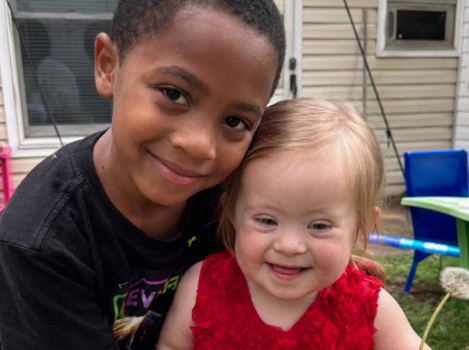
The first time my eight-year-old son Noah saw the red dress, he stopped so suddenly that I nearly walked straight into him.
“Mom.”
He was pointing toward a tiny dress hanging in the window of a little shop down the street.
It was bright red, with a full skirt and a small bow tied neatly around the waist.
I looked at the dress, then at my son.
“Yes?”
He kept staring at it.
“Lucy needs that.”
I smiled.
“Needs?”
Noah thought about the word for a moment.
“Okay,” he admitted. “Wants.”
I laughed.
“She hasn’t even seen it.”
He gave me the most serious expression an eight-year-old can make.
“She’d like it, Mom.”
“How do you know?”
He looked at me as if I had just asked the most obvious question in the world.
“Because she’d look like a princess.”
And that was Noah.
He had always been the kind of child who noticed things adults often overlooked.
Especially when it came to Lucy.
Lucy lived next door with her mother, Hannah. She was almost two years old and had Down syndrome.
From the time Lucy was old enough to recognize Noah walking through the gate, she had adored him.
He brought her dandelions.
He drew terrible pictures of dogs for her.
He made ridiculous noises just to make her laugh.
And Lucy always laughed.
Her laugh could turn an ordinary afternoon into something warmer.
Hannah was raising her alone, and I knew money was tight.
A few weeks before Lucy’s second birthday, Hannah and I were sitting outside drinking coffee while Lucy stacked plastic cups on the patio.
“I don’t think I’m really doing a party this year,” Hannah admitted.
She glanced toward Lucy.
“Just cake at home. Maybe some balloons.”
I knew what she meant before she finished.
“We’ve had extra appointments lately,” she continued. “Everything costs something.”
I nodded.
There was nothing judgmental in her voice. Just exhaustion.
Later that day, Noah asked me why Lucy wasn’t having a “real birthday.”
I tried to explain it in the simplest way I could.
“Hannah has other things she needs to pay for right now, sweetie.”
Noah looked toward the house next door.
“Like helping Lucy learn stuff?”
“Exactly.”
He nodded once.
Then he went quiet.
I didn’t think much of it.
I should have.
Over the next three weeks, Noah became strangely careful with money.
The first time I offered him five dollars for an after-school snack, he pushed it back toward me.
“I’m good, Mom.”
That immediately caught my attention.
Noah had never once in his life been “good” when French fries were available.
“You sure?”
He nodded.
I tried again.
“Want an extra dollar for later?”
This time he grinned when I handed it to him.
Then he started asking his dad whether there were small jobs he could do around the house.
One afternoon, he asked Cyril if he could rake leaves for money.
“You live here,” my husband reminded him.
“I know, Dad.”
Cyril looked at me.
“I respect the confidence.”
Soon Noah was knocking on Mrs. Reynolds’ door, asking whether she needed leaves collected.
Then he asked another neighbor.
And another.
He started keeping dollar bills in an old pencil case underneath his bed.
I assumed he was saving for a toy.
Maybe a new video game.
Maybe a bike accessory.
Something eight-year-olds normally save money for.
Then one afternoon, I found the lunch money.
Three crumpled bills sat on his dresser beside a school cafeteria receipt from several days earlier.
I stared at it.
That evening, after Noah finished his homework, I sat beside him.
“Noah, what did you eat for lunch today?”
He kept looking at his homework.
“School food.”
“What kind?”
Silence.
I waited.
“Noah.”
He finally looked up.