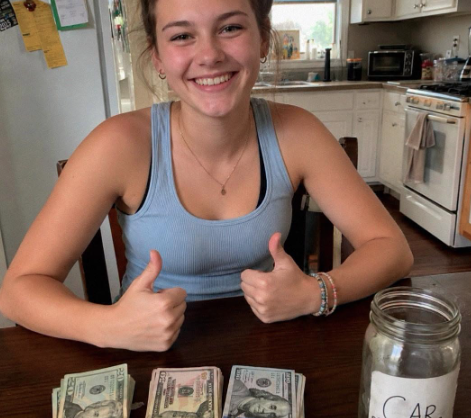
My sixteen-year-old daughter had spent almost the entire summer working for one thing.
Her first car.
For months, Lily had talked about nothing else. She had found a used car she loved, calculated how much she needed, and then worked nearly every day to reach her goal.
By the end of the summer, she had saved $4,086.
Every dollar had been earned.
Every dollar had been counted.
And every dollar had a purpose.
So when the morning finally arrived and we were supposed to go buy the car, I expected Lily to be practically bouncing off the walls.
Instead, she walked into the kitchen looking like she’d barely slept.
She wouldn’t even touch the keys.
Then she told me her money was gone.
All $4,086 of it.
And when she finally told me where it had gone, I couldn’t decide what shocked me more: what she’d done, or who had inspired her to do it.
The morning had started quietly.
I was sitting at the kitchen table with a cup of coffee when I found something I hadn’t seen in years.
An old metal keychain.
It made a soft clinking sound against my coffee mug when I set it down.
The keychain had belonged to Michael, Lily’s dad.
It had been buried for four years in the back of our junk drawer beneath dead batteries, takeout menus, old receipts, and three pens that hadn’t worked in years.
A small rectangular metal tag was attached to it.
One word was stamped across the front.
HOME.
Michael had carried that keychain until the day he died.
That Saturday morning, I cleaned it with a dish towel and placed the empty ring beside my coffee.
By lunchtime, if everything went according to plan, Lily’s first car key would be hanging from it.
I smiled at the thought.
Then I heard her bedroom door upstairs.
“Ready?” I called.
No answer.
I picked up the keychain and jingled it.
“Lily, if you make us late, that car is going to find another family.”
Her voice came from the hallway.
“Mom?”
Something about the way she said it made me lower the keychain.
She walked into the kitchen wearing jeans and an old café T-shirt.
But something was wrong.
She wasn’t carrying her purse.
Her hair hadn’t been brushed.
And she wasn’t looking at the car listing I’d printed and left on the table.
She sat across from me and rubbed her thumb along the edge of the table.
“What’s wrong, sweetheart?”
She didn’t answer immediately.
Then she whispered, “We can’t go.”
I thought she meant the seller had canceled.
“What happened?”
“I don’t have the money anymore.”
For a second, I simply stared at her.
“What money?”
She finally looked up.
“My car money.”
I laughed once because my brain couldn’t make sense of what she was saying.
“You have four thousand and eighty-six dollars.”
“Had.”
That single word wiped the smile off my face.
“Lily…”
“I’m sorry, Mom.”
“Where is it?”
I pulled out the chair beside her and sat down.
“Did somebody get into your account?”
“No.”
“Did you buy something?”
She shook her head.
“Did someone ask you for money online?”
“No, Mom.”
“Then where did four thousand dollars go?”
Lily blinked quickly.
“I gave it away.”
I leaned back in my chair.
For a moment, neither of us spoke.
All summer, I’d watched my daughter work for that money.
While her friends spent Saturdays at the lake, Lily carried plates of pancakes to families who somehow managed to leave syrup in places syrup had no business being.
She came home smelling like coffee and fryer oil.
She counted her tips at this very kitchen table.
She turned down movie nights because she had the breakfast shift.
Once, after an eleven-hour Saturday, she collapsed onto the couch and said, “If I ever own a restaurant, chairs will be illegal.”
She wanted that car badly.
This wasn’t some passing teenage obsession.
The car represented freedom.
It meant she could drive herself to school.
She could get to her part-time job without borrowing my car.
She could stop asking friends for rides.
And although she rarely talked about it directly, driving was also one of those milestones that carried a little piece of Michael’s absence with it.
When Lily was nine, Michael had once let her sit behind the wheel of his parked truck.
“I’m teaching her early,” he’d announced.
I’d nearly dropped the grocery bags.
“You absolutely are not.”
Lily had grinned.
“Dad said yes.”
Michael immediately raised both hands.
“Dad has reconsidered.”
She still told that story.
Now, the money she’d spent three months earning was gone.
“All of it?” I asked.
Lily nodded.
“Four thousand dollars?”
Another nod.
I kept my voice low.
I knew if I shouted, she might stop talking.
“Who did you give it to?”
Lily wiped at one eye.
“Mom, I need you to understand something first.”
“No. I need a name first, Lily.”
“It’s not one name, Mom.”
I stared at her.
“What?”
She hesitated.
“Seventeen names.”
I honestly thought I’d heard her wrong.
“Seventeen people?”
“Yeah.”
“What people?”
Lily stood up.
“Come with me.”
“Lily, I’m not going anywhere until you explain what happened.”
She turned toward the counter, grabbed her café hoodie, and pulled it on.
“Please.”
I looked at the empty key ring beside my coffee.
Then I looked back at my daughter.
Something told me this wasn’t going to be a simple conversation.
Twenty minutes later, we were walking toward the café where she’d worked all summer.
Neither of us said much.
I had too many possibilities running through my head, and every one of them irritated me more than the last.
Had her coworkers pressured her?
Had some adult discovered she had savings?
Had Lily decided that being generous meant giving money to anyone with a sad enough story?
She was sixteen.
Kindness at that age could be enormous.
It could also be reckless.
When we reached the café, Mrs. Patel was unlocking the front door.
She had owned the place for almost twenty years and had hired Lily in June.
She looked at me.
Then she looked at Lily.
Her smile disappeared.
“You told her?”
Lily nodded.
I stopped walking.
“You knew?”
Mrs. Patel slowly pushed the door open.
“Come inside, Rachel.”
“You knew?”
The question came out sharper than I intended.
Mrs. Patel sighed.
“I know how this looks.”
“That sentence isn’t helping.”
“I know.”
The café wasn’t open yet.
Chairs were still upside down on tables.
The pastry case was empty.
Mrs. Patel led us past the counter and into the cramped office where Lily usually disappeared after her shifts to count her tips.
She opened a metal cabinet.
“Before you get angry with me,” she said, “I didn’t know how far she was going with this until fairly recently.”
I folded my arms.
“I didn’t know how far she was going with this until fairly recently,” she repeated.
She reached behind a box of receipt rolls.
Then she pulled out an old index card.
It wasn’t impressive.
The edges were bent.
One corner was stained with coffee.
Written across the front in blue and black ink were sixteen first names, each accompanied by dates.
And next to several names was a single word.
FRIDAY.
I took the card from her.
Then I saw the handwriting.
Michael’s handwriting.
I knew it instantly.
My thumb moved slowly across the letters.
“No.”
Mrs. Patel said nothing.
I looked at Lily.
“Where did you get this?”
“I found it in July, Mom.”
“What is it?”
Mrs. Patel pulled out the desk chair.
“Sit down.”
I didn’t.
She sighed.
“Your husband used to come here a lot.”
“I know that.”
Michael had loved diner coffee more than any reasonable person should.
He used to insist coffee tasted better in thick white mugs.
I always told him that was nonsense.
He called me uncultured.
But I’d never known Mrs. Patel knew him as anything more than a regular customer.
She tapped the top of the card.
“Do you remember George?”
“No.”
“The first name.”
She pointed to it.
GEORGE.
“About seven years ago, Michael came in early one morning. He noticed a man washing his face in the restroom.”
“George?”
Mrs. Patel nodded.
“George had been sleeping in his car.”
Lily sat silently beside me.
“He had a job interview that morning,” Mrs. Patel continued. “Michael saw him trying to straighten a shirt that looked like he’d slept in it.”