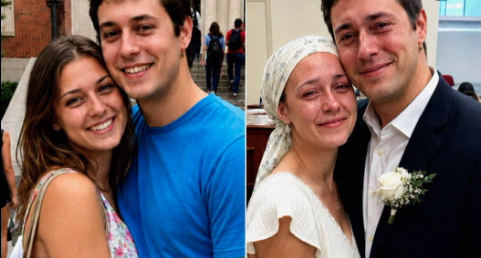
Ten years after the woman I loved disappeared without a trace, she suddenly appeared on my doorstep.
She was sick, frightened, and running out of time.
And she had one final request for me.
At first, I thought her return might finally give me the closure I had spent years chasing. I had spent a decade wondering where she had gone, why she had left, and whether there had ever been something I could have said or done differently.
Instead, the truth she left behind forced me to question almost everything I thought I knew about the woman I had loved.
I met Cara during my first week of college.
It happened in an overcrowded sociology lecture where there were barely enough seats for everyone. I arrived late, carrying my notebook, only to discover that the seat I had been planning to take was already occupied.
By her.
Cara looked up at me as though I were the one who had made the mistake.
She glanced at my notebook, smiled, and said, “You can sit beside me, but only if your handwriting is useful.”
I sat down.
I didn’t know it then, but I had fallen in love with her before that lecture was even over.
For three years, we became the couple everyone loved to roll their eyes at.
We studied together.
We cooked terrible pasta.
We spent Sunday mornings arguing over crossword clues, each of us absolutely convinced the other was wrong.
Cara dreamed of owning an old house with green shutters.
I dreamed of finding a job that would allow me to travel.
At the time, neither of us questioned whether those dreams could coexist.
Of course they could, we thought.
We were young.
We were in love.
We believed the future would simply make room for everything we wanted.
Then one night, we had an argument that seemed insignificant to me.
It was about everything and nothing at the same time.
I had just been accepted into graduate school. My mind was filled with possibilities—research, Europe, another degree, new places, new experiences.
Cara wanted to know what came after all of that.
She stood beside the kitchen sink, gripping a dish towel in both hands.
“When do you picture us having children?” she asked.
I laughed nervously.
“Not for years,” I said. “There’s too much I want to do first.”
I thought it was a normal conversation about timing.
She didn’t.
I accused her of turning one conversation into a deadline.
Cara became quiet.
She told me I never listened.
I told her she was making something simple into something complicated.
Neither of us apologized.
The next morning, her side of the closet was empty.
At first, I assumed she had gone to her mother’s house to cool down.
Then her phone stopped working before lunch.
By evening, every account she owned had disappeared.
I called her friends.
I called her mother.
I contacted old professors.
No one knew where she had gone.
Or, at least, no one admitted that they did.
Cara had vanished from my life so completely that it felt as though someone had erased her.
And I searched for her.
For ten years.
Not every day.
But often enough.
Often enough to interfere with every good thing that came afterward.
I dated kind women, but sometimes caught myself comparing their laughter to Cara’s.