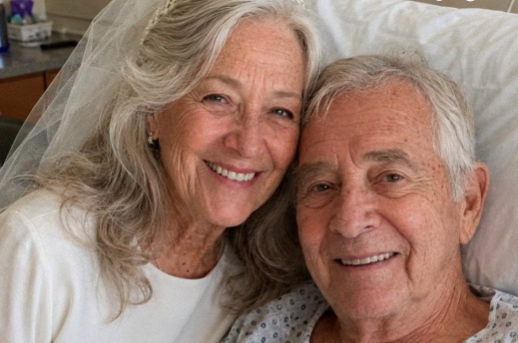
I thought saying goodbye to the love of my life would be the hardest thing I would ever have to do.
I was wrong.
The hardest part came afterward, when the lawyer who had stood beside us on our wedding day knocked on my apartment door and told me that the marriage I had believed was simply a dying man’s final wish had been something much more.
It had been a trap.
But I wasn’t the one it was designed to catch.
The rain tapped softly against the living room window of my little rented apartment as I sat at the kitchen table, slowly stirring a cup of instant coffee I could barely afford.
At 73 years old, I had returned to the town I had left when I was seventeen.
The streets had changed. Storefronts had been rebuilt. Old houses had disappeared beneath new paint and new owners. Yet somehow, every corner still seemed to recognize me.
It was a strange thing about coming home.
Nothing looked the same.
But everything felt the same.
My pension hadn’t stretched far enough to cover the cost of living, so I had pinned my old nursing badge onto a fresh uniform and gone back to work at the local hospital. It was the same work I had spent most of my life doing before retirement.
Apparently, retirement was a luxury I could no longer afford.
I had never married.
I had never had children.
There had been dates over the years. There had been a few kind men who made me laugh and treated me well. There had even been moments when I thought perhaps one of them could become something more.
But none of them ever became Thomas.
Thomas.
I hadn’t said his name out loud in more than fifty years.
He had been my first love.
We were both seventeen when we met, young enough to believe that love automatically meant forever and that saying the word “forever” was enough to make it true.
I had dreams of college and a life beyond our little town.
Thomas had chosen a different path. He stayed home and went to work in his father’s business.
When the day came for me to leave, he stood with me at the bus station, trying desperately to hide how scared he was.
“Please don’t go, Nancy,” he begged.
I remember looking at him through tears.
“I have to, babe. I’ve worked too hard for this.”
His face fell.
“Then you’re breaking my heart.”
The bus came.
I climbed aboard.
And that was the last time I saw Thomas.
Or at least, I thought it was.
For fifty-six years, I believed that chapter of my life had ended at that bus station.
I had no idea it had only been waiting.
The phone ringing in my apartment pulled me back into the present.
I already knew who it was before I answered.
“Nancy, honey, it’s Raymond. Just checking in on my favorite cousin.”
Favorite cousin.
That phrase almost made me laugh.
Raymond and I had barely spoken in thirty years.
But ever since I moved back, he had started calling almost every week. He was always cheerful. Always friendly.
And always asking questions.
“How’s the apartment treating you?” he asked. “Rent’s a killer at our age, isn’t it?”
“I’m managing, Raymond.”
“You got everything squared away? Paperwork, will, that sort of thing?”
I said nothing.
“A woman living alone needs to be careful,” he continued.
“I’m fine, dear. Really.”
“You know, I used to visit Aunt Margaret every week before she passed. Helped her with all her affairs. Family should look after each other, don’t you think?”
Something about the way he said it made my coffee suddenly taste bitter.
I couldn’t explain why.
“That’s kind of you, Raymond, but I have to run. My shift starts soon.”
I hung up before he could continue.
At the time, I told myself I was simply being impatient.
Looking back, I realize I had been uncomfortable for a reason.
The hospital smelled exactly the way hospitals always smell.
Disinfectant.
Coffee.
And quiet human worry.
I pushed my cart down the hallway, checking room numbers as I went. I was already tired, and it wasn’t even ten in the morning.
Room 220.
New admission.
Long-term care.
I knocked once and stepped inside.
I opened the chart the way I had opened thousands of charts throughout my nursing career.
My eyes moved across the page.
Then they stopped.
Thomas.
I stared at the last name beneath it.
My mouth went dry.
It couldn’t be.
There had to be thousands of men named Thomas in the state.
Thousands of coincidences.
I told myself that as I looked toward the bed.
Then I saw him.
Fifty-six years disappeared in a single second.
Thomas was thinner than I remembered. His skin was pale, his face hollowed by the illness consuming his body.
But his eyes.
Those eyes were exactly the same.
They were the same eyes that had looked at me at seventeen and begged me not to get on that bus.
He smiled.
It was the smile of a man who had been waiting a very long time.
“Hello, Nancy,” he said softly.
I couldn’t speak.
I stood there with a blood pressure cuff in my hand, staring at the boy I had loved and the old man he had become.
It felt as if my entire life had suddenly been placed inside one hospital room.
“Thomas,” I finally whispered.
My voice broke.
“My goodness. Thomas.”
From that moment on, I found reasons to check on him during every shift.
Sometimes I had legitimate reasons.
Sometimes I didn’t.
I simply wanted to see him.
We talked about everything and nothing.
We laughed about our gray hair, our aching knees, and how neither of us could remember where we had left our glasses half the time.
Sometimes we talked for an hour.
Other times, we simply sat together in silence.
There was a comfort in that silence I had never found with anyone else.
One afternoon, he looked at my coffee and smiled.
“You still take it black?”
I raised an eyebrow.
“Still do.”
“I knew it.”
I laughed.
There was something strangely peaceful about Thomas.
Most patients in his condition were frightened, angry, or overwhelmed by what was coming.
Thomas seemed different.
He was almost calm.
Like a man who had been holding his breath for decades and had finally decided it was safe to breathe again.
One morning, while I was adjusting his blanket, he asked me something that seemed almost casual.