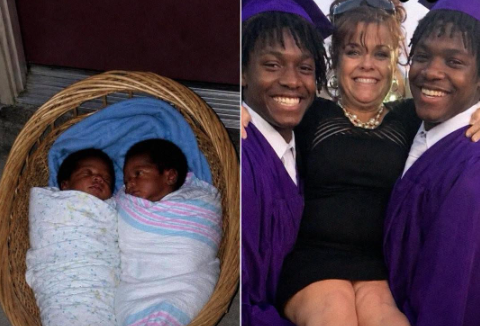
I thought I knew every chapter of my sons’ lives because I’d been there for nearly all of them.
I remembered their first steps, their first words, their scraped knees, their school plays, their teenage arguments, their birthdays, their graduations, and the quiet moments in between.
I had watched them grow from two tiny babies into the young men sitting across from me at my dining table that Friday night.
I thought I knew our story.
Then they brought something from our past to that table, and suddenly, the story I’d spent twenty years believing began to unravel.
The basket sat between us as if it had somehow fallen through time.
Woven wicker.
One broken reed near the handle.
The same faded blue lining I hadn’t touched in twenty years.
My grown sons watched me from across the table, their dinner plates barely touched.
I couldn’t move my hands.
“Mom?”
Caleb’s voice sounded strangely distant.
I was in my early fifties, but for one terrifying moment, I felt thirty-two again.
Barefoot.
Standing on a porch.
Staring down at two tiny faces I’d never seen before.
And suddenly, I remembered everything.
The Life I Thought I Had Lost
The official diagnosis came on a Monday.
I remember because Ben and I had tickets to a concert that Friday.
I’d been looking forward to it.
Instead, I spent the drive home wondering whether we should still go.
We didn’t.
A few weeks later, my husband stood in our home with a duffel bag already at his feet.
He wouldn’t look at me.
“Kim, don’t make this harder.”
I stared at him.
“You can’t give me the family I want,” he muttered.
I felt as though the air had been knocked out of me.
“So that’s it?”
He didn’t answer immediately.
“Harder for whom?” I asked. “You knew infertility was a possibility. I mean, look at me.”
He left before I could finish the thought.
Before I could even finish the question I was asking myself.
I was thirty-one years old.
And suddenly, the future I thought I’d been building had disappeared.
That same night, Raymond showed up with two pizzas.
I hadn’t called him.
I hadn’t called anyone.
But somehow, there he was on my porch in his beat-up jacket, looking at me the way he’d looked at me since college.
As if I were still worth showing up for.
He took one look at my face.
“What’s wrong, Kimberley? Where’s Ben?”
I broke.
“Raymond, Ben left.”
My voice shook.
“I couldn’t give him children because of my dwarfism.”
Then I cried.
Raymond didn’t try to give me some perfect speech.
He didn’t tell me everything would work out.
He simply stayed.
He boxed up my husband’s records while I sat on the kitchen floor eating cold pizza.
Neither of us mentioned the word “divorce” until sunrise.
I was thirty-one.
A Quiet Year
That’s how my life went for the year that followed.
Quietly.
I built a small life around the pieces I had left.
I took a graphic design job I could run from my dining room.
I learned how to enjoy ordinary mornings.
I learned how to come home to an empty house without feeling like the emptiness was swallowing me.
Every Sunday, Raymond and I had coffee at the same diner.
The waitress, Denise, eventually stopped asking whether we were together after we’d said no enough times.
One Sunday, I stirred my tea and looked across the table at him.
“Why don’t you date, Ray?”
He raised an eyebrow.
“You’re not hideous.”
“High praise.”
“I’m serious. You’d be a catch for somebody.”
He gave that slow, easy shrug of his.
“I’m picky, Kim.”
“How picky?”
“Ruinously.”
I laughed.
And I let him be.
At the time, I didn’t understand what I was looking at.
Looking back, the signs were everywhere.
Raymond remembered the anniversary of my diagnosis.
He always found some reason to be around that week.
He remembered the boys’ birthdays years before I knew what those birthdays would mean to our family.
The year Caleb broke his wrist at hockey camp, Raymond drove three hours through a snowstorm to be there.
I called it friendship.
I called it luck.
I called it anything except what it was.
Because thinking too hard about Raymond felt disloyal to the version of my life I’d worked so hard to accept.
Then the boys grew up.
They moved out.
The house became quiet again.
And I told myself I was fine with that, too.
Then came that Friday.