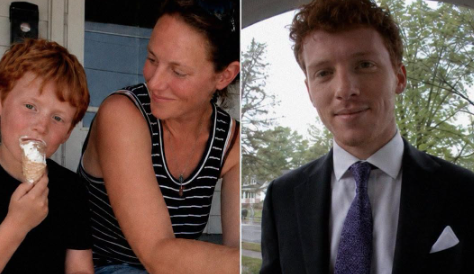
I never had children of my own.
Maybe that’s why, when I first noticed the skinny little boy sitting alone across the street from my house, I couldn’t simply look away.
It was late October, and the wind had already turned bitter. The trees were shedding their final leaves, and the neighborhood had that quiet, gray feeling that comes before winter.
The boy sat on the front steps of his house with his knees pulled tightly against his chest.
His jacket looked at least two sizes too small.
I watched him from my kitchen window for several minutes.
Then I made a mug of hot tea, crossed the street, and stopped in front of him.
“Would you like to come inside for a while?” I asked. “You look freezing.”
He looked up at me.
He studied my face carefully, almost as though someone had taught him that kindness should never be trusted too quickly.
Finally, he nodded.
“Tea would be nice,” he said quietly.
Then he hesitated.
“And maybe… if you have any cookies.”
I smiled.
“I think I can manage that.”
That was how I met eight-year-old Dylan.
At the time, I didn’t know that this quiet little boy would become one of the most important people in my life.
I didn’t know I’d feed him almost every day for the next ten years.
And I certainly didn’t know that, two decades later, he would return to my porch carrying a black box that would force me to question everything I thought I knew about the people closest to me.
Dylan’s parents weren’t the sort of people social services would immediately investigate.
Their house was clean.
Their bills were paid.
There were no bruises anyone could see.
From the outside, they looked like an ordinary family.
But they were impossibly strict.
Dylan wasn’t allowed candy.
Or pizza.
Or birthday cake.
His lunches consisted mostly of vegetables, homemade grain patties, and unsweetened fruit.
His mother proudly called it “building discipline.”
I called it making childhood unnecessarily difficult.
The first time I offered Dylan a chocolate chip cookie, he stared at it as though I’d handed him something priceless.
“Are you sure?” he whispered.
“It’s just a cookie.”
He looked down at it.
“It smells amazing.”
Then he took the smallest bite imaginable.
After that, he started stopping by whenever he saw me outside gardening.
Sometimes I’d make grilled cheese sandwiches.
Sometimes we’d bake brownies.
Other days, we’d simply sit at my kitchen table and talk while he drank hot chocolate that his parents probably would have considered a crime.
He never asked for much.
Mostly, he just wanted someone to listen.
And I was happy to listen.
As the years passed, Dylan slowly became part of our daily routine.
He would see me struggling with grocery bags and appear without being asked.
He raked leaves every autumn.
He shoveled snow every winter.
Once he got tall enough, he started changing lightbulbs for me.
Whenever I tried to pay him, he’d grin.
“You already paid me.”
“With what?”
“Pizza.”
I laughed every single time.
Somewhere along the way, he became the son I’d never had.
My husband, Richard, never completely understood our relationship.
“You’re getting too attached,” he’d say from his recliner.
“He needs someone.”
“He has parents.”
“They barely speak to him.”
“They feed him.”
“They feed him kale.”
Richard would roll his eyes.
“You know what I mean.”
He wasn’t cruel.
He was simply skeptical.
Richard believed people should solve their own problems.
I believed neighbors existed for a reason.
And I believed Dylan needed someone who would make him feel like he mattered.
One afternoon, Dylan wandered into our garage while I was looking for Christmas decorations.
“Need help?” he asked.
“If you don’t mind.”
He climbed onto a ladder before I could stop him.
“You keep everything,” he laughed.
“I call it being organized.”
“I call it having a museum.”
He reached toward a dusty storage bin.
That’s when Richard appeared in the doorway.
His expression changed immediately.
“Dylan.”
The boy climbed down.
“Sorry. Mrs. Holland asked me to help.”
“I’ll handle it.”
“It’s okay,” I said. “We’re almost finished.”
“I said I’ll handle it.”
The room suddenly felt much colder.
Dylan stepped away from the shelves.
“Sorry.”
Then he left.
I frowned at my husband.
“What was that about?”
“I don’t like people digging through my things.”
“He wasn’t digging.”
“That boy notices everything.”
I laughed.
“He’s curious. That’s what kids do.”
Richard shook his head.
“Sometimes curiosity gets people into trouble.”
The conversation stayed with me longer than I realized.
A week later, Dylan came over again while I was organizing boxes in the garage.
He pointed toward a small metal lockbox tucked behind a stack of old paint cans.