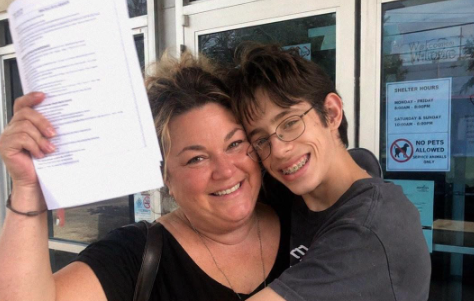
Everyone warned me not to adopt Luke.
He was sixteen years old and had already been through ten different placements. Ten homes. Ten families who had, for one reason or another, eventually given up.
People looked at his history and saw a difficult teenager.
I saw a boy who had been moved from one place to another so many times that I wondered whether he had ever truly believed a home could be permanent.
But two weeks after his adoption became final, Luke sat across from me at the dinner table, barely touching his food. His hands began to shake.
Then he looked at me with tears filling his eyes and said six words that nearly made me faint.
“Mom, I need to tell you something.”
Three years earlier, I had buried both of my children.
My daughter, Grace, and my son, Noah, were killed in a car accident.
For months after their deaths, I couldn’t bring myself to open their bedroom doors.
Every morning, I would walk past those doors and feel as if the entire world had stopped behind them.
Eventually, I started leaving the doors open.
I don’t know why.
Maybe closed doors felt like I was accepting that they were truly gone.
Maybe seeing their rooms was painful, but not seeing them was somehow worse.
Grace had left a sweatshirt hanging over the back of her desk chair.
Noah had three library books stacked beside his bed.
I couldn’t move any of it.
People kept telling me that grief would change.
Maybe, they said, one day it would become easier.
Technically, they were right.
It changed.
It went from something that crushed me every morning into something I learned to carry quietly, without anyone noticing how heavy it still was.
But the house stayed silent.
And eventually, that silence became unbearable.
That was why, one rainy Tuesday afternoon, I walked into a foster care agency and told a woman named Denise that I wanted to talk about becoming a parent again.
Denise didn’t smile immediately.
Instead, she looked at me carefully.
“I’m going to ask you something difficult,” she said. “Are you trying to replace your children?”
“No.”
“Are you sure?”
“I don’t think anyone could replace them.”
She studied me for a moment.
Then she nodded.
“Good answer.”
The process took months.
There were training sessions, interviews, background checks, home visits, paperwork, and conversations about childhood trauma that sometimes left me sitting in my car afterward, crying before I could drive home.
I learned that loving a child wasn’t enough.
You also had to understand what that child had survived.
You had to be prepared for fear, anger, distrust, silence, and behaviors that often made sense only after you understood where they came from.
Eventually, Denise invited me to an agency event where prospective parents could meet some of the children.
Most of the younger kids were playing.
There were toys scattered across the room, crayons on tables, and children talking over one another.
Then I noticed a teenage boy sitting alone beside a window.
He had a paperback open on his knees.
He wasn’t trying to get anyone’s attention.
He wasn’t talking.
He simply sat there reading.
A little girl nearby accidentally knocked over a box of crayons.
Several crayons rolled across the floor.
The boy immediately put his book down.
He crouched beside her and started gathering them.
One blue crayon had rolled underneath a table.
He crawled underneath it, reached as far as he could, and pulled it out.
Then he handed the crayon back to the little girl, returned to his chair, and opened his book again.
I nodded toward him.
“Who’s that?”
Denise followed my gaze.
The moment she realized which boy I was asking about, her expression changed.
“Luke.”
“How old is he?”
“Sixteen.”
“Can I meet him?”
She hesitated.
“You should know he’s had a lot of placements.”
“How many?”
“Ten.”
I stared at her.
“Was he violent?”
“No.”
“Did he hurt younger children?”
“No.”
“Drugs?”
“No.”
“Then what happened?”
Denise sighed.
“Different things. Luke is…complicated.”
I hated that word.
I had heard adults use words like that before.
Years earlier, after my husband died, Noah’s teachers had described him as “complicated” because he stopped talking in class.
What they really meant was that my grieving eleven-year-old had stopped behaving in a way that made their jobs easy.
I looked back at Luke.
“I’d still like to meet him.”
Denise nodded.
I walked over.
Luke glanced up from his book.
He looked at the only empty chair beside him and gestured toward it.
“Please, ma’am. You can sit here.”
I almost laughed.
“I’m forty-seven, not ninety.”
His mouth twitched.
“I wasn’t implying anything.”
“You absolutely were.”
That got a real smile out of him.
We started talking about the book in his hands.
One conversation turned into another, and before I realized it, nearly an hour had passed.
When I finally stood to leave, Denise stopped me.
“One good conversation doesn’t guarantee a placement.”
“I know.”
And I did.
So I came back.
Again and again.
Luke was guarded, but he was kind.
He had a dry sense of humor and an incredible memory. He remembered almost everything I told him.
For four months, Luke and I met at the agency, then at libraries, diners, parks, and supervised outings.
I kept waiting for the difficult teenager everyone had warned me about.