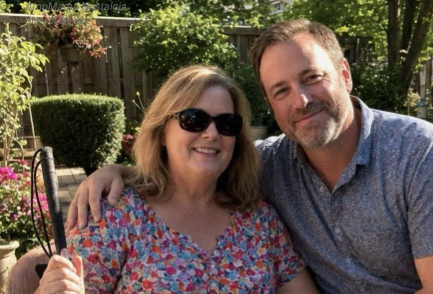
For years, I believed losing my eyesight had been the greatest tragedy of my life.
I was wrong.
Losing my eyesight changed the way I lived. It changed how I moved through my own home, how I depended on other people, and eventually, how I trusted the man I had married.
Looking back now, I realize the darkest part of those years had nothing to do with what I could or couldn’t see.
It had everything to do with what was being hidden from me.
The afternoon sun pressed warmly against the windows as I sat at the kitchen table, both hands wrapped around a mug of tea I could barely see.
Eleven years of marriage had shaped my routine down to the smallest detail.
I knew my house by sound.
The hum of the refrigerator.
The steady tick of the hallway clock.
The familiar low rumble of Brian’s car as he pulled into the driveway every evening.
I knew where every piece of furniture was because I had memorized the rooms long before my vision became almost useless.
I was 35 years old, and I hadn’t seen my own face clearly in nearly a decade.
I couldn’t quite see.
When Brian and I first married, my eyesight had been perfectly normal.
Then, about a year after our wedding, a rare eye disease began stealing it from me.
At first, it was easy to dismiss.
Distant signs became blurry.
Then people’s faces became harder to recognize.
Eventually, everything around me softened into pale shapes, shadows, and vague outlines.
By the fourth year, I carried a white cane.
By the sixth, I had stopped pretending I could manage unfamiliar places by myself.
The disease kept taking more.
And within a few years, I had lost almost all of my sight.
I could barely distinguish light from darkness or make out large shapes.
Brian took over almost everything.
He drove me wherever I needed to go.
He read the mail.
He handled anything that required good eyesight.
He became my guide through a world I could no longer clearly see.
“Don’t worry about the garage, honey,” Brian told me once, gently guiding me back toward the kitchen. “I’ll sort it out now that you’ve got your footing.”
The garage had gradually become a place I simply stopped thinking about.
It was filled with different machines and supplies related to my condition.
Brian also kept his tools, storage boxes, car supplies, and other things in there.
“I could at least help you organize it,” I offered one afternoon.
“Gina, please. There’s nothing in there for you. Let me take care of it. I’ll grab whatever you need.”
I noticed something in his voice whenever I mentioned that room.
A slight tightening.
A subtle change in his tone.
But I told myself it was protectiveness.
That’s what love looked like, I thought.
That’s what devotion sounded like.
My best friend, Marissa, didn’t completely agree.
One afternoon, she sat across from me at the kitchen table and studied me for a long moment.
“You’ve been shrinking, Gina.”
I frowned.
“What do you mean?”
“You used to argue with me about everything,” she said. “Now you wait for Brian to decide.”
“He’s been good to me, Issa.”
“I know he has.”
She paused.
“But have you looked into that clinical trial I sent you?”
“Brian says it’s a long shot. He doesn’t want me to get my hopes up.”
Marissa leaned back.
“You’ve been shrinking.”
I didn’t know how to answer that.
She was quiet for a moment before asking a question that stopped me cold.
“And what do you want?”
I didn’t answer.
I couldn’t.
Somewhere along the way, I had stopped asking myself that question.
For years, specialists had told me there was nothing they could do.
Then, a month earlier, Marissa told me about an experimental laser eye surgery being offered through a clinical program.
The doctors were very clear.
There were risks.
There were no guarantees.
It might not work.
Brian thought I was setting myself up for disappointment.
But for the first time in years, I wanted something badly enough to take the chance.
That night at dinner, I brought it up.
“Dr. Halim’s office called back about the laser program.”
Brian immediately put down his fork.
“Sweetheart, we talked about this.”
“I know. I just thought…”
“You’ll break your own heart,” he said.
There was that tightness in his voice again.
The same one I had noticed whenever the subject came up.
“I don’t want to watch you fall apart when it doesn’t work.”
I sighed.
“I’ve thought about it a lot.”
I took a breath.
“Marissa’s willing to help me through the recovery either way.”
“Marissa,” Brian repeated flatly.
“Of course.”
He didn’t argue again.
Instead, he changed the subject to the leftovers.
And I let him.
Arguing with Brian had never been something I was particularly good at.
A few days later, Brian left for another one of his week-long business trips.
He kissed my forehead before leaving and promised he’d call every night.
Then the front door closed.
The house became quiet.
And for the first time in a long time, I made a decision without waiting for Brian’s approval.
With Marissa’s help, I decided to take the chance.
The following afternoon, she arrived at my door carrying coffee and a letter from the clinic.
I could hear the excitement in her voice.
“You got in.”
“What?”
“You’ve been accepted into the trial!”
For a moment, I couldn’t speak.
My husband was away.
And I had just made one of the biggest decisions of my life on my own.
That night, I thought about the woman I’d been before the diagnosis.