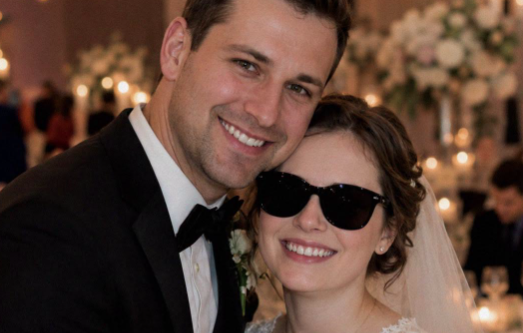
She was sitting alone.
Her white cane rested across her knees.
She looked impossibly small.
I hurried toward her.
“I came as fast as I could.”
She nodded.
Her fingers were cold when I took her hand.
“Have they told you anything?”
“Only that they took him in,” she said. “That was two hours ago.”
We waited.
The clock moved.
The minutes became hours.
Neither of us said much.
Around the fourth hour, I tried to break the silence.
“How are you holding up?”
She gave me a faint smile.
But it wasn’t the smile of someone who felt hopeful.
It was the smile of someone confirming something she had already feared.
Then she said quietly, “Alice, you’re a good sister.”
Something in her voice caught my attention.
She sounded like someone who had been preparing for this conversation long before that moment.
At hour ten, the surgeon finally appeared.
I knew before he spoke.
His shoulders told me.
His expression told me.
His hands, folded together too neatly, told me.
“We’re so sorry,” he said. “We did everything we could.”
My legs went numb.
I realized I was still standing only because I’d locked my knees.
I heard myself thank him.
I don’t know why.
Lily didn’t move.
I think she already knew.
I fumbled for my phone.
My eyes wouldn’t focus.
I tried to find Mom’s number.
Lily gently tugged at my sleeve.
“You were the one I had to tell first.”
I looked at her.
“Tell me what?”
“Alice, we need to talk.”
“Lily, not now. Please.”
“It has to be now.”
I could barely speak.
“He just…”
“I know.”
Her voice cracked.
Then steadied.
“I know. But Ed made me promise.”
She reached into her bag.
“Your family never knew why he married me.”
My chest went completely still.
“What?”
“He would have wanted you to know the truth.”
I stared at her.
“If this is about the house, or the accounts, or whatever Mom is going to come in here and start asking about, I don’t care. I don’t want any of it. That’s yours.”
“It isn’t about money.”
“Then what is it?”
Lily swallowed.
“It’s going to break your heart, Alice. But you have to hear it from me, not from a lawyer. Not from your mother’s version.”
She pulled out a thick envelope.
It was sealed.
There was wax pressed into the center.
She placed it in my hands.
“When you finish reading this,” she whispered, “you’ll understand why Ed spent the last eighteen months lying to everyone he loved.”
Before I could ask anything else, footsteps came rushing down the hallway.
My parents had arrived.
Mom’s eyes were red.
But the first thing she noticed was the envelope in Lily’s hand.
“What is that?”
“Mom, please,” I said. “Ed just died.”
“What is that?”
“It’s private,” Lily said.
“Nothing about my son is private from me.”
Dad put a hand on Mom’s arm.
He seemed as though he wanted to stop her.
But he didn’t.
Mom stepped closer.
“Whatever Ed left behind belongs with his real family.”
My stomach turned.
She continued.
“You can barely manage on your own, sweetheart. We would never abandon you, but the house, the accounts, those things need someone who can handle them.”
“Mom, stop.”
“I’m being kind, Alice. Someone has to think clearly. Ed would never want her drowning under bills and paperwork alone.”
Lily didn’t argue.
She simply held the envelope toward me.
“Read it before you decide anything.”
I looked at my father.
I expected him to say something.
Anything.
Instead, he lowered his eyes.
And that was when I understood.
This wasn’t grief speaking.
My parents had thought about this.
They had probably discussed it before Ed was even dead.
Maybe for months.
I took Lily’s arm and led her away.
We walked down the hallway and into the small hospital chapel.
The room was quiet.
Soft light came through the windows.
We sat on a wooden bench.
My hands were shaking so badly I could barely open the envelope.
“Tell me first,” I said.
“Say it out loud.”
Lily shook her head.
“If I tell you now, you’ll spend the rest of your life wondering whether I changed his words.”
I looked at the envelope.
Then I opened it.
The first date I saw stopped me cold.
Eighteen months ago.
My hands started trembling.
Inside were medical reports.
Specialist consultations.
Test results.
Medication records.
Legal documents.
Insurance policies.
Trust documents.
Property records.
Everything dated over the previous eighteen months.
My mind raced backward.
Easter.
The birthday dinner.
The doctor’s appointment.
Every time Ed had smiled and told me he was fine.
None of it had been true.
He hadn’t been pulling away from us.
He had been preparing.
And then I found his letter.
His handwriting covered the page.
He wrote about the day he received his diagnosis.
He wrote about his cardiologist.
He wrote about what he wanted to accomplish before he died.
And then I reached the line that made everything inside me collapse.
“I didn’t marry Lily because I was dying.”
I stopped breathing for a second.
The next sentence was even harder.
“I married her because I refused to let death decide what happened to her after I was gone.”
I lowered the letter.
Lily was crying silently.
Ed had spent eighteen months changing everything.
He had rewritten insurance policies.
He had restructured the trust.
He had changed beneficiaries.
He had arranged the property so Lily could never simply be pushed out of her home.
He had planned everything.
Not because he didn’t trust her.
Because he knew my parents would try to take control.
And suddenly, my mother’s behavior in the waiting room made perfect sense.
Ed knew.
He knew exactly what would happen.
He had known for eighteen months.
I folded the letter carefully.
Then I stood.
I walked back into the waiting room.
Mom was already on the phone.
“Has anyone found his papers yet?” she was asking. “His insurance? His will?”
She looked around the room.
“Someone has to make sure nothing gets lost.”
Then she saw me.
“We need a lawyer here tonight,” she said. “Lily can’t manage a house, let alone an estate.”
I looked at her.
“She manipulated him.”
I stepped between her and Lily.
“Put the phone down, Mom.”
She stared at me.
“You need to hear this.”
I read Ed’s final pages aloud.
I told them about the diagnosis.
The cardiologist.
The attorney.
The trust.
The insurance policies.
The eighteen months of preparation.
Mom’s face hardened.
“She manipulated him,” she said.
“A dying boy, and she let him.”
I looked at her.
“Did you know he was dying?”
She froze.
“Don’t twist this. We would’ve helped him if we’d known.”
“Did either of you notice a single cardiology appointment?”
Silence.
“One prescription?”
Nothing.
“One missed dinner?”
Dad lowered his head.
“I should have asked more questions,” he said quietly.
He looked at Lily.
“I’m sorry. I failed both of you.”
Mom turned sharply toward him.
“Don’t you dare speak to me like that.”
I looked at her.
“He couldn’t tell you.”
She stared at me.
“He couldn’t tell you because he already knew what you’d do the moment he was gone.”
I paused.
“And you proved him right within the hour.”
Mom’s eyes flashed.
“I’m your mother.”
“And she’s my sister.”
I pointed toward Lily.
“Ed made sure of it. And I’m going to make sure of it too.”
Mom threatened to take everything to court.
“Then I’ll be there,” I said.
“Not you.”
The weeks that followed were painful.
There were lawyers.
Documents.
Questions.
Arguments.
Things I never imagined my family would have to discuss while grieving my brother.
But Ed had prepared for all of it.
And slowly, the truth became impossible to deny.
My mother had believed she could step into the space Ed left behind and decide what happened next.
She was wrong.
Lily had been his wife.
She had been his best friend since childhood.
And she had been the person he chose to protect even after he knew he wouldn’t be there to do it himself.
Weeks later, Lily and I began going through Ed’s study.
It was one of the hardest things I had ever done.
Every drawer contained some small piece of him.
A receipt.
A book.
A note.
A photograph.
We laughed over a paperback he’d dog-eared so many times the pages were almost falling out.
Then we found a birthday card Lily had never seen.
She cried when she read it.
Later, we discovered a small notebook in the back of one drawer.
Ed’s handwriting filled the pages.
Most of it was ordinary.
Pick up milk.
Call Alice.
Fix the porch step.
Then I saw one line that made me stop.
“Make sure Lily never feels alone.”
There was no date.
No explanation.
I handed the notebook to Lily.
She traced the indentation of the words with her fingertips.
“He wrote things down so he wouldn’t forget,” she whispered.
I shook my head.
“No.”
She looked at me.
“He wrote down the things he refused to fail.”
She cried again.
So did I.
Later, I took one of our favorite family photographs from Ed’s desk.
I placed it inside the same shoebox where I had been sorting photographs before all of this began.
Lily stood beside me.
“He didn’t leave me alone,” she whispered.
I looked at her.
“No.”
I smiled through my tears.
“He never left you behind.”
Then I took her hand.
“And neither will I.”