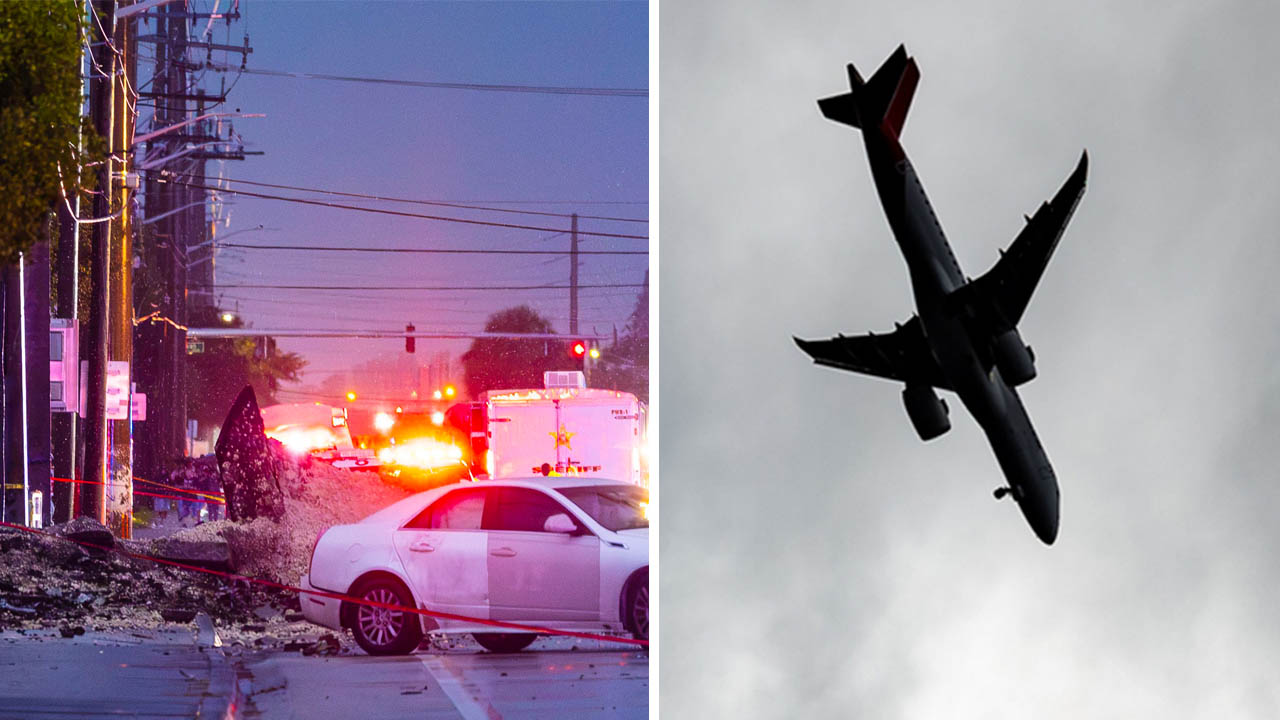
A devastating private jet crash in Florida has left at least nine people dead after an aircraft plunged from approximately 35,000 feet before crashing into a residential area. Now, an aviation expert has offered a possible explanation for what may have happened during the plane’s final moments, pointing to severe turbulence and potentially dangerous weather conditions.
The fatal accident occurred at approximately 12:50 p.m. on Sunday, November 1, in Palm Beach County, Florida, according to the Federal Aviation Administration (FAA).
The aircraft involved was a Learjet 60 private jet that had departed Austin-Bergstrom International Airport in Texas. It was travelling to North Eleuthera Airport in the Bahamas when disaster struck.
According to the FAA, nine people were aboard the aircraft at the time of the crash.
A spokesperson for the agency confirmed the incident to LADbible, explaining that the aircraft went down in a residential area near Cresthaven, Florida.
“A Learjet 60 crashed in a residential area near Cresthaven, Florida, around 12:50 p.m. local time on Sunday, Nov. 1. Nine people were on board,” the spokesperson said.
The FAA also confirmed that the agency and the National Transportation Safety Board (NTSB) would investigate the circumstances surrounding the disaster, with the NTSB taking the lead.
“The FAA and National Transportation Safety Board will investigate. The NTSB is in charge of the investigation and will provide all updates,” the spokesperson added.
Pilot reported ice accumulating on the aircraft before the crash
In the moments leading up to the tragedy, the pilot reportedly contacted air traffic control with concerning information about the aircraft’s condition.
According to the initial reports, the pilot warned that ice was accumulating on the jet, raising concerns about the conditions the aircraft was experiencing at high altitude.
The situation appeared to become even more dangerous when the pilot also reported severe turbulence.
The aircraft was reportedly being thrown up and down by as much as 700 feet, suggesting that the jet was encountering extremely unstable air conditions.
These reports have raised questions about whether the weather played a significant role in the crash and whether the aircraft was exposed to conditions that made it difficult for the pilot to maintain control.
While investigators have not yet determined what caused the disaster, an experienced aviation professional has now shared his assessment of the aircraft’s final moments.
Aviation expert explains what may have caused the aircraft to lose control
DeWitt Ingram, a Learjet-qualified captain who founded and leads aviation consultancy Par-Avion Group, examined flight-tracking data from the aircraft’s final moments.
Based on the information available, Ingram highlighted the aircraft’s extraordinarily rapid descent as one of the most concerning aspects of the incident.
The Learjet reportedly fell from approximately 35,000 feet to the ground in around 60 seconds.
Such a dramatic loss of altitude has prompted questions about what happened inside the aircraft and whether the pilot was able to maintain control during the emergency.
Speaking to CBS12 News, Ingram suggested that powerful thunderstorms and the extreme air currents surrounding them could have contributed to the accident.
He explained that if the aircraft had entered the upper portions of a thunderstorm, it could have encountered turbulence powerful enough to cause serious damage.
“What we saw today is a jet coming out of high altitude very quickly,” Ingram told the news outlet.
“If the pilot flew into the tops of one of the thunderstorms, in that very rough air, he could have damaged the airplane to the point where he lost control.”
His assessment raises the possibility that the aircraft encountered severe atmospheric conditions that may have affected its structural integrity and the pilot’s ability to control it.
Could severe turbulence have triggered the deadly 35,000-foot plunge?
Ingram also discussed what may have happened after the aircraft potentially lost control.
He suggested that an uncontrolled descent could have caused the jet to accelerate rapidly, placing enormous physical stress on the aircraft.
As an aircraft descends at increasing speed, the forces acting on its structure can become extremely demanding. If the jet had already sustained damage while travelling through severe turbulence, the situation could have become even more dangerous.
However, these remain possible explanations rather than confirmed findings.
Although the pilot’s reported warnings about accumulating ice and severe turbulence provide important details about the conditions before the crash, investigators have not established whether either factor directly contributed to the accident.
The exact sequence of events that led to the aircraft’s rapid descent also remains unclear.
FAA and NTSB investigation underway
The National Transportation Safety Board is now leading the investigation into the deadly Learjet 60 crash, working alongside the Federal Aviation Administration.
Investigators will need to establish what happened during the flight, examine the aircraft’s condition, and determine whether weather conditions, mechanical problems, or other factors contributed to the tragedy.
For now, the aviation expert’s comments provide one possible explanation for how the aircraft may have lost control, but no official cause has been established.
The investigation is ongoing, and authorities are expected to provide further information as more details become available.