At My Daughter’s Memorial, Her Husband Gave Up Their Girls-Then Her Final Envelope Changed Everything
The soil over my daughter Rose’s grave was still fresh when her husband announced that he no longer intended to raise their three daughters.
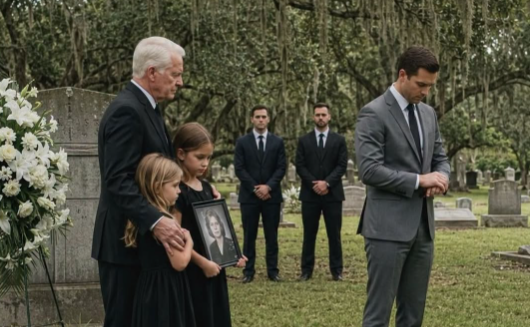
More than two hundred people had gathered in the memorial garden in Savannah. White lilies surrounded Rose’s photograph. Friends stood shoulder to shoulder with relatives, neighbors, former colleagues, and people who had known her throughout the thirty-five years of her life.
The service had ended less than an hour earlier.
People were still crying.
Some were placing flowers beside her portrait.
Others were hugging the girls.
And then Arthur, Rose’s husband, looked toward his three daughters and calmly announced the decision that would change all of our lives.
“If no relative is willing to care for the girls,” he said, “I will contact a licensed family-placement agency on Monday.”
I stared at him.
I thought I had misunderstood.
Arthur continued.
“Melissa and I have already made plans for our future, and I am not prepared to handle everything alone.”
The garden went silent.
Even the people who had been whispering stopped.
Twelve-year-old Lucy stood beside me holding her mother’s photograph against her chest.
Nine-year-old Rachel stared at the flowers.
Six-year-old April had pressed herself against my coat, her tiny fingers wrapped tightly around mine.
Arthur, meanwhile, looked perfectly composed in his tailored gray suit.
His phone vibrated.
He glanced at the screen.
For the briefest moment, he smiled.
I felt something inside me break.
“What exactly are you saying?” I asked.
Arthur looked at me as though I were making the situation more complicated than necessary.
“Rose is gone,” he said. “I have to make practical decisions.”
“And your daughters?”
“Melissa isn’t prepared to become a full-time parent to three children. My job requires frequent travel.”
I stared at him.
“You are their father.”
“I understand that.”
“Then why are you speaking about them as though they belong to someone else?”
Arthur adjusted one of his cuffs.
“You’re their grandfather. If the girls are going to stay together, living with you may be the most practical solution.”
I looked at my granddaughters.
April squeezed my hand harder.
Rachel remained completely silent.
But Lucy was watching her father.
She wasn’t crying.
She wasn’t begging.
She looked guarded.
Almost suspicious.
Then she glanced at Rachel.
Rachel looked at April.
No one said a word.
Yet somehow, the three girls appeared to understand something the adults around them didn’t.
They were protecting something.
I lowered myself until I was at eye level with them.
“You’re coming home with me,” I said.
April immediately leaned against me.
Rachel finally looked away from the flowers.
Lucy gave a small nod.
Arthur visibly relaxed.
“That settles the immediate arrangements,” he said.
“No,” I answered. “It means they’re safe tonight. Everything else will be decided carefully, with their needs coming first.”
For the first time, something flickered across his face.
Then his phone vibrated again.
“We can discuss the details later,” he said. “Melissa is waiting.”
He didn’t kneel beside his daughters.
He didn’t hug them.
He didn’t ask whether they were frightened.
He didn’t ask what they needed.
He simply walked toward a white SUV parked beyond the memorial garden.
Melissa was sitting inside wearing oversized black sunglasses.
She had attended the memorial, but she had remained near the back of the gathering, almost completely separate from Rose’s family.
Arthur climbed behind the wheel.
Seconds later, the SUV disappeared beyond the oak trees.
Only then did Lucy finally release the breath she had been holding.
“Mom Told Us Not to Let Dad Find It”
“You don’t have to explain anything today,” I told the girls. “We’re going home. We’ll take this one step at a time.”
Lucy moved closer.
“Grandpa?”
“Yes?”
“Mom told us not to let Dad find her blue notebook.”
I looked at her carefully.
“Where is it?”
Rachel answered this time.
“I hid it in my overnight bag.”
I glanced at the small purple bag she was carrying.
“There are voice recordings too,” she added quietly. “Mom saved them on an old phone and gave it to me before she went back to the hospital.”
Then April reached inside her coat.
She pulled out a cream-colored envelope.
My name was written across the front.
I recognized the handwriting immediately.
Rose.
Even after everything, I would have known my daughter’s handwriting anywhere.
“She said this one was only for you,” April whispered.
I stared at the envelope.
“Did your father know about any of this?”
All three girls shook their heads.
Lucy looked toward the road where Arthur’s vehicle had disappeared.
“Mom said Dad was making plans before she was ready to tell everyone,” she said. “She wanted you to know the whole story before anyone tried to make us leave our home.”
I slipped the envelope carefully inside my coat.
I didn’t open it.
Not there.
Not in front of everyone.
Around us, people were gathering chairs and collecting flowers.
To them, the memorial was ending.
To me, something else had just begun.
The Purple Bag
We drove home that afternoon.
I locked the doors behind us.
Then I checked them again.
April stayed close to me.
Rachel barely spoke.
Lucy kept looking toward the windows.
She behaved like a child who expected someone to arrive unexpectedly.
Shortly after three in the morning, she appeared in the kitchen carrying the purple bag.
“Grandpa,” she whispered, “you promised you wouldn’t call Dad.”
“I promise.”
She placed the bag on the table.
Inside were several things Rose had apparently considered important enough to hide.
Her old phone.
The blue notebook.
A USB drive.
And the sealed envelope.
I finally opened Rose’s letter.
The first few lines made my hands shake.
Rose had documented things I had never known about.
Canceled medical appointments.
Medication changes she had not authorized.
Financial documents Arthur had pressured her to sign while she was sick.
Transfers of money she couldn’t explain.
And, most troubling of all, conversations about a family trust created for the girls.
The recordings on the old phone were even more disturbing.
Arthur could be heard demanding control over the trust.
He talked about the money.
About timing.
About what would happen after Rose’s death.
The girls had been listening to pieces of this without fully understanding what they meant.
Rose had apparently understood everything.
And she had been preparing for the possibility that she wouldn’t be there to protect them.
Her final letter explained why.
She had already contacted an estate attorney.
Her name was Miriam Hale.
The Trust Rose Had Quietly Protected
The next morning, Miriam came to my home.
She reviewed the notebook.
The recordings.
The USB drive.
And finally, Rose’s letter.
Then she told me something I hadn’t expected.
Rose had visited her months earlier.
She had known she was running out of time.
And she had anticipated what Arthur might do after her death.
Arthur believed he was entitled to a substantial distribution from the Sterling Trust—approximately $2 million.
But there was a condition.
The money was tied to his legal and financial authority over the children.
Rose had created protections specifically designed to prevent anyone from treating the girls’ inheritance as personal property.
Arthur apparently didn’t understand how those protections worked.
He believed that by remaining the girls’ father, he would retain control.
Instead, his own decisions were about to trigger the safeguards Rose had put in place.
Miriam explained that Arthur had also signed documents relinquishing several rights connected to the children.
Custody.
Guardianship.
Insurance decisions.
Inheritance authority.
And fiduciary responsibilities.
He had signed them believing they were temporary arrangements.
He had never asked why Miriam had expanded the language of the agreement.
That mistake would become extremely expensive.
Arthur Was Already Planning His New Life
While we were trying to understand Rose’s documents, Arthur was doing something completely different.
He was planning his wedding.
He had scheduled an extravagant ceremony with Melissa.
And according to the documents, the timing was significant.
The wedding was scheduled for the same afternoon Arthur expected the trust distribution to arrive.
He believed he was walking toward a new life.
A new wife.
A large financial payment.
And freedom from the responsibilities he had just described as too difficult to handle.
But Rose had left one final instruction.
The sealed envelope was not to be fully activated without Arthur’s presence.
Miriam followed the instructions exactly.
Arthur would have to hear the truth himself.
The Envelope Was Opened in Front of Everyone
When Miriam finally opened the remaining documents, Arthur was present.
His confidence disappeared almost immediately.
She explained that his voluntary waiver had activated one of the trust’s protection clauses.
The result was devastating for him.
The disputed estate would not go to Arthur.
It would be protected for Lucy, Rachel, and April.
The scheduled payment was rejected.
Financial investigators had already begun examining transfers and records connected to the estate.
Medical records and account activity were also being reviewed.
Arthur stared at Miriam.
“You can’t do this.”
Miriam remained calm.
“We aren’t doing this, Mr. Collins. The documents were written by Rose, signed according to the required procedures, and activated by decisions you made yourself.”
Arthur looked toward me.
Then toward his daughters.
For the first time since Rose’s memorial, he seemed to understand what had happened.
Rose had not left her children defenseless.
She had left them a shield.
The Girls Still Had to Heal
The legal victory did not magically repair what had happened.
Money could provide stability.
It could pay for therapy.
It could fund education.
It could secure a safe home.
But it couldn’t replace their mother.
Lucy had spent too long believing she needed to protect her younger sisters.
It took months for her to understand that she was allowed to be a child too.
Rachel found comfort in photography.
She began carrying a camera everywhere and documenting ordinary moments—sunsets, flowers, family dinners, even April’s drawings.
And April slowly began laughing again.
Real laughter.
The kind that doesn’t ask whether it’s safe.
The kind Rose would have recognized.
Arthur’s wedding never became the celebration he had imagined.
The financial case continued through the courts, and the girls’ assets were placed under independent management so that no one person could control them for personal benefit.
Their future was protected.
But the most important inheritance Rose left them wasn’t money.
It was the truth.
Rose’s Final Message
Years later, we found one more photograph inside the purple bag.
None of us had noticed it before.
It was an old photograph of Rose with the girls.
Lucy was still small.
Rachel was missing one of her front teeth.
April was sitting on Rose’s lap, laughing.
On the back, Rose had written a short message.
“The truth matters. What you build afterward matters more.”
I read it several times.
Then I looked at my granddaughters.
They had lost their mother.
They had been abandoned by the person who was supposed to protect them.
But they had also survived something Rose had quietly prepared them to survive.
Arthur thought Rose’s death meant the end of his responsibilities.
He thought he could walk away from three little girls and step directly into a new life.
He was wrong.
Rose had left behind a notebook.
A phone.
A handful of recordings.
A legal safeguard.
And one final envelope.
But more than anything, she had left her daughters a message that would stay with them long after the legal battles were over:
The truth can protect you—but what you choose to build after the truth comes out is what defines you.
And that was exactly what Lucy, Rachel, and April did.
They rebuilt.