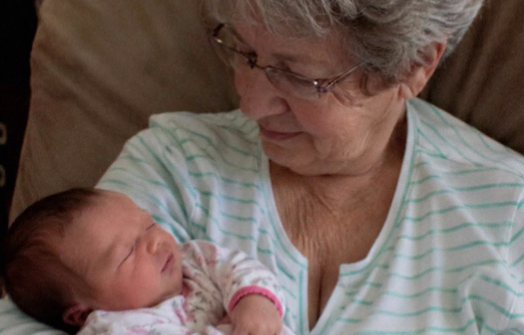
Grace had been home with me for only three days when a crying 42-year-old woman appeared at my front door.
The moment she looked at the newborn in my arms, something in her expression changed.
Then she asked a question that made my heart stop.
How did she know so much about my baby?
And why had the fertility clinic called her?
I was 33 years old when I froze my eggs.
At the time, the decision did not feel dramatic. It felt practical. Sensible, even.
I had a career I cared about, friends who filled my weekends, and a small apartment that always seemed too cramped for the life I imagined I would eventually have.
I kept telling myself there was plenty of time.
Back then, I was convinced I would become a mother someday.
I could picture it so clearly that I rarely worried about exactly when it would happen.
I imagined a tiny hand wrapped around my finger.
I imagined birthday cakes, school photographs, scraped knees, bedtime stories, and a little voice calling me Mom from somewhere in the house.
In my mind, the order of things was obvious.
First, I would meet the right man.
Then we would get married.
Then we would have children.
That was how I had always imagined my life unfolding.
The doctor who helped me freeze my eggs was careful to warn me that the procedure was not a guarantee.
He explained that medicine could preserve a possibility.
It could not promise an outcome.
I understood him.
At least, I thought I did.
I signed the paperwork, completed the process, and went home feeling strangely relieved.
I had protected my future.
That was how I looked at it.
I never imagined that future would take more than four decades to arrive.
But somehow, it did.
Years passed faster than I expected.
There were relationships.
Some were serious enough that I genuinely believed one might finally become permanent.
None of them did.
One man wanted children but did not want marriage.
Another wanted marriage but somehow changed the subject every time I brought up having children.
One relationship lasted nearly five years. For a long time, I thought we were building a life together.
Eventually, I realized we had simply built a comfortable routine around avoiding every difficult conversation.
And then, slowly, I stopped trying to force my future into the shape I had imagined when I was younger.
No husband.
No children.
For years, those facts embarrassed me.
At weddings, people would smile and ask when it would finally be my turn.
At baby showers, women younger than me would complain about sleepless nights while I smiled, congratulated them, and helped fold tiny onesies.
I really was happy for them.
I truly was.
But I eventually learned something important.
Being happy for someone else does not erase your own grief.
By my late 40s, people had mostly stopped asking whether I planned to have children.
Their silence was almost worse.
It felt as though everyone had silently decided that chapter of my life was over.
The frozen eggs remained at the fertility clinic.
Every year, I paid the storage fee.
And every year, I told myself I was not ready to let them go.
For a long time, those eggs represented possibility.
Eventually, they became something closer to a memory.
They belonged to the 33-year-old version of me who had believed motherhood was merely delayed.
As I grew older, I built a full life anyway.
I traveled.
I worked.
Eventually, I retired.
I made friends and lost some.
I cared for my parents before they died.
I became the relative people called when they needed advice because everyone assumed I had fewer responsibilities than they did.
In some ways, they were right.
In others, they had no idea.
I learned how quiet a house could become after dinner.
I learned that holidays could be beautiful and lonely at the same time.
And somewhere along the way, I stopped believing I would ever become a mother.
Motherhood became something I rarely spoke about.
Then, at 75, I made a decision that almost everyone around me called crazy.
The thought had not appeared overnight.
It had been building inside me for months.
One afternoon, while clearing out an old cabinet, I found a folder.
Inside were documents from the fertility clinic.
I sat on the floor and read through them until my legs went numb.
Thirty-three.
That number appeared beside my name again and again.
I stared at it for a long time.
That woman was me.
The younger version of me had trusted her older self to do something with the chance she had preserved.
The next morning, I called the clinic.
There were tests.
There were consultations.
There were uncomfortable conversations about my age, my health, my finances, and what would happen to a child if I died while she was still young.
I did not avoid those questions.
At 75, pretending death was far away would have been foolish.
I met with an attorney.
I updated my will.
I spoke with younger relatives about guardianship.
I made plans for situations I prayed would never happen.
Then I made my choice.
I would use my last remaining frozen egg.
I found a surrogate.
The process was exhausting.
There were appointments, legal documents, phone calls, medical decisions, and moments when I genuinely wondered whether I had lost my mind.
Some people told me directly that I had.
One longtime friend sat across from me one afternoon and asked, “Margaret, have you really thought about what you’re doing?”
“Every day,” I told her.
She shook her head.
“You’ll be in your 90s before she’s grown.”
“I know.”
That answer never seemed to satisfy anyone.
But there was something they did not understand.
I had already spent more than 40 years wondering what would have happened if I had tried.
I could not spend whatever years remained wondering the same thing.
When the pregnancy was confirmed, I cried alone in my kitchen.
Then I laughed because, suddenly, crying did not feel like enough.
I followed every update.
I kept ultrasound photographs beside my bed.
I bought baby clothes far too early.
I worried about everything.
And when the surrogate told me the baby had started kicking, I pressed the phone against my ear as though I might somehow hear the movement myself.
Nine months later, I held my daughter for the first time.
Grace.
She was perfect.
Her fingers were impossibly small.
Her face was red and scrunched, and a soft layer of dark hair covered her tiny head.
When the nurse placed her against me, the entire room seemed to disappear.
I couldn’t stop crying.
Grace opened her eyes for only a moment.
That was enough.
After 42 years of waiting, I was finally someone’s mother.
Bringing her home frightened me more than I expected.
I had prepared the nursery carefully.
Her crib stood beside a pale wooden dresser.
Bottles were lined up in the kitchen.
Diapers filled two drawers.
Everything was ready.
Except me.
I checked whether she was breathing every few minutes.
The first night, I barely slept.
The second night was not much better.
I was exhausted, overwhelmed, terrified, and happier than I knew how to explain.
Then, three days after bringing Grace home, someone knocked on my door.
I was standing in the living room with Grace against my chest.
The knock came again.
I wasn’t expecting anyone.
I moved slowly toward the door and looked through the peephole.
A woman stood outside.
She appeared to be around 40.
Her eyes were red from crying.
There was something about the way she stood there that made me hesitate.
Then Grace stirred in my arms.
I opened the door only partway.
The woman looked directly at me.
“Are you Margaret?”
“Yes.”
Her eyes immediately dropped to the baby in my arms.
She stared at Grace.
Then she whispered, “Was she born three days ago?”
My stomach tightened.
“Who are you?”
The woman swallowed hard.