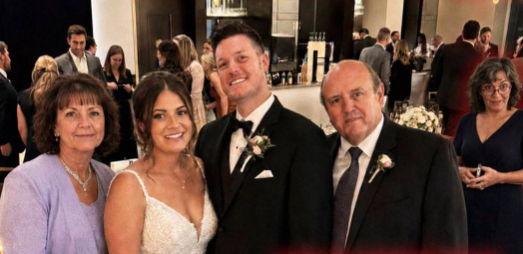
We found an uninvited woman standing at the edge of our wedding pictures.
At first, I thought she was simply someone who had wandered into the wrong room.
She stood alone near the back of the reception hall, keeping just far enough away from everyone else to avoid being noticed. She didn’t speak to anyone. She didn’t drink. She didn’t dance.
She simply watched.
Then I noticed something strange.
She was watching my husband.
Not me.
Not the wedding.
Him.
I pointed her out.
And the moment my mother-in-law saw the woman, all the color seemed to drain from her face.
Within minutes, she was crying.
Carrie looked up at us through her tears.
“Her name is Miriam,” she whispered.
Then she said something that made the entire room go silent.
“And she came back for Bob.”
My husband stared at his mother.
“For me?”
Carrie covered her mouth.
Her husband, Frank, sat beside her with both hands flat against the table.
He did not look surprised.
That frightened me more than Carrie’s tears.
“You know her too,” I said.
Frank closed his eyes.
“Yes.”
Bob pushed back his chair.
“Who is she?”
Carrie slowly turned the old wedding album toward us.
The photograph had been taken twenty-five years earlier.
Carrie stood beneath an arch of white flowers beside Frank.
At the back of the crowd stood the woman from our wedding.
She looked younger in Carrie’s photograph, but there was no mistaking her.
The same narrow face.
The same dark hair.
The same silver locket clutched between her fingers.
And the same navy-blue dress.
Not a similar dress.
The exact dress.
It had a high collar, pearl buttons and a pale stain near the left cuff.
In our wedding photograph, the fabric looked faded with age.
Bob stared at the picture.
“What does she have to do with me?”
Carrie began crying harder.
Frank reached for her hand.
She pulled away.
“No,” she said.
Her voice shook.
“I have to tell him.”
Bob stood.
“Tell me what?”
Carrie looked at the man she had raised.
Then she said the words that divided his life into before and after.
“I did not give birth to you.”
Bob laughed once.
It was a short, empty sound.
“What?”
“I am your mother,” Carrie said quickly. “I have always been your mother. But I did not give birth to you.”
Bob stared at her.
I reached for his hand.
He didn’t seem to feel me touch him.
“Then who did?”
Carrie looked down at the woman in the photograph.
“Miriam.”
Bob pulled his hand away from mine and crossed the room.
“You are telling me that a stranger crashed our wedding because she is my biological mother?”
Carrie nodded.
“She also came to ours because she wanted to stop us from taking you.”
My stomach dropped.
“Taking him?” I repeated.
Frank stood.
“It was not like that.”
Bob turned on him.
“Then tell me what it was like.”
Frank looked at Carrie.
She shook her head.
“No more protecting me.”
Then she began.
Miriam was Carrie’s older sister.
They had been born only eleven months apart, but they had never been close.
Carrie was quiet, careful and eager to please their parents.
Miriam was different.
She left home at seventeen.
She traveled with a local band.
And when she returned at twenty-one, she was pregnant.
Their parents were deeply religious and obsessed with appearances.
They couldn’t tolerate the idea of their daughter having a child outside marriage.
So they began hiding the pregnancy from the people around them.
They told neighbors Miriam was working in another state.
When the pregnancy became impossible to hide, they sent her to live with an aunt.
Bob was born at a private clinic two towns away.
There was no announcement.
No family photograph.
No celebration.
And no father listed on the birth certificate.
Bob’s voice was barely above a whisper.
“What happened to my biological father?”
Carrie lowered her eyes.
“We never knew his full name.”
“Miriam knew.”
“She refused to tell us.”
Bob gave a bitter laugh.
“So everyone knew something except me.”
After Bob was born, Miriam struggled.
She had no steady job and no permanent home.
There were times when she disappeared for days, leaving the baby with her parents.
Carrie was 22 and engaged to Frank.
She began caring for Bob.
At first, it was one afternoon.
Then one night.
Then entire weeks.
“He slept in a laundry basket beside my bed,” Carrie said. “You would not sleep unless someone kept a hand on your chest.”
Bob’s face changed.
Carrie had told that story for years.
Only she had always claimed it happened after bringing him home from the hospital.
Now he understood.
A family memory had become proof of a lie.
“What did Miriam want?” I asked.
Carrie took a breath.
“She loved him.”
She looked at Bob.
“But loving him and caring for him were not always the same thing.”
Miriam would disappear, then return with gifts and promises.
She wanted to take Bob with her.