My husband died suddenly of a heart attack.
There was no warning. No final conversation. No chance to say goodbye in the way you always imagine you will when you think about losing someone you love.
One day he was there.
The next, he was gone.
Afterward, my house seemed to hold its breath, waiting for footsteps that would never come again.
Every room reminded me of him. His chair. His coffee cup. The quiet spaces where his voice used to be. Even the silence seemed to belong to him.
A few months after his death, I started volunteering at the local retirement home.
Everyone assumed I had come there to give back, to help lonely people reconnect with the world.
That was partly true.
But the honest truth was simpler, and much sadder.
I was the one who needed someone to talk to.
That was where I met Albert.
He was eighty-nine years old, sharp as a tack, and somehow the funniest man in the entire building.
Every Wednesday, we drank tea, played chess, and he told me stories from his long and remarkable life. He had a story for everything, and somehow, no matter how ordinary the subject, he could make me laugh.
One afternoon, as we sat across from each other over the chessboard, Albert studied my move and shook his head.
“You play chess like someone who’s thinking about ten other things,” he said.
“Maybe I am,” I admitted.
“Then you’re a dangerous woman,” he replied. “Distracted people win by accident.”
I laughed.
It surprised me how good it felt.
A moment later, he moved his piece.
“Checkmate,” he announced, grinning like a boy.
“You cheated.”
“I’m eighty-nine,” he said. “I’ve earned a little cheating.”
That became our rhythm.
Week after week, I would arrive at the retirement home, and Albert would already be waiting for our chess game and tea.
He never asked about my grief directly, and I appreciated that more than he probably realized.
He never forced me to talk about my husband. He never gave me the usual advice about moving on. He simply let me be there.
One Wednesday, feeling unusually bold, I decided to tease him.
“Albert, can I ask you something personal?”
“Only if it’s scandalous.”
“Would you ever get married again?”
He set down his teacup and studied me for a long moment.
Then his entire face lit up.
“I’m only eighty-nine,” he said, straightening his shoulders. “Give me a little more time. You never know.”
We both laughed.
For a moment, the hollow feeling in my chest lifted.
Nothing about that conversation suggested that Albert had already made a decision that would change both of our lives.
“You should laugh more often,” he said.
I frowned.
“Why?”
“It suits you better than that other face you wear.”
“What other face?”
“The one you put on when you think nobody’s looking.”
I shrugged and reached for my tea.
“You’re imagining things.”
“Maybe,” he said.
But his eyes lingered on me longer than they normally did.
When our hour was over, I gathered my things.
“Same time next Wednesday?” I asked.
“Wouldn’t miss it,” he promised. “Though next week, I might just surprise you.”
“Albert, you surprise me every week.”
He smiled, but there was something quieter underneath it.
Something I couldn’t quite name.
“Not like this,” he murmured.
I didn’t think much of it at the time.
I assumed he was simply being his playful self.
But as I headed toward the door, I glanced back.
Albert was speaking quietly with Nurse Sarah.
The moment they noticed me watching, both of them fell silent.
I thought it was strange, but I didn’t give it much thought.
I walked through the sliding doors and into the parking lot.
And as soon as I was outside, the mask I wore for everyone else disappeared.
By the time I reached my car, I was once again the hollow woman I had been that morning.
The woman who dreaded returning to an empty house.
The woman who had learned how loud silence could be.
I never noticed Albert watching me from the window.
I had no idea what he had planned for the following Wednesday.
And I certainly had no idea that it would change everything I believed about my own life.
The next Wednesday, we had just finished our usual game of chess when Albert slowly stood.
He reached into his jacket pocket.
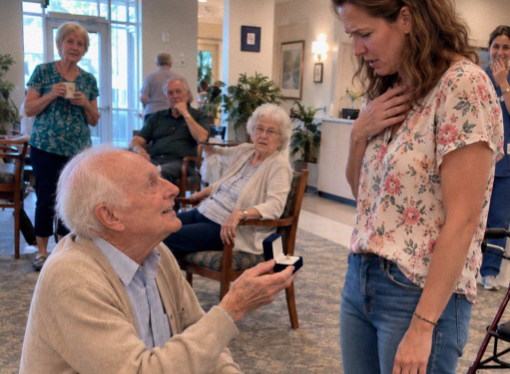
Then, carefully and deliberately, he lowered himself onto one knee.
Every resident, nurse, and visitor in the room turned to stare.
Then Albert looked up at me.
“Will you marry me?”
For several seconds, I couldn’t move.
I was completely frozen.
My first thought was that he was joking.
My second was that he was going to hurt himself.
“Albert, please,” I whispered, reaching toward him. “Get up. This isn’t funny anymore.”
He gently swatted my hands away.
“I’m not trying to be funny,” he said. “Sit back down.”
“You’re going to hurt your knees. People are staring.”
“Let them stare.”
I looked around the room.
Nurse Sarah stood near the doorway, one hand pressed over her mouth.
But she made no attempt to stop him.
That surprised me more than anything.
A few residents had gathered near the tea table, watching us.
And strangely, they didn’t look shocked.
They looked as though they already knew what was coming.
Somehow, I was the only person in the room who hadn’t seen this coming.
“Albert, I can’t marry you,” I said, my voice cracking. “You know that. You know why.”
“Because of your husband,” he answered softly.
