Three weeks after burying my newborn son, I gave away everything I’d bought for him to a desperate mother who was sitting outside a grocery store with her baby.
I didn’t know her.
She didn’t know me.
There was no grand plan behind what I did. I wasn’t trying to start anything. I wasn’t looking for praise, gratitude, or even forgiveness.
I was simply a grieving mother who had reached the point where she couldn’t bear to see a nursery filled with things her child would never use.
That night, for the first time since Noah died, I slept through the night.
But before sunrise, something happened that I never could have imagined.
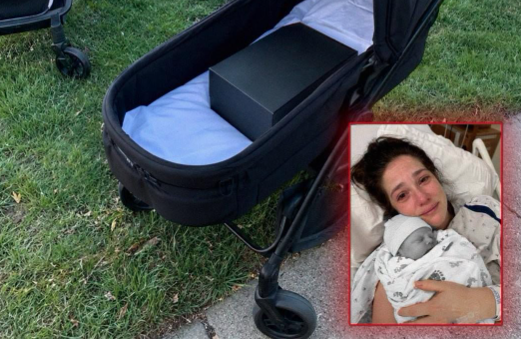
When I opened my front door, my lawn was covered with dozens of baby strollers.
They were arranged in loose rows across the wet grass, each one holding a sealed box.
And every box contained a story.
A story about a child who had been loved, lost, and never forgotten.
At first, I thought I was dreaming.
Then I saw my name written on one of the boxes.
And everything changed.
Morning sunlight filtered through the dusty blinds of Noah’s nursery, casting long, pale stripes across the room.
The light fell over the crib first.
A crib that had never held him.
I stood in the doorway, staring at it, unable to step inside and unable to make myself walk away.
The room still looked exactly as it had before.
His little outfits were folded neatly on the changing table.
The diapers were unopened.
A package of wipes sat beside them.
His stroller was still packed away in its original box near the closet.
Thomas and I had assembled it once, laughing nervously as we pushed it down the hallway during a practice run. We had joked about how neither of us knew what we were doing.
Then we’d folded it back up and put it away.
We had assumed we’d have years to use it.
We were wrong.
Three weeks had passed since my little boy died in the hospital.
Three weeks since everything I had imagined for my life had been ripped apart.
And Thomas was gone now, too.
A week earlier, I had walked into our bedroom and found him packing a suitcase.
I remember standing in the doorway, staring at him as he folded shirts into the bag.
“You’re really leaving me?” I had asked.
He didn’t look at me immediately.
“I can’t stay here,” he said.
His voice was quiet.
“Every time I walk past that door, I feel like I’m being buried alive.”
I stared at him.
“He was your son, Thomas.”
He finally looked at me.
“That’s exactly why I can’t look at any of it.”
He zipped the suitcase shut.
“So you’re walking away… from him. From me. Two weeks after we buried him?”
“I can’t stay here.”
He looked down at the carpet.
“I asked you to pack the nursery,” he said quietly. “Weeks ago. You wouldn’t.”
“Because it’s his room. I’m not ready.”
“It’s an empty room, Kate.”
His voice hardened.
“It’s an empty room and it’s killing both of us.”
I could feel something breaking inside me.
“How do you think I feel?” I asked. “I’m the one who carried him. He was alive inside me. I felt him kicking. I felt him moving. I spent months imagining what he would look like, what his voice would sound like, what it would feel like to hold him.”
My voice cracked.
“And then he came out into the world and… he was gone.”
Thomas said nothing.
“I asked you to pack the nursery,” he repeated.
“So what?” I demanded. “You want me to erase him? You want to keep the nursery empty and pretend he never existed?”
He shook his head.
“You want to keep the nursery waiting for his ghost? Like some kind of sick memorial?”
He waved one hand toward the hallway.
“This is exactly why I can’t stay here anymore.”
He picked up his suitcase and headed toward the door.
Then he stopped.
“I called a realtor,” he said.
I stared at him.
“I want to list the house.”
“No.”
“Kate—”
“No.”
He turned toward me.
“You can’t stay in a place like this alone.”
“Watch me.”
He stared at me over his shoulder.
There was something in his expression that I will never forget.
It was as though he was judging me for grieving the wrong way.
For not being ready to throw away the room where my son had been supposed to grow up.
“I’ll come back for the rest of my things next week,” he said.
“You can’t take my home!” I yelled after him as he walked away.
But he didn’t turn around.
The front door closed behind him with a soft, final click.
And suddenly the house felt impossibly quiet.
I walked into Noah’s room.
I sat on the floor beside the crib and pressed my forehead against the wooden slats.
“I’m sorry, baby,” I whispered.
My voice barely existed above a breath.
“I would’ve given anything to keep you here.”
The mobile above the crib swayed slightly in the draft from the vent.
For a moment, I simply watched it move.
“I would’ve given anything to keep you here.”
That night, I ate crackers standing over the kitchen sink.
I didn’t turn on the television.
I didn’t answer my mother’s third phone call.
I walked past the nursery on the way to bed and deliberately didn’t look inside.
Then I lay down on Thomas’s side of the bed.