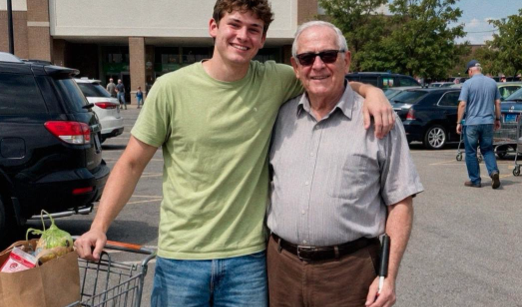
My blind grandfather was moving carefully through a crowded grocery aisle when an impatient man snapped that “people like him should stay home.”
Grandpa quietly asked me to let it go.
Five minutes later, that same man came rushing back toward us in a panic, shouting a question I never expected to hear.
Every Saturday, Grandpa Joe inspected apples as if he were choosing diamonds.
He would take one in his palm, turn it slowly, run his thumb across the skin, and then hand it to me.
“Bruised.”
I stared at the apple.
“It looks perfect, Grandpa.”
“That’s because you’re relying too much on your eyes, Adam dear.”
Grandpa had been blind for almost six years, but he still refused to use grocery delivery.
“They send you whichever apples they want,” he always complained. “I have standards.”
So every Saturday morning, the two of us walked through the same grocery store together.
Grandpa knew almost every inch of it.
Produce first.
Bakery to the right.
Coffee halfway down aisle five.
Frozen foods near the humming compressors at the back.
He knew the store so well that he rarely needed directions. When displays were moved, he counted the aisles. He listened carefully for carts and footsteps. When he needed to confirm what he had picked up, he ran his fingers over the packaging.
I described anything that had changed.
Nothing more unless he asked.
That was our deal.
I would help Grandpa without turning my help into permission to take over.
He had spent years rebuilding his independence after losing his sight, and I wasn’t about to take that away simply because I loved him.
And I did love him.
More than almost anyone.
My parents divorced when I was eight.
Dad moved three states away.
Mom worked constantly.
Grandpa Joe became the person who simply showed up.
He taught me to ride a bike by running beside me down our street until, one day, I realized his hand wasn’t on the seat anymore.
When I failed algebra, he sat with me every night for three weeks.
And when I got dumped at seventeen and announced that my life was over, Grandpa handed me a wrench and made me help him change the oil in his truck.
“Slow down first,” he told me whenever I panicked. “Nothing smart happens while you’re rushing.”
He said it so often that eventually I started hearing his voice in my head whenever I was about to make a bad decision.
Years later, after his sight disappeared, I became more protective than he liked.
If someone bumped into him, I reacted first.
“Slow down first.”
If a waiter spoke to me instead of him, I corrected them.
If strangers stared at his white cane, I stared back.
Grandpa usually noticed.
“You planning to fight the entire city today?” he’d ask.
“If necessary.”
“Sounds exhausting, son.”
“I’ve got time, Grandpa.”
“You’ve got a job, Adam.”
Grandpa always found a way to make me laugh before I embarrassed us both.
That Saturday, the store was packed.
Carts jammed the produce section. Children reached across shelves. Someone had built a massive cereal display near the entrance, narrowing the walkway enough to create a traffic jam.
Grandpa tapped his cane lightly ahead of him.
“Busier than usual.”
“Very.”
“Holiday?” he muttered.
“No.”
“Then people have simply decided they all need bananas at once!”
I laughed.
We worked our way through produce, bread, canned goods, and coffee.
At one point, I tried slipping an expensive brand of coffee into the cart.
Grandpa immediately rejected it.
“Absolutely not.”
“You can’t even see the price.”
“I heard your breathing change.”
“My breathing?” I frowned.
“That’s the sound you make before wasting money, son.”
I put the coffee back.
“You’ve become impossible, Grandpa.”
“I raised you, Addy. I know you better.”
By aisle nine, the crowd had thickened.
The aisle was narrow, boxed in on one side by shelves of pasta sauce and on the other by a temporary display of paper towels.
Grandpa moved carefully.
His cane swept ahead in controlled arcs while one hand rested lightly against the cart.
I walked beside him.
Behind us, someone sighed.
Loudly.
Then again.
I glanced over my shoulder.
A man in his early forties stood a few feet behind us with a shopping cart. He looked well-kept, wearing a pressed button-down shirt and an expensive watch. A phone was loosely cupped in one hand.
His wife stood beside him.
A little girl, perhaps six or seven years old, walked near the cart holding a box of cereal against her chest.
