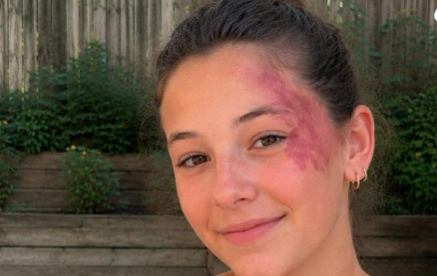
For years, I watched my daughter make herself smaller just to avoid cruel comments about the birthmark on her face.
She learned how to position herself in photographs. She learned how to let her dark hair fall across one side of her face. She learned to recognize whispers before they became laughter and to pretend she didn’t notice when someone stared too long.
Then, one evening, she made a brave decision.
She decided to stand beneath a spotlight with her hair pulled away from her face and sing in front of the entire school.
I knew that choice could change everything.
What I didn’t know was that, when someone tried to humiliate her in front of hundreds of people, I would have to make the hardest decision of all: Should I step in and protect my daughter, or should I finally trust her enough to let her stand on her own?
The laughter started while Eliza was still standing under the spotlight.
One second, my daughter was singing.
The next, a girl’s voice sliced through the auditorium.
“Someone’s feeling confident tonight.”
I knew the voice before I even turned around.
Maddie.
A few students laughed.
Then a few more joined in.
And Eliza stopped singing.
The music continued behind her, completely unaware that the girl holding the microphone had gone silent.
Slowly, almost instinctively, Eliza’s hand rose toward the crimson birthmark covering nearly half of her face.
I pushed myself out of my seat.
Then Eliza looked directly at me.
And in that instant, I remembered the promise she’d made me give her just two hours earlier.
“Don’t come save me.”
That was when I realized I had no idea how difficult keeping that promise would be.
Earlier that morning, I’d already come dangerously close to breaking one of Eliza’s oldest rules before we’d even finished breakfast.
She was sitting at the kitchen table, laughing at something on her tablet, when I quietly lifted my phone.
“Mom.”
I froze.
“I didn’t take it.”
“You were going to take the photo.”
“You looked happy, baby.”
“I can be happy without photographic evidence.”
She gave me a look.
“You were going to take the photo.”
I lowered my phone.
“One day, you’ll wish I had more pictures.”
“One day, you might retire that sentence.”
That shut me up.
My daughter was fifteen.
She was sharp, funny, observant, and far more perceptive than most adults gave her credit for.
She had also been born with a large crimson birthmark covering most of her left cheek and stretching toward her temple.
When she was little, she didn’t care about it.
School taught her to.
Children stared.
They whispered.
Some asked if she’d been burned.
Others simply looked at her for too long and then laughed when she noticed.
By middle school, Eliza had learned to wear her dark hair over one cheek. She checked every photograph before allowing anyone to post it. She would angle her face carefully, delete pictures she didn’t like, and sometimes refuse to be photographed at all.
I hated watching her make herself smaller.
So I compensated.
I watched everyone around her.
I questioned teachers.
I noticed whispers before she did.
At least, I told myself I did.
That morning, Eliza pushed her bowl away and looked at me.
“You’re staring now.”
I blinked.
“I’m sorry.”
She touched the hair covering her cheek.
“You don’t have to check whether I’m okay every five minutes.”
“I’m your mother. Checking is part of the contract.”
“Can we renegotiate?”
Despite myself, I smiled.
“I’ll consider it.”
She smiled back.
Then she looked down at her tablet again.
I thought the conversation was over.
I didn’t realize she was preparing to tell me something that would change the entire day.
That afternoon, I stopped by school to help prepare for the talent show.
I was carrying programs down the hallway when I passed the art room and spotted Eliza inside with Miss Cole.
Miss Cole was her art teacher and one of the few adults at school whom Eliza genuinely adored. She had a way of being warm without hovering, supportive without making Eliza feel watched.
As I walked past the doorway, something caught my attention.
A self-portrait sat on a drying rack.
I stopped.
It was Eliza.
But it wasn’t the version of Eliza I usually saw in photographs.
She had painted herself with her hair tucked behind both ears.
Her birthmark was completely visible.
I stared at it.
Miss Cole walked over.
“She painted that face three times.”
I looked at her.
“Why?”
“The first two times, she covered half of it with her hair.”
My throat tightened.
Eliza turned around.
“Are you discussing me?”
“Never,” I said quickly.
Miss Cole folded her arms.
“Your mother was criticizing your technique.”
“I was admiring it!”
Eliza shook her head, amused.
“Sure.”
I pointed toward the painting.
“It’s beautiful.”
“Thanks.”
She wiped her hands on a rag and spoke almost casually.
“I’m wearing my hair like that tonight.”
I looked at her.
“What’s happening tonight?”
She stared at me.
Miss Cole suddenly became very interested in a jar of paintbrushes.
My stomach dropped.
“Eliza?”
“I signed up for the talent show.”
I blinked.
“You’re singing?”
She gave me a nervous smile.
“Yes. I’m singing.”
Eliza loved singing.
But she had always done it behind closed doors.
She sang in her bedroom. She sang in the shower. She sang when she thought nobody was listening.
