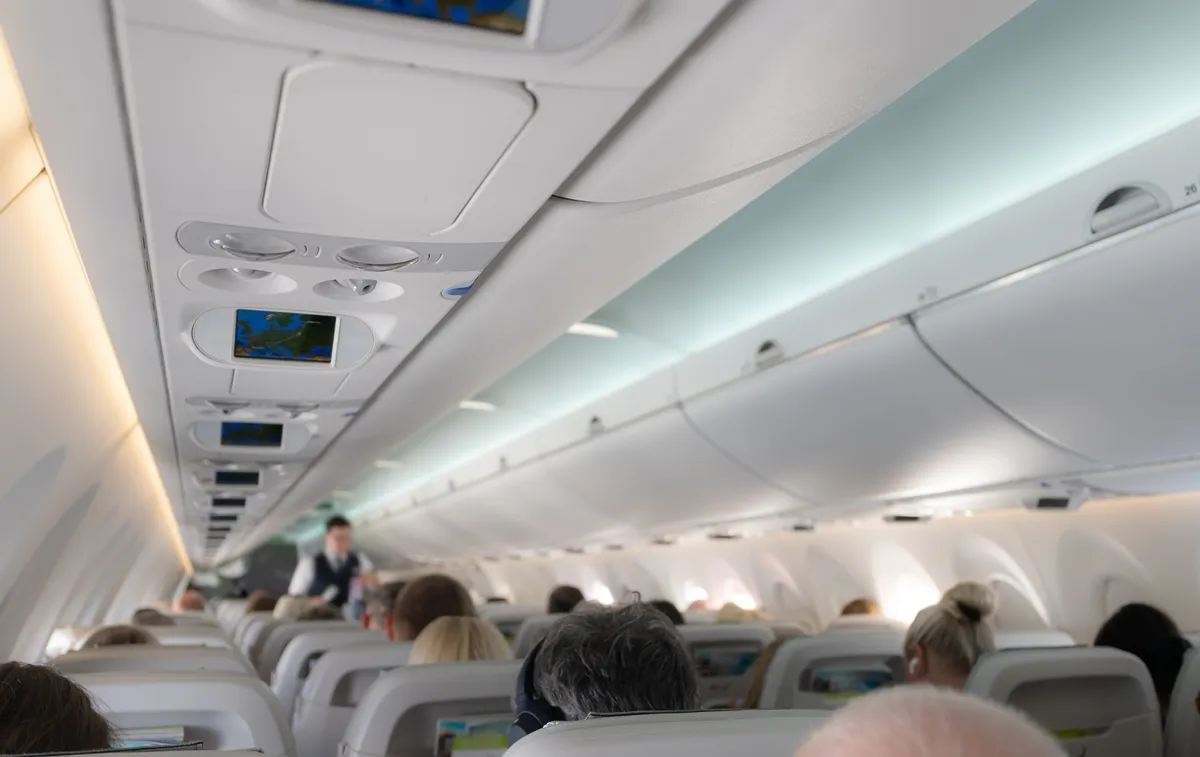
My mother’s first flight after cancer treatment was supposed to be a peaceful journey. I had booked her a window seat because she had always loved watching the clouds. But before long, a stranger was shouting at us, demanding that we stop talking.
Then a flight attendant noticed something unusual on my mother’s boarding pass.
What happened next revealed a promise my late father had made eight years earlier, and it changed the way we understood that journey forever.
My Mother’s First Flight After Cancer Treatment
I booked the window seat because my mother had always loved watching the clouds.
Even when I was a child, she would stop washing the dishes whenever the sky turned pink. She would stand beside the kitchen window, a towel draped over her shoulder, and call me over.
“Come look, Daniel. You never get the same sky twice.”
Six months before our flight, she was diagnosed with lymphoma.
After that, our lives became a blur of hospital rooms, plastic chairs, prescription bottles, and doctors speaking in careful, measured voices. Mom lost weight. Most of her hair fell out. Some days, she couldn’t even walk from her bedroom to the kitchen without stopping to catch her breath.
But she never stopped looking up.
Even on the way to treatment, she would point toward the sky and find shapes in the clouds.
“That one looks like a rabbit,” she would say.
“It looks like a shoe,” I’d reply.
“You have no imagination.”
“I have excellent eyesight.”
She would laugh, and for a few precious moments, cancer no longer seemed to be sitting between us.
The idea of taking a trip was hers.
Her latest scans had shown improvement, and my cousin Rachel had invited us to visit her in Oregon. I was hesitant at first, knowing how exhausting travel could be for Mom.
I reminded her that it was a five-hour flight.
“I know how airplanes work,” she replied.
“You get tired walking to the mailbox.”
“Then put the mailbox in Oregon.”
The following morning, she appeared at breakfast with her blue suitcase packed beside the door.
That was all the convincing I needed.
I booked the tickets, paid extra for a window seat near the front, arranged wheelchair assistance, and requested early boarding. I wanted every detail to go smoothly. After everything she had been through, she deserved a trip that felt special.
Still, Mom was nervous as soon as we arrived at the airport.
She repeatedly checked her purse to make sure her identification was there. She asked twice whether her medication was allowed on the plane. When the attendant pushed her wheelchair toward the gate, she gripped the armrests so tightly that her knuckles turned white.
“You okay?” I asked.
“I’m fine.”
“You’re crushing the chair.”
“I don’t trust wheels I can’t control.”
I smiled.
“You haven’t controlled wheels since you backed into Mrs. Fowler’s mailbox.”
“That mailbox came out of nowhere.”
I kept the conversation light because I knew it helped her. I pointed out the planes, joked about the ridiculously expensive airport coffee, and repeatedly asked whether she needed water, a sweater, or something to eat.
Every time she smiled, I felt useful.
For months, I had watched her endure treatments and exhausting days when there was very little I could do to help. That morning, at least, I could make sure she was comfortable.
A Stranger Turned Our Peaceful Flight Into a Nightmare
We boarded early.
Mom settled into the window seat, I sat beside her, and an older woman took the aisle seat. Across from us sat a man wearing a gray blazer. He glanced at us briefly before opening a magazine.
As the plane began its takeoff, Mom grabbed my hand.
“That sound is normal,” I reassured her.
“That one?”
“Also normal.”
“The shaking?”
“Normal.”
She looked at me.
“If the wing falls off, will that be normal too?”
“At that point, I will admit something unusual has happened.”
The woman beside me laughed. Mom did too, although she kept holding my hand until the plane reached cruising altitude.
For the next hour, we talked quietly.
Mom asked me to identify the towns below us. I admitted I had no idea what we were looking at, so she started inventing names for them.
“That’s Millersburg,” she announced.
“How can you tell?”
“It looks like a Millersburg.”
A little later, she mentioned my father.
Dad had been gone for eight years. A heart attack took him before any of us knew he was seriously ill.
“He would have loved this view,” Mom said.
“He would have complained about the legroom,” I replied.
She smiled.
Then, without warning, the man across the aisle slammed his magazine shut.
Mom jumped.
He leaned toward us and shouted:
“Keep it down or get out!”
His voice carried across several rows. Passengers looked up from their phones, and someone sitting behind us sighed in apparent agreement.
My face burned with embarrassment.
“I’m sorry,” I said. “We’re trying not to disturb anyone.”
The man gave a bitter laugh.
“Trying? You’ve been talking since takeoff. Some of us paid for a peaceful flight.”
“We’re speaking quietly,” I replied.
“No, you are not.”
Mom immediately shrank toward the window. I could see the embarrassment on her face, and I felt anger building inside me.
I wanted to tell him that my mother had spent six months listening to hospital machines and enduring treatments. I wanted to ask him how much peace he thought she had been given lately.
But I held back.
“We’ll keep our voices down,” I said.
Mom squeezed my hand.
“It’s okay,” she whispered.
“No,” I whispered back. “It’s not.”
The man heard her.
“There. You’re doing it again.”
The older woman sitting beside me finally turned toward him.
“They aren’t being loud.”
“I didn’t ask you,” he snapped.
That was when a flight attendant approached.
Her name tag read Maria.
“Is everything all right?” she asked.
Before I could answer, the man pointed toward us.
“They’ve been talking the whole flight. Either move them or make them stop.”
Maria looked at my mother.
“Ma’am, are you feeling okay?”
Mom quickly nodded.
“I’m fine. I’m sorry. I didn’t realize we were bothering anyone.”
“You aren’t bothering me,” Maria replied.
The man scoffed.
“Of course not. You’re not sitting near them.”
Maria’s expression became more serious.
“Sir, I need you to lower your voice.”
Then she turned back toward Mom.
“May I see your boarding pass?”
Mom looked confused.
“My boarding pass?”
“Please.”
I reached into the seat pocket, retrieved the pass, and handed it to her.
Maria read my mother’s name.
Evelyn Parker.
Then her eyes moved toward the bottom of the boarding pass.
She stopped.
“Is something wrong?” I asked.
Maria read the small print again.
“Mrs. Parker, did you know there was a special service note attached to your ticket?”
Mom shook her head.
“I don’t think so.”
Maria looked at me.
“Did you arrange anything?”
“Only wheelchair assistance.”
She stared at the boarding pass for another moment, then glanced toward the closed cockpit door.
“Excuse me,” she said.
She walked into the galley, picked up the intercom phone, and spoke quietly.
“Captain, I think you need to come out here.”
The man across the aisle rolled his eyes.
“This is ridiculous.”
But nobody answered him.
