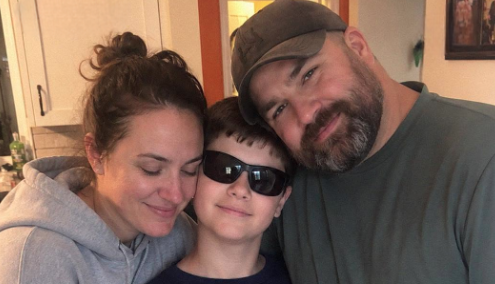
After five years of trying to become a mother, three different specialists eventually gave me the same devastating answer.
I would never carry a child.
I remember sitting in that doctor’s office, staring at the floor while the words settled over me.
There was nothing more they could do.
No treatment.
No procedure.
No hopeful next step.
The doctor spoke gently, as though a softer voice could somehow make the truth hurt less.
My husband, Rick, reached across the space between us and squeezed my hand.
“We’ll find another way,” he whispered.
I wanted to believe him.
That night, I cried until the morning sun began creeping through our bedroom curtains.
Rick stayed beside me.
He didn’t try to tell me everything would be fine.
He didn’t tell me to stop crying.
Instead, he talked about adoption.
“We can still be parents,” he said quietly.
“A family doesn’t have to begin in a hospital room.”
Those words gave me something I hadn’t realized I’d lost.
Hope.
Four months later, we drove to a children’s home two counties away.
I remember feeling nervous the entire way.
I wondered whether I would know immediately.
I wondered whether I would connect with a child.
I wondered whether a child would even want us.
The director, Mrs. Palmer, led us into a bright recreation room filled with board games, puzzles, donated books, and children who watched every adult who walked through the door with the careful interest of people who had learned not to hope too quickly.
Then I noticed Owen.
He was sitting near a window.
He was nine years old then, small for his age, with dark hair falling across his forehead.
A white cane rested beside his chair.
His fingers moved slowly over the raised dots of a book.
Mrs. Palmer lowered her voice.
“Owen lost his sight in an accident five years ago.”
She paused.
“His mother cared for him until she passed away.”
Then came the part that made my heart ache.
“Apparently, his father placed him here rather than raise a blind child alone.”
I looked at Rick.
He had stopped walking.
I assumed the story had upset him.
I didn’t understand why.
Not yet.
I walked over and sat beside Owen.
“What are you reading?” I asked.
He tilted his head toward my voice.
“You smell like cinnamon.”
I laughed.
“I work in a bakery.”
“Do you make cinnamon rolls?”
“Every morning.”
He closed his book.
“I love them, but I’ve never had a warm one.”
I smiled.
“Then somebody has failed you terribly.”
He laughed.
It was a small laugh.
But it stayed with me.
“What are you reading?” I asked again.
“A mystery.”
“Is it good?”
“The dog found the missing necklace before the detective did.”
I smiled.
“That sounds like a talented dog.”
Owen laughed again.
And just like that, something inside me clicked.
I loved him.
Not in the way a mother loves a child she has already raised.
Not yet.
But in the strange, immediate way you sometimes recognize that someone is supposed to become part of your life.
On the drive home, however, Rick barely spoke.
His hands were wrapped tightly around the steering wheel.
His knuckles were white.
Finally, he spoke.
“He will need specialists.”
I looked at him.
“Of course.”
“Appointments. Constant care.”
I frowned.
“We knew that.”
“We cannot handle that.”
I stared at him.
“We are choosing a son, Rick. Not whichever child requires the least effort.”
“You connected with him after one conversation.”
“You looked like you liked him too.”
“I did not.”
His answer came too quickly.
I looked at him.
He kept his eyes on the road.
Over the following weeks, Rick delayed the adoption paperwork.
The first time, he said his work schedule was unstable.
The second time, he said we needed a larger emergency fund.
Each delay hurt me.
But I could see that it hurt Owen too.
He never complained.
He never demanded anything.
Instead, during our visits, he began asking careful questions.
“Are you still coming next Saturday?”
“Yes.”
“Are you still thinking about me?”
“Every day.”
He smiled.
Those questions broke my heart.
One afternoon, Owen reached toward Rick’s voice.
Rick stepped backward.
Later, when we were alone, I confronted him.
“I am giving him space,” he said.
“He was reaching for your hand.”
“He barely knows me.”
“He is trying.”
“I don’t want to overwhelm him.”
“You’re not overwhelming him,” I said. “You’re avoiding him.”
Rick looked away.
Two months after our first meeting, Owen finally came home.
The first night, he walked around the house with his cane, carefully counting his steps.
Within a week, he knew the entire layout.
Twelve steps from his bedroom to the bathroom.
Seven from the kitchen door to the table.
Three from the couch to the bookshelf.
At night, I could hear the soft tapping of his cane moving along the hallway.
One evening, I found him standing outside his bedroom.
“Are you all right?” I asked.
“I am memorizing.”
“You can do that tomorrow.”
He shook his head.
“I sleep better when I know where everything is.”
Rick stood silently behind me.
Then something happened that I will never forget.
Owen turned toward him.
“Dad?”
Rick flinched.
It was the first time Owen had called him that.
“Yes?” Rick answered.
Owen smiled.
“I think I know that smell.”
Rick touched his neck.
“Do you always wear the same aftershave?”