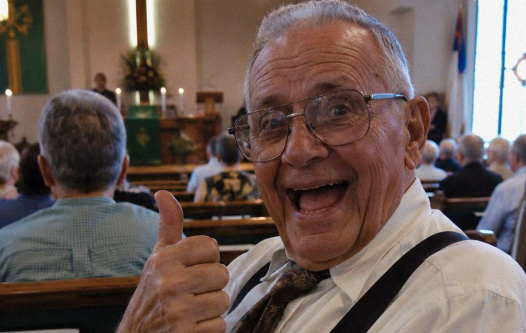
Every Sunday, I saved the same seat.
Second row from the back.
Right beside mine.
People used to ask why I placed my Bible on the cushion before the service began, even when the sanctuary was already filling with people.
I’d simply smile.
“Someone’s sitting there.”
That someone was Harold.
He was already in his 70s when I first met him.
His wife had died several years earlier, and after that, he always came to church alone.
The first Sunday I noticed him, he was standing in the aisle with his hat pressed against his chest, looking from one crowded row to another.
Nobody was deliberately ignoring him.
People were greeting friends, gathering their children, making room for relatives.
But somehow, no one noticed that Harold had nowhere to sit.
I raised my hand.
“There’s room here.”
He looked behind him, as if I must have been speaking to someone else.
Then he pointed at himself.
I nodded.
He shuffled over and sat beside me.
“Thank you,” he whispered.
After the service, he tried to leave before anyone could reach him in the fellowship hall.
I caught up with him near the doors.
“They’ve got coffee,” I said.
He gave me a doubtful look.
“Church coffee?”
“The worst kind.”
That made him laugh.
It was the first time I’d seen his face change.
Until then, he had looked like a man carrying something far too heavy for one person.
When he smiled, he suddenly looked ten years younger.
We drank terrible coffee from foam cups and talked about baseball.
The following Sunday, I saved his seat.
I did it again the week after that.
Before long, it became our tradition.
For nearly 20 years, rain or shine, I arrived early enough to place my Bible on the cushion beside me.
Harold always entered through the side door.
He would scan the room, spot the seat, and give me a small nod before walking over.
After church, we talked about everything and nothing.
The vegetables growing in his garden.
The terrible luck of our baseball team.
Stories from his years in the Navy.
Harold could describe a storm at sea so vividly that I could almost feel the saltwater on my face.
But whenever I asked about his family, his voice changed.
I knew he had a daughter named Caroline.
That was almost all I knew.
“Does she live nearby?” I asked him once.
“Not too far.”
“Do you see her often?”
He stared into his coffee.
“They don’t need an old man like me anymore.”
He said it with a sad little smile that warned me not to press.
So I didn’t.
I assumed Caroline had moved on with her own life.
Maybe they had argued.
Maybe she had a husband who didn’t like Harold.
Maybe there had been some family disagreement I would never understand.
Families became complicated for reasons outsiders rarely saw.
I told myself that if Harold wanted to talk, he would.
Then one winter morning, his seat stayed empty.
I kept glancing toward the side door, expecting him to appear with snow on his coat and an apology about his old truck.
He never came.
The following Sunday, the seat was empty again.
A few days later, our pastor called.
Harold had died peacefully in his sleep.
He had been found in his bed with a book open on his chest and his reading glasses folded neatly on the nightstand.
At his funeral, I cried quietly, remembering the years we’d spent together.
I wanted to introduce myself to his family after the burial.
But I assumed they probably didn’t know who I was.
After all, Harold hadn’t seemed to be in contact with them for years.
The church felt different after he was gone.
For months, I still placed my Bible on his seat before remembering that no one would take it.
Sometimes I left it there anyway.
It felt wrong to let someone else sit in his place.