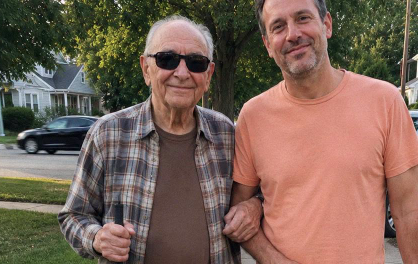
For eight years, I believed my father spent every Thursday going to doctor’s appointments, picking up groceries, visiting the pharmacy, or having lunch with our longtime neighbor, Ben.
It was a routine that gave me peace.
Dad had been diagnosed with glaucoma ten years earlier, and by the time doctors discovered how severe it was, much of the damage had already been done. Within two years, his eyesight had deteriorated to the point where he could see little more than shadows.
But Dad refused to leave the house he had shared with my mother for decades.
I lived nearly a thousand miles away, with two children, a demanding job, and a marriage to a woman who was just as driven as I was. I couldn’t simply drop everything and move closer.
So we made an arrangement.
Dad could still take care of himself, but he needed regular glaucoma checkups, medical appointments, prescriptions, groceries, and help getting around town.
That was where Ben came in.
Ben had been our neighbor for decades. He had known my parents for most of my life and had long ago stopped feeling like a neighbor and started feeling like family.
He was retired and, as he liked to joke, “running out of excuses to avoid being useful.”
Every Thursday, I paid Ben to drive Dad wherever he needed to go.
Sometimes it was the eye doctor. Sometimes the pharmacy. Sometimes the grocery store.
And sometimes, Dad told me, it was lunch.
Ben never made the arrangement feel like charity.
“Your father spent years helping people,” he told me once. “Let somebody return the favor without making it weird for him.”
Those words mattered more to me than he probably realized.
I visited whenever work allowed, and Dad and I spoke every day.
He would tell me about meals he cooked by touch, audiobooks he hated, and checkers games Ben allegedly lost on purpose.
Whenever I heard Ben protesting in the background, Dad would laugh.
“He’s lying,” Ben would shout.
Those calls became the best part of my day.
Dad never pressured me to visit more.
Instead, he’d ask about my kids, whether they were doing well in school, and whether I’d eaten something decent.
Sometimes I’d hear a car door slam in the background.
Keys would jingle.
Then Ben would announce dramatically, “Your royal carriage awaits.”
Dad would answer, “It smells like old coffee and questionable choices.”
Their laughter always made the distance feel smaller.
For eight years, I thought Thursdays were ordinary.
I never imagined they were anything but.
Then my father died.
He passed peacefully in his sleep one Friday morning. Ben was the one who found him.
Dad was still wearing the blue sweater my daughter had given him for Christmas the year before.
The funeral passed in a blur of casseroles, handshakes, condolences, and people telling me how proud my father had been of me.
I thanked everyone with a solemn smile.
But inside, I kept thinking about our last phone call.
We had left it unfinished.
Dad had told me, “Thursday was productive.”
I had laughed and asked what that meant.
He told me not to interrogate an old man.
My daughter needed help with homework, so I promised I’d call him the next day.
There was no next day.
After the burial, people slowly began drifting toward their cars.
I stayed beside the grave.
Fresh dirt covered the place where my father had been laid to rest, and a light rain began to fall.
That’s when Ben approached me.
He was wearing the same brown coat he had worn to my mother’s funeral years earlier.
In his hands was a sealed envelope.
My name was written across the front in my father’s handwriting.
Ben held it out.
His hands were trembling.
I reached for it, but he didn’t let go immediately.
“He made me promise,” Ben said quietly, “to tell you where we really went.”
For a second, I almost smiled.
I thought maybe Dad had been sneaking off to casinos.
Maybe there had been secret lunches.
Some harmless rebellion he’d hidden because he knew I worried too much.
Then Ben shook his head.
“I wasn’t only driving him.”
The rain became heavier.
“What does that mean?” I asked.
Ben looked toward my father’s grave.
“The places mattered,” he said. “But what we were doing there mattered more.”
I tucked the envelope beneath my coat.
“What were you doing?”
Ben was silent for several seconds.
Then he finally began to tell me.
It started with his daughter, Claire.
Claire was Ben’s only child.
I remembered her as a sharp, funny teenager who once painted her bedroom black and blamed the walls for making her father angry.
She had moved away after college.
Whatever happened between them afterward, nobody in town ever talked about it.
But Dad knew.
Apparently, he’d noticed the change whenever I mentioned my children and Ben suddenly went quiet.
One Thursday, Dad finally asked him about it.
“What did you do?”
Ben had immediately become defensive.
“Why assume I did something? It’s not my fault. You know she’s stubborn as an ox.”
Dad wasn’t impressed.
“For one thing,” he told him, “you’re defending yourself quite vehemently for an innocent man.”
Ben hated that.
But Dad kept asking.
He didn’t let things go easily.
By the third Thursday, Ben finally caved.
“I told him about all the snide comments I’d made about her work and her family life,” Ben said. “I told her things I thought were jokes. Things I thought would make her toughen up.”
He swallowed.
“But really, I just missed her. And she never came around like you did.”
Ben wiped a tear from his eye.
“I almost punched your dad when he told me, ‘You miss a lot. You miss your daughter, and you missed your chance to make up with your daughter. Goodness, man.’”