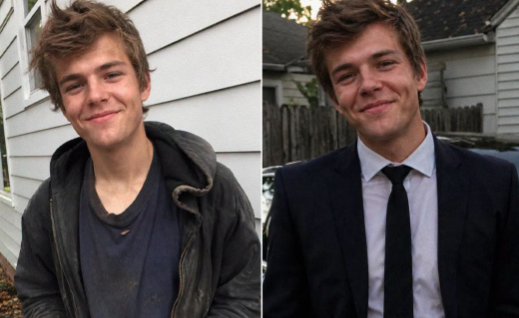
When I was eight years old, my mother began giving some of our best food to a homeless teenager who slept behind our house.
At the time, my family was struggling just to put enough food on the table. My father had died that spring, leaving my mother alone with unpaid bills, grief, and a kitchen where every meal required careful calculation.
Yet every afternoon, she packed a plate, wrapped it in foil, and walked toward the dump beyond our street.
She never explained herself.
I was eight when Luke first began sleeping there, beneath a sheet of rusted roofing tin. He looked eighteen, maybe younger, with hollow cheeks, dirty sleeves, and the cautious eyes of someone who had learned to expect trouble from almost everyone.
Sometimes, Luke received chicken while we ate soup.
Sometimes, he received bread while my mother claimed she wasn’t hungry.
And every afternoon, I watched from the window as he accepted whatever she brought him with both hands, always thanking her as though she had saved his life.
To me, however, it felt like she was taking something away from mine.
One Saturday, I saw my mother carrying an apple pie toward the back door.
The pie was still warm. The plastic cover had fogged from the heat, and the smell filled the kitchen.
Apple pie had always been my favorite thing my mother occasionally baked.
“Is that for dinner?” I asked, already smiling.
Mom shifted the dish against her hip and avoided my eyes.
“It’s for Luke. There’s soup waiting on the stove.”
Something inside me cracked.
“Why does he get dessert when we can’t even have decent food?!”
My mother’s face changed instantly.
The anger in her expression was so fierce that I stopped crying.
“Never say that about Luke again,” she said. “Never make me hear it.”
She picked up the pie and walked out.
I stood alone in the kitchen, ashamed, furious, and absolutely certain that Luke had somehow replaced me.
After that, I hated him with the intense, uncomplicated focus only a child can manage.
Luke tried waving whenever I passed him.
Once, he carved me a small wooden bird.
I deliberately dropped it beside his shoes.
He didn’t get angry.
“You don’t have to like me,” he said quietly. “But your mother worries when you walk near traffic after school.”
I ignored him.
As far as I knew, Luke had no parents, no home, and no job. My mother never explained why she seemed to feel responsible for him, and I convinced myself that his presence was another reason I had less of her attention.
Years passed.
Luke disappeared from the dump sometime before I finished high school, and my mother refused to explain where he had gone.
The moment I graduated, I moved three hours away. I accepted the cheapest apartment I could find and rarely called home.
At first, Mom and I spoke on birthdays.
Then on holidays.
Eventually, we spoke only when one of us felt guilty enough to try again.
I thought there would always be time to fix what had broken between us.
I was wrong.
Eleven years later, a hospital nurse called while I was at work.
“Are you Evelyn Hart’s daughter?”
“Yes.”
“Your mother has suffered a severe stroke. Her condition is critical. You should come as soon as possible.”
By the time I arrived, machines surrounded Mom, and she could barely speak.
I took her hand and apologized for all the years of distance.
Her fingers tightened weakly around mine, but her eyes remained painfully clear.
“I’m here,” I whispered. “You don’t have to worry about anything. I’ll handle the house, the bills—everything now, Mom.”
Her mouth moved several times before a sound finally emerged.
“Don’t abandon Luke. Promise me.”
Those were her final words to me.
I felt anger before I felt sorrow.
Luke hadn’t even come to the hospital, yet my mother was spending what little strength remained protecting him again.
“I promise,” I whispered.
Even as I said it, resentment made the words taste bitter.
Mom closed her eyes and died quietly before sunset.
After the funeral, I cooked beef stew, packed bread, and drove toward our old neighborhood carrying the weight of an unwanted duty.
I expected to search the dump or ask the neighbors whether Luke still wandered nearby.
My plan was simple.
I would leave the food, tell him Mom was gone, and consider my promise fulfilled.
Instead, I saw a black SUV parked outside our old house.
A clean-shaven man in an expensive coat stood beside it.
He was watching my car.
Tears gathered in his eyes.
“I thought you wouldn’t come,” he said when I stepped onto the curb, still holding the covered pot against my chest.
I studied his face.
There was something familiar beneath the polished hair, expensive clothes, and tired lines around his eyes.
Then I recognized him.
“Luke?”
His smile was uncertain.
He looked toward the dark house.
“You brought dinner.”
I nodded, suddenly embarrassed by the cheap container in my hands.
A chill moved through me.
“But what happened to you?” I asked. “How is this possible? The way Mom spoke about you, I thought you were still living nearby and needed help.”
Luke didn’t answer immediately.
Instead, he opened the SUV and removed a dented metal box.
“Your mother hid something from you,” he said.
He placed the box on the hood.
“Before she died, she begged me to keep her secret.”
My stomach tightened.
“What did she hide?”
Luke rested one hand on the metal box.
“Your father’s death was not the first loss connecting my family to yours.”