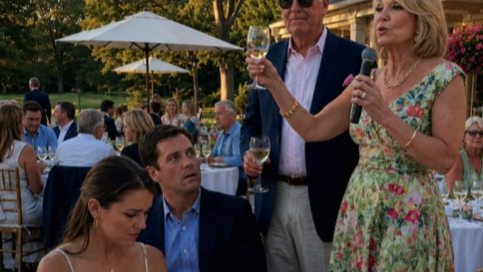
My husband’s wealthy parents had invited us to dinner at their country club to celebrate our daughter’s christening.
I knew the evening would be uncomfortable.
What I didn’t know was that they planned to turn the celebration into a public humiliation.
My mother-in-law stood beneath a crystal chandelier, a champagne flute in one hand and a microphone in the other. Her smile looked polished from a distance, but there was something sharp behind it that sent a chill through me.
I knew she was about to say something mean.
I just had no idea how deeply her words would cut.
“To our son,” she said, looking directly at me. “Taking in a girl from such a humble background is your most noble charity project yet.”
A few uncomfortable laughs fluttered through the room.
She glanced around as though she were performing for an audience.
“And we’re so glad we could pay for tonight and give her a little taste of how civilized people live.”
I don’t think I’ve ever wanted the floor to swallow me more than I did in that moment.
“Your most noble charity project yet.”
My three-month-old daughter, Hazel, slept peacefully against my chest, completely unaware that her own grandmother had just turned her christening dinner into a public spectacle.
Beside me, my husband, Garry, stood frozen.
Across the table, my father-in-law, Harrison, smirked into his drink.
For one terrible moment, I thought there was only one thing left to do.
Run.
Take my daughter, walk out of that room, and never let her sit at a table with these people again.
Then my 80-year-old grandfather quietly stood up.
And he started walking toward my mother-in-law.
If you’d told me when we left home that morning that one quiet walk across a dining room would change everything, I never would have believed you.
But that night, I learned just how much damage a single sentence can do.
I also learned that sometimes the quietest person in the room is the one everyone should have been paying attention to.
It had all started with a drive to the country club.
The drive felt longer than the actual miles.
I kept adjusting the collar of my borrowed dress in the passenger mirror, then turning around to check on Hazel in her car seat.
Her tiny fingers were curled around the edge of a knitted blanket Grandpa had brought from home.
She was three months old and already about to attend the fanciest dinner of her life.
“You look beautiful,” Garry said.
I looked at myself again.
“I look like someone playing dress-up.”
“You look like my wife.”
I smiled, though I wasn’t convinced.
Grandpa sat quietly in the back beside Hazel, dressed in his worn brown suit.
He hadn’t said much during the drive.
He rarely did.
If someone had told me then that this quiet, eighty-year-old farmer would stand up later that evening and interrupt a room full of wealthy people with a statement that would leave them speechless, I would have thought they were joking.
“You okay back there?” I asked him.
“I’m fine, sweetheart,” he said. “Just listening.”
That was Grandpa.
Always listening.
He had raised me after my parents died, on a stretch of land nearly two hours from any real town.
He taught me how to work a field.
How to weigh a calf.
How to look a man directly in the eye when he tried to lowball you.
He taught me that a person’s clothes didn’t tell you what they were worth.
And Grandpa never raised his voice.
Somehow, that made everything he said stick harder.
When we arrived at the country club, Margot was waiting at the entrance with her arms open.
Her lips brushed the air beside my cheek.
“Oh, look at her,” she cooed, peering into Hazel’s blanket. “So precious. Is this blanket handmade?”
“My grandfather made it,” I said.
“How rustic.”
Grandpa smiled politely.
It was the same smile he wore whenever someone underestimated him.
I’d learned early in life that this smile usually meant someone was about to make a very expensive mistake.
Inside, Harrison was already at the bar, holding court with two men in gray suits.
His voice carried across the room in the way rich voices sometimes do when the speaker wants to be overheard.
“…Big development play,” he was saying. “Four hundred acres, dirt cheap. The town council loved the proposal. We told them we’d include a wellness center.”
One of the men laughed.
Harrison took a drink.
“Tiny little thing,” he said, pinching his fingers together. “Maybe an acre if they’re lucky. Gives everyone something wholesome to point at.”
If Harrison wasn’t talking about golf, he was talking about buying something.
Acres.
Tax incentives.
Returns.
Projects.
Numbers so large they meant almost nothing to someone who had grown up counting grocery money.
“The other three hundred ninety-nine acres?” Harrison continued, swirling the ice in his glass.
“Data center. Cooling infrastructure.”
He grinned.
“That’s where the real money is. Nobody builds a four-hundred-acre wellness center.”
Another laugh.
“But it does make people stop asking questions. Time somebody civilized those backwater towns.”
I stopped listening after that.
But Grandpa didn’t.
He had gone completely still beside me.
It was the first time all evening I saw something change in his face.
“Dad, come meet Hazel,” Garry called.
Harrison waved him off without looking.
“In a minute, son. Business.”
Grandpa watched him for another second before quietly looking away.
I assumed he’d been offended because Harrison had put business before family.
I was wrong.
Grandpa wasn’t simply offended.
He was paying attention.
Dinner was worse than I’d feared and better than I’d expected, which was how these things always seemed to go.
Margot seated me between two women who asked what I did and then stopped listening halfway through my answer.
Grandpa sat across from me, sipping water and watching everything.
“Your grandfather doesn’t talk much, does he?” Margot murmured.
“He talks when it matters.”
“How charming.”
Garry squeezed my knee beneath the table.
I knew that squeeze.
It meant, “I love you. I’m sorry. Please don’t make a scene.”
I never made scenes.
That was the problem.
I’d spent most of my life absorbing every jab and every polite little cut.
I thought that if I stayed small enough, eventually the world might decide I was big enough to keep.