A month after burying my husband, I boarded a six-hour flight with our two children, hoping a visit with my mother might help us breathe again.
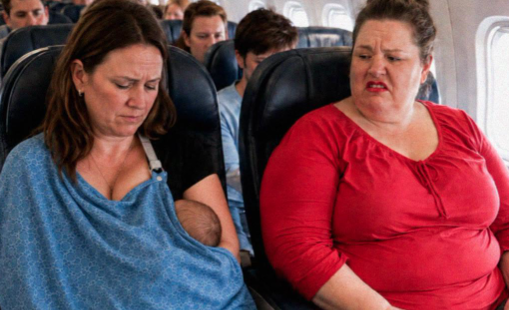
Instead, before the plane had even left the ground, the stranger sitting beside me had already decided she knew exactly what kind of mother I was.
She had no idea what we’d been through.
And she certainly wasn’t prepared for what my eight-year-old daughter was about to say.
A month ago, I buried my husband, Mark.
He was thirty-seven.
Funny, stubborn, and absolutely convinced he would outlive everyone around him.
Cancer took him in nine months.
Nine months was all it took to turn our ordinary family life into hospital rooms, whispered conversations, medication schedules and the kind of silence that settles over a house when everyone knows the ending is coming.
When my mother invited the children and me to stay with her, I agreed.
I needed to get away from the nightmare, even if only briefly.
Louise had stopped asking when Daddy was coming home.
That hurt worse than the questions ever had.
She was eight years old.
Noah was five months old, and he still turned toward the door whenever he heard a man’s voice.
At night, after both children were asleep, I still reached toward Mark’s side of the bed before remembering.
Grief had turned ordinary habits into traps.
I had packed his blue sweater in my carry-on even though I knew I wouldn’t wear it.
I just couldn’t leave it behind.
On the morning of our flight, Louise held Noah’s bottle while I checked our documents for the third time.
She watched me fold everything back into the bag without saying a word.
Then she placed her favorite stuffed rabbit beside the documents, as if both belonged to the same emergency plan.
Neither of us mentioned that Mark had always handled the passports.
We didn’t need to.
The flight was full, and the only available seats placed Louise one row behind me.
I settled into the aisle seat with Noah against my chest while Louise squeezed my shoulder from behind.
The woman sitting beside me looked irritated before the aircraft doors had even closed.
“I can see you,” she said. “And I know how to press the call button.”
I looked at her.
“Only for emergencies.”
“What about bad snacks?”
“Especially not.”
She wore a gray suit and pearl earrings.
Her expression was the kind worn by someone already composing a complaint in her head.
Then she looked at Noah.
“If your baby starts screaming, I’m not going to sit here and listen to it. I’m warning you.”
“We haven’t taken off yet.”
Behind us, Louise leaned forward.
“I know babies,” she said. “They always scream when people are trapped.”
The woman looked at her.
“I’ll do my best.”
“People say that,” the woman replied. “Then everyone else suffers.”
Louise sat back.
“My brother is usually quiet.”
She looked at me through the gap between the seats.
I could see the frown reflected in the window.
Louise had inherited Mark’s sense of fairness.
It usually appeared just before she said something dangerous.
I gave her a warning look.
She opened her tablet without another word.
The plane pushed back from the gate.
Noah startled at the sudden vibration.
I braced myself for the cry Evelyn—the woman beside me—clearly expected.
But he only blinked.
Then he curled one tiny fist around my finger and settled again.
Louise waved through the gap between the seats.
I waved back.
It was such a small thing, but I was grateful for the reassurance.
Evelyn opened a magazine with a sharp snap and angled it between us like a wall.
Every few minutes, she looked over the top edge to check on Noah.
I couldn’t tell whether she was afraid he would wake or simply frustrated that he hadn’t yet given her the evidence she seemed to be waiting for.
Either way, I waited.
I rocked him.
I offered his pacifier.
I checked his diaper.
And I whispered the song Mark used to sing off-key.
For most of the first two hours, Noah slept.
I watched the clouds outside the window and tried not to picture Mark’s empty hospital bed.
