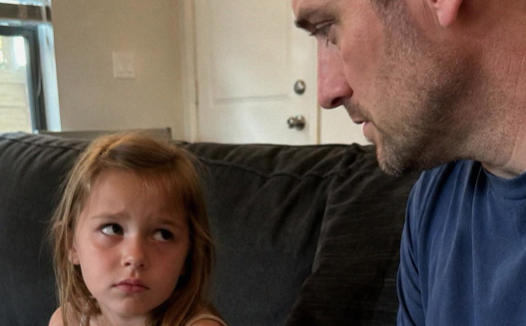
I thought my husband’s Sunday outings with our daughter were the safest part of our marriage.
Every week, Ryan packed a small backpack, checked Chloe’s things, kissed me goodbye, and took our seven-year-old daughter out for what he always described as a simple father-daughter adventure.
Sometimes they went to the park.
Sometimes they rode bicycles.
Sometimes they stopped for a snack before coming home.
I trusted him completely.
Then, one Sunday, Ryan carried Chloe through our front door with her face red and covered in hives.
She was wheezing.
I called 911 immediately.
Within minutes, paramedics were kneeling beside our daughter, checking her breathing and asking questions.
One of them looked directly at Ryan.
“What did she eat?”
Ryan answered without hesitation.
“Just a plain apple. We were at the park the whole time.”
I looked across the living room at my husband.
His face was pale.
Sweat clung to his forehead, and his hands were shaking at his sides.
Then Chloe, lying on the stretcher between us, slowly turned her head.
“We weren’t at the park,” she whispered.
Ryan stepped closer.
“Sweetheart, you’re tired. The medicine is making you confused.”
“We were at the park the whole time,” he repeated.
Chloe shook her head.
“I’m not confused.”
Her voice was weak, but there was absolute certainty in it.
“And we didn’t have apples, Daddy.”
“Chloe,” Ryan warned.
I moved between them.
“Then where were you?”
She looked at Ryan before answering.
That frightened me more than anything else.
“At Miss Dana’s house, Mama.”
I had never heard the name before.
And suddenly, the Sunday outings I had trusted for years looked very different.
Ten minutes earlier, Ryan had carried Chloe through the door.
She was red-faced, covered in hives and struggling to breathe.
I’d called 911 while Ryan paced helplessly around the living room.
The paramedics arrived quickly and stabilized her breathing.
Once she was safe enough to answer questions, they asked what she had eaten.
Ryan gave them his story about the apple.
He wouldn’t look at me.
One paramedic crouched beside Chloe.
“What did you eat at Dana’s house?”
“Ice cream,” Chloe said.
“It had crunchy pieces. Nuts, I think.”
My stomach dropped.
“Macadamia nuts,” I said.
The words came out immediately.
“That’s her worst allergy.”
Ryan rubbed both hands over his face.
“I didn’t know what was in the topping, Maeve.”
“You didn’t know?”
“It was an accident.”
The allergic reaction had been an accident.
I understood that.
But taking our daughter somewhere I’d never heard of wasn’t an accident.
Taking her to another woman’s house wasn’t an accident.
And lying to the paramedics wasn’t an accident either.
The paramedic stood.
“We’re taking her in for observation. One parent can ride with us.”
“I’ll go,” Ryan said.
“No.”
He stared at me.
I had never spoken to him like that before.
Ryan and I had met in our early twenties.
He had been steady through the years before Chloe arrived, the kind of man I believed I could depend on.
When Chloe was born, she became the center of our world.
Ryan packed extra water.
He checked her seat belt twice.
He knew which snacks she liked and which ones were safe.
Every Sunday, he took her on father-daughter adventures.
That morning, he had packed a backpack and told me they were going to the park across town so Chloe could practice riding her bicycle.
He kissed my forehead before leaving.
They would be home by three, he promised.
Now our daughter was lying on a stretcher, and I had discovered that her father had lied about where he had taken her.
“Maeve,” he said quietly. “I’m her father.”
“And I’m riding with her.”
“You’re upset.”
“Our daughter could barely breathe a few minutes ago, Ryan.”
“I know, but—”
“You’ll follow in the car.”
The ambulance doors closed between us.
During the drive, I held Chloe’s hand.
Her skin felt cooler now, but she looked so small beneath the blanket that my heart ached.
“Mommy?”
“I’m here.”
“Are you mad at me?”
The question hurt more than anything Ryan had said.
“No. Why would I be mad at you?”
Her lower lip trembled.
“Daddy said not to talk about Miss Dana.”
I kept my voice gentle.
“What else did he tell you?”
“He said the visits would make you sad.”
“Visits?”
“We go there on Sundays.”
I gripped the edge of the seat.
“How many times?”
Chloe counted on her fingers.
“I don’t know. A lot.”
“Instead of the park?”
She nodded.
I wanted to ask everything.
Who was Dana?
What happened at her house?
What had Ryan told Chloe?
How long had this been happening?
But my daughter had already been through enough.
I brushed her hair away from her forehead.
“You didn’t do anything wrong, my little love. I promise I’m not mad at you.”
“I didn’t want to lie.”
“I know.”
“Daddy said it wasn’t really lying. He said we were protecting your feelings.”
I closed my eyes for a moment.
Ryan hadn’t simply hidden something from me.
He had taught our daughter that secrecy could be a form of kindness.
I turned back toward Chloe.
“You never have to protect me that way, sweetheart. Grown-ups are responsible for grown-up secrets.”
At the hospital, Chloe was taken into a treatment room.
The medical staff checked her breathing and watched carefully for another reaction.
I stayed beside her.
Ryan arrived several minutes later and hovered near the doorway.
I looked at him.
“Who is Dana?”
“Can we focus on Chloe?”
“I am focused on Chloe. That’s why I’m asking.”
“It’s not what you think, Maeve.”
“You don’t know what I think.”
He glanced toward Chloe, who had finally fallen asleep.
“She’s a friend.”
“A friend you visit every Sunday?”
“Maeve, please.”
“How long have you been taking our daughter to her house?”
He stared at the floor.
His silence answered before he did.
Then his phone vibrated.
Ryan looked at the screen and walked into the hallway.
I waited several seconds before following.
He stood near the exit with his back to me.
“Don’t come here,” he whispered into the phone. “I’ll explain later.”
I stopped.
“Who are you talking to?”
He spun around.
“No one.”
“You just told someone not to come here.”
“It was work.”
“On a Sunday?”
“I’ll explain later.”
His jaw tightened.
“This isn’t the place.”
“You brought our daughter into this hospital because you lied about where you were.”
“Keep your voice down.”
“Why? Are you worried people will hear the truth?”
For years, Ryan’s calm tone had been enough to make me question myself.
Not that day.
“You used our seven-year-old daughter to hide a secret,” I said. “Don’t tell me how quietly I’m allowed to say it.”